
James McCormack
United States Air Force general
About James McCormack
Lived 1910 – 1975 (aged 64). James McCormack was an American military officer, military engineer, communications Satellite Corporation and united States Atomic Energy Commission.
James McCormack Jr. (8 November 1910 – 3 January 1975) was a United States Army officer who served in World War II, and was later the first Director of Military Applications of the United States Atomic Energy Commission.
A 1932 graduate of the United States Military Academy at West Point, McCormack also studied at Hertford College, Oxford as a Rhodes Scholar, earning a Master of Arts degree in Romance languages, and at the Massachusetts Institute of Technology (MIT), where he earned a Master of Science degree in civil engineering. In 1942, he was assigned to the War Department General Staff. On 1 July 1944, he became the Chief of the Movements Branch of Twelfth United States Army Group, remaining in this role until 28 May 1945. He then returned to the War Department General Staff, where he served in the Operations and Plans Division.
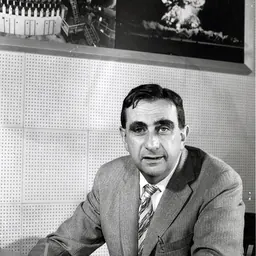
In 1947, McCormack was chosen as the Director of Military Applications of the United States Atomic Energy Commission with the rank of brigadier general. He took a pragmatic approach to handling the issue of the proper agency to hold custody of the nuclear weapons stockpile, and encouraged and supported Edward Teller's development of thermonuclear weapons. He transferred to the United States Air Force on 25 July 1950, and was appointed Director of Nuclear Applications at the Air Research and Development Center in Baltimore, Maryland, in 1952. He was subsequently promoted to major general, and became Deputy Commander of the Air Research and Development Command.
After retiring from the Air Force in 1955, McCormack became the first head of the Institute for Defense Analysis, a non-profit research organization created to provide advice and support to the Department of Defense's scientific and technological research efforts formed by ten universities. In 1958 he became vice president for industrial and governmental relations at MIT, in which capacity he originated the proposal that the National Advisory Committee for Aeronautics be used as the basis for a new space agency, which eventually became the National Aeronautics and Space Administration. He was Chairman of the Massachusetts Bay Transportation Authority, and from 1965 to 1970 was chairman of the Communications Satellite Corporation.
Early life and career
James McCormack Jr., was born in Chatham, Louisiana, on 8 November 1910. He attended the Riverside Military Academy in Gainesville, Georgia, before entering the United States Military Academy at West Point on 2 July 1928. He was commissioned as a second lieutenant in the United States Army Corps of Engineers on graduation on 14 August 1932, ranking 19th in his class. He departed for England where he studied at Hertford College, Oxford, as a Rhodes Scholar. He was promoted to first lieutenant in August 1935, and awarded his Bachelor of Arts degree in Romance languages from Oxford (this was later converted to a Master of Arts degree). On returning to the United States, he was posted to the 8th Engineers at Fort McIntosh, Texas, as a troop commander.
In June 1936 he became a student at the Massachusetts Institute of Technology, from which he graduated with a Master of Science degree in civil engineering in August 1937. His thesis was a joint project with three other student officers from the Army Corps of Engineers under the supervision of Kenneth C. Reynolds. He then became a student officer at the Engineering School at Fort Belvoir, Virginia. In June 1938, he reported to Vicksburg, Mississippi, as Assistant Project Engineer on the Sardis Reservoir Project.
World War II McCormack reported to Fort Benning, Georgia, as a company commander in the 21st Engineers in October 1939. and that while the two men had disagreed over the merits of the Super, that he saw nothing dishonest or disloyal in Oppenheimer's opposition to it.
McCormack retired from the Air Force in 1955, and became the first head of the Institute for Defense Analysis, a non-profit research organization to provide advice and support to the Department of Defense's scientific and technological research efforts formed by ten universities.
In 1964, the Governor of Massachusetts, Endicott Peabody, appointed McCormack as Chairman of the Massachusetts Bay Transportation Authority. In October 1965, he was appointed chairman of the Communications Satellite Corporation (COMSAT), with a $125,000 salary. To allow himself to concentrate on his new position, he resigned all his company directorships, along with his post at MIT. He attended his first board meeting in Washington, DC, in his dinner jacket, having flown from Los Angeles after a speaking engagement. As head of a quasi-government organization, McCormack strove to employ the company's resources to carry out the policies of Congress and the President, and was able to persuade Congress to declassify plans for a domestic satellite network so he could consult with the television networks. He retired as chairman due to ill health in 1970, although he remained a director.
Don’t just read it —
keep it.
Full-length biographies made to live with: read them, listen on the way to work, watch them tonight.
- E-book
- Audio
- Video
Instant download · yours to keep · every purchase keeps this site free
Important facts
People in James McCormack's life
Named in this biography and alive at the same time

Related people
Same field, nearest in time



Contemporaries
People whose lives overlapped James McCormack's






Frequently asked questions
Who was James McCormack?
United States Air Force general (1910–1975)
When was James McCormack born?
James McCormack was born on 8 November 1910 in Chatham.
When did James McCormack die?
James McCormack died on 3 January 1975 in Hilton Head Island.
What was James McCormack's occupation?
James McCormack was a military officer, military engineer, communications Satellite Corporation and united States Atomic Energy Commission.
What nationality was James McCormack?
James McCormack was American.
Sources & further reading
Cite this page
APA: Biography.guide. (2026). James McCormack. https://biography.guide/james-mccormack-military-officer/
MLA: "James McCormack." Biography.guide, https://biography.guide/james-mccormack-military-officer/.
Chicago: "James McCormack." Biography.guide. https://biography.guide/james-mccormack-military-officer/.
Data last updated: 2026-09-20 · Spot an error? Report a correction.
Page generated 2026-09-27 05:28 UTC