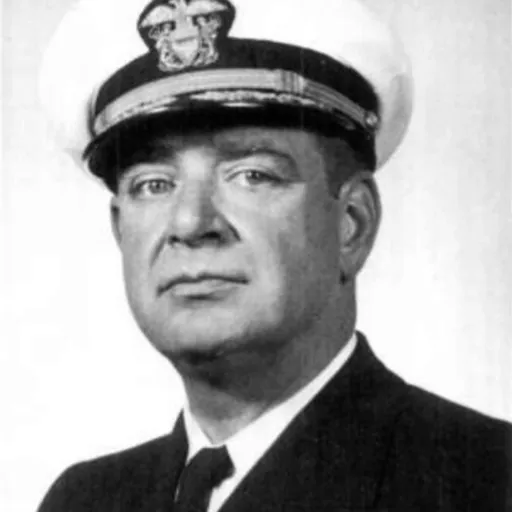
About James L. Holloway Jr.
Lived 1898 – 1984 (aged 85). James L. Holloway Jr. was an American military officer and philadelphia Naval Asylum.
James Lemuel Holloway Jr. (June 20, 1898 – January 11, 1984) was a four-star admiral in the United States Navy who served as superintendent of the United States Naval Academy from 1947 to 1950; as Chief of Naval Personnel from 1953 to 1957; and as commander in chief of all United States naval forces in the eastern Atlantic and Mediterranean from 1957 to 1959, in which capacity he commanded the 1958 American intervention in Lebanon. As founder of the Holloway Plan, he was responsible for creating the modern Naval Reserve Officer Training Corps.
Holloway was the father of four-star admiral and Chief of Naval Operations Admiral James L. Holloway III. , they are the only father and son to both serve as four-star admirals in the United States Navy while on active duty, as opposed to being promoted to that rank posthumously or at retirement.
Early career Holloway was born on June 20, 1898, in Fort Smith, Arkansas, to future centenarian James Lemuel Holloway and the former Mary George Leaming. In 1904, his family moved to Dallas, Texas, where he was a varsity football tackle and a member of the debate team at Oak Cliff High School, from which he graduated in 1915. Unable to secure an appointment to the United States Military Academy—his original ambition—Holloway instead passed the entrance examinations for the United States Naval Academy at Annapolis, Maryland, and entered the Naval Academy as a midshipman in 1915. He graduated in June 1918 near the bottom of the accelerated class of 1919, ranked 149th out of 199, and later said he had avoided flunking out of the Academy only because his class graduated early due to World War I. "I knew I would have bilged in mechanics."
World War I Commissioned ensign on June 7, 1918, Holloway was assigned to the destroyer , operating out of Brest, France, as part of the destroyer force tasked with anti-submarine patrols against German U-boats in European waters. He made a poor impression almost immediately. "They never told me about the lack of space on destroyers. My baggage filled the whole wardroom. I was a very unpopular young officer for that."
Operation Torch
Holloway had applied for immediate sea duty after the Pearl Harbor attack and on 20 May 1942, he assumed command of Destroyer Squadron Ten (Desron 10), a newly built and newly commissioned member of the Atlantic Fleet. Promoted to captain in June, in November he led Desron 10 in screening the landings at Casablanca during the opening stages of Operation Torch, the Allied invasion of North Africa. As one of three principal destroyer commanders in this operation, he received a Navy Commendation Ribbon with the following citation: "Holloway prevented the many enemy submarines in the area from delivering effective torpedo fire and, by his aggressive fighting spirit and courageous leadership, contributed materially to the winning of a decisive victory over the enemy." For this success, Holloway was awarded the Legion of Merit, whose citation commended his having "built up an efficient organization, turning over to the Fleet competent seagoing vessels and thoroughly indoctrinated personnel. His conspicuous success in fulfilling this important assignment and his skill in collaboration with other commands have contributed vitally to the effective prosecution of the war."
Despite being captain of the premier surface vessel in the U.S. Navy, Holloway recognized that naval aviation had become dominant. Soon after assuming command of Iowa, he wrote an urgent letter to his son, Lieutenant James L. Holloway III, who was following in his father's footsteps as a junior officer on a destroyer, to advise the young lieutenant to abandon his promising career in the surface Navy to become a naval aviator as soon as possible. "The war in the Pacific is being won by the carriers. The future of the U.S. Navy lies in naval aviation." Lieutenant Holloway promptly applied for flight training and went on to captain the nuclear aircraft carrier , the premier aviation vessel of its era.
Demobilization Promoted to rear admiral, Holloway reported as Commander, of Fleet Training Command, Pacific Fleet on 8 August 1945. He was detached from that command less than two months later, on 26 September, to take charge of the Navy's troubled postwar demobilization.
Under Holloway's immediate direction, the task of demobilizing over three million men was completed by September 1, 1946.
Submitted to Congress for approval, the Holloway Plan spent the summer of 1946 stagnating as draft legislation in the House Naval Affairs Committee. Finally, with only two months before colleges were scheduled to begin their autumn classes, Holloway made a pilgrimage to the Georgia farm of committee chairman Carl Vinson, and the bill was placed on the House Calendar the following week. It passed by unanimous vote and was signed into law by President Harry S. Truman on August 13, 1946.
During its early years, critics complained that the Holloway Plan was a waste of taxpayer money because many reservists enrolled in the program only for the free college education, and quit the Navy after serving the minimum three-year commitment. Holloway himself anticipated that NROTC graduates would be less committed to a naval career than Naval Academy graduates, given that "The Naval Academy is an undergraduate institution which no man should enter unless he wishes to make the Navy a life career." He was convinced that Annapolis remained the surer but tougher path to a successful Navy career, but argued that the Navy should not risk "putting all our eggs in one basket insofar as methods of initial [officer] procurement are concerned." Annapolis loyalists objected that if NROTC graduates were given the same career opportunities and chances for promotion as Naval Academy graduates, there would be no advantage to attending the Naval Academy and the quality of its midshipmen would plummet because the better officer candidates could opt for an easy commission at a civilian university that lacked the rigor of Naval Academy discipline. A popular Annapolis chant went: "Keep your car, keep your gal, keep your pay—be an officer the 'Holloway'!" Officers in the fleet quipped: "Did you get your commission the hard way or the Holloway?"
Forty years later, Holloway's son was responsible for interviewing the eminent lawyers, businessmen, and government officials who applied for membership in the exclusive Metropolitan Club of the City of Washington between 1988 and 1992. "I was truly amazed at the number of these prospective members who asked if I were any relation to the admiral who founded the Holloway Plan," recalled the younger Holloway, by then a famous admiral in his own right. "When I answered yes, they would tell me that they wouldn't be sitting there today if it weren't for the Holloway Plan....It had put them through college—schools like Princeton, Duke University, Caltech, and Stanford. After the Korean War and Vietnam, the opportunities were so great on the outside that many of them left the service and became quite successful in their civilian careers."
Superintendent of the U.S. Naval Academy As superintendent of the United States Naval Academy, circa 1947.
On January 15, 1947, Admiral James L. Holloway Jr. became the 35th superintendent of the United States Naval Academy, succeeding Vice Admiral Fitch. At 48, Holloway was the youngest superintendent in fifty years, having been handpicked by Secretary of the Navy Forrestal to implement the academic changes suggested by the Holloway Board, which had recommended that the Naval Academy curriculum move away from rote recitation and continuous crams "to give a stronger emphasis to basic and general education, rendering more fundamental and less detailed instruction in strictly naval material and techniques."
In his first year as superintendent, Holloway revised the curriculum to promote a balanced program of mutually supporting courses, including a newly expanded leadership course on human relations problems, for which half of the textbook was written by psychology experts from Johns Hopkins University and the other half by Holloway himself. The first class was also delegated greater responsibility for student governance, and attempted to purge "flagrant violations of mature personal dignity" from midshipman hazing rituals, with mixed success.
Despite his energetic reforms and personal popularity among the midshipmen, Holloway's three-year tour as superintendent ultimately was too brief to reverse the Naval Academy's entrenched cultural bias against academic achievement. A more durable legacy was the series of yawl races Holloway initiated to promote seamanship and competitive sailing, dubbed the Holloway trophy races after the award for the winning midshipman skipper. Holloway also addressed the dismal living conditions of the enlisted men based at the Academy by upgrading their quarters from trailer parks to a village of Wherry housing units on the north shore of the Severn River. He declared that a midshipman's first lesson must be a concern for enlisted men's welfare and that Annapolis of all places must set the example.
In January 1947, less than two weeks after becoming Academy superintendent, Holloway rebuffed a proposal by Army Chief of Staff Dwight D. Eisenhower to essentially unify the Naval Academy with the United States Military Academy at West Point. Eisenhower believed the curricula of West Point and Annapolis should be as close to identical as possible and proposed a full-scale exchange program in which West Point cadets and Annapolis midshipmen would each spend their third year at the other service's academy. Holloway's bluntly phrased rejection drove a furious Eisenhower to complain to Chief of Naval Operations Chester W. Nimitz that Holloway considered his idea "the ultimate in ridiculousness." Colonel and President of Georgia Tech Blake R Van Leer later defended Holloway's plans for training and education for naval officers. President Harry S. Truman and Holloway would later appoint Van Leer to the visitor board and have him assist with creating programs and advising on the curriculum.
In March 1949, Holloway was the junior member of the Stearns-Eisenhower Board, convened to consider the topic of educational unification among the services. Chaired by University of Colorado president Robert Stearns, the board was initially inclined to recommend that officer candidates from all services study the same core academic curriculum at a single unified academy, as favored by the new Secretary of Defense, Louis Johnson, with Annapolis and West Point being reduced to specialized training campuses. To everyone's surprise, Holloway persuaded the other members to adopt the diametrically opposite recommendation that the existing service academy system be not only preserved but expanded by adding a new service academy for the Air Force.
In 1954, Holloway's loyalty to the Naval Academy landed him in professional trouble for the only time in his career. Testifying before a congressional committee in favor of the proposed creation of the United States Air Force Academy, Holloway declared that he was sick and tired of sending Naval Academy graduates to the Air Force and admitted that he did everything possible to prevent such "desertions." Called to account by an infuriated Deputy Secretary of Defense Roger M. Kyes, Holloway stood by his words. "What's wrong with that?" he demanded. "We don't want our boys going to the Air Force. We teach them things we don't want used against us later."
Chief of Naval Personnel
After completing his tour as superintendent in 1950, Holloway served 30 months as Commander, Battleship-Cruiser Force, Atlantic (COMBATCRULANT) before being promoted to vice admiral on February 2, 1953, and appointed chief of the Bureau of Naval Personnel (BuPers). He served as Chief of Naval Personnel from 1953 to 1957, longer than any other BuPers chief in 75 years. Charged by statute with the selection and assignment of all naval personnel, his hiring philosophy was, "We should get the best people we can for these jobs and make them play over their heads." as well as the desegregation of the Navy. He abolished the policy of separate recruitment of black and white sailors that had tended to channel white recruits into mainstream branches but relegate black recruits to menial commissary and steward functions.
"Keeps a taut ship," remarked contemporaries at the Pentagon, but also "keeps a tight lip," despite a reputation for florid speech and unusually lengthy prepared statements before Congressional committees.
Hyman G. Rickover
Holloway was an early ally of Rear Admiral Hyman G. Rickover, the controversial father of the Navy's nuclear propulsion program. To induce promising line officers to submit to the rigors of nuclear training, Rickover insisted that only nuclear-qualified officers be allowed to command a nuclear vessel. Holloway agreed with Rickover's concept and allowed Rickover to screen the candidate pool from which BuPers would select officers for nuclear training. Rickover retained this absolute control over nuclear candidate selection until his retirement in 1982.
In June 1953, Rickover faced mandatory retirement after being passed over by the rear admiral selection board, and Holloway was one of the few flag officers to push for his promotion. Only a couple of weeks later, Congress proved Holloway's point by attaching a provision to the annual defense appropriations bill that promoted Brigadier General Robert S. Moore to major general, after the Army had refused to advance him through the normal system. "This sort of thing is what we must guard against," complained General Herbert B. Powell, Holloway's counterpart in the personnel section of the Army staff at the time. "We must follow the system set up and prescribed by law.”
Commander in Chief, U.S. Naval Forces, Eastern Atlantic and Mediterranean On October 26, 1957, President Dwight D. Eisenhower named Holloway to succeed Admiral Walter F. Boone as Commander in Chief, U.S. Naval Forces, Eastern Atlantic and Mediterranean (CINCNELM), Holloway assumed command in November 1957, with additional duty as Commander, Subordinate Command U.S. Atlantic Fleet (COMSCOMLANTFLT), and later as U.S. Commander Eastern Atlantic (USCOMEASTLANT). As CINCNELM, Holloway commanded all U.S. naval forces in Europe, including the Sixth Fleet commanded by Vice Admiral Charles R. Brown.
Lebanon crisis of 1958 On July 14, 1958, the Hashemite dynasty in Iraq was overthrown by a military coup d'état. Fearing that he would be next, Lebanese president Camille Chamoun appealed for American military aid within 48 hours to settle domestic unrest in his own country, invoking the Eisenhower Doctrine, which stated that the United States would intervene upon request to stabilize countries threatened by international communism. Holloway, who happened to be serving on a Selection Board in Washington at the time, promptly met with Chief of Naval Operations Arleigh A. Burke, who warned that a deployment order was imminent but that commitments in East Asia precluded any reinforcements from the Seventh Fleet. Retorted Holloway, "I don't need any help. I can take over all of the Lebanon if you say the word." As one of Burke's few remaining peers in the Navy, Holloway took the opportunity to tease the CNO. "But I've already had another proposition....From some Britisher. He thinks, if there's action, I should go up and take the port of Tripoli to protect their oil installations there." The famously mercurial Burke cursed him out.
At 6:23 p.m. on July 14, President Eisenhower ordered that the American intervention force begin to arrive at Beirut by 9:00 a.m. on July 15, when he planned to announce the intervention on national television. Burke relayed the order to Holloway at 6:30 p.m., adding, "Join your flagship now. Sail all Sixth Fleet eastward." Holloway had been given less than fifteen hours to establish a beachhead. He immediately flew back to his London headquarters, where he stopped just long enough to assemble his staff and activate Operation Bluebat, a preplanned scenario for suppressing a coup d'état in Lebanon, before flying on to Beirut.
On July 15, only four minutes behind schedule, the first wave of Marines landed on a tourist beach near Beirut. In one of the most colorful episodes in Marine Corps history,
At 10:30 a.m. on July 16, as the Marines prepared to move into Beirut, it was discovered that Lebanese Army tanks had blocked the road from the airport, with orders to prevent the Marines from entering the city. Holloway raced to the scene, arriving at the roadblock at the same time as the American ambassador to Lebanon, Robert M. McClintock, and the general in chief of the Lebanese Army, General Fuad Chehab. Adjourning to a nearby schoolhouse for an impromptu conference, they devised a compromise whereby the Lebanese Army would escort the Marines into the city. Holloway insisted that they start moving right away, "tootey-sweetey".
"We were really sitting on a powder keg," Holloway said later, "but fortunately there were no incidents. We just got in a car—Ambassador McClintock and I—and led the column straight through."
With the Lebanese government nominally stabilized, Holloway was directed on August 5 to begin planning a withdrawal schedule, which he submitted for approval on August 11. The first Marine battalion began reembarking immediately. United Nations diplomat Rajeshwar Dayal observed the Marines' departure, "a process which seemed more difficult of accomplishment than the landing. It was evident that the gallant Admiral Holloway, sceptical from the start about the wisdom of the whole exercise, felt an infinite sense of relief at the prospect of an early departure." President Chehab took office on September 23 and a unity government was formed on October 23. The last American troops left Lebanon two days later.
In the end, Operation Bluebat sent nearly 15,000 American troops to Lebanon from commands in Europe and the continental United States, including 6,100 Marines and 3,100 Army airborne troops armed with nuclear artillery; the 76 ships of the Sixth Fleet; and a 200-plane Composite Air Task Force based out of Incirlik Air Base, Turkey. The intervention forces remained in Lebanon for 102 days, at a cost of over $200 million, acting as an urban security force and losing only one American soldier to hostile fire.
Holloway professed satisfaction with the near-perfect outcome. "The proof of the pudding is in the eating. The operation would appear to stand as an unqualified success." Nevertheless, Operation Bluebat came to be viewed as a case study in how not to plan an operation. According to one history, "Virtually every official report opens with the caveat that had Operation Bluebat been opposed, disasters would have occurred, and argues that problems encountered during the operation's course could have been solved well before the order to execute was given."
Holloway inadvertently created one of these problems himself when he ordered Major General David W. Gray to establish an Army base in a large olive grove just east of the airport. Said Gray, "I asked, 'Isn't that private property? Whom should I see about it?' I shall never forget [Holloway's] answer. Waving his arms in characteristic fashion, he replied, 'Matter of military necessity. Send the bills to the Ambassador.' Of course, it didn't work out exactly that way...." It turned out that the olive grove was the largest in Lebanon and vital to the local economy, but the Lebanese women who harvested the olives refused to enter the grove while American troops were present, risking the loss of the entire crop and severe unemployment. Holloway wryly observed that when his forces finally departed, they left behind a constitutionally elected president, a united army, peace in the area, and "a few legal beagles to pay for damage to the olive groves."
Holloway's superiors on the Joint Chiefs of Staff (JCS) introduced complications of their own, recalled Gray. "One day I walked in on Admiral Holloway to find him sputtering. He said, 'Do you know what I just told the JCS? I am sixty-years old, I have thirty-five years of service, I have a physical infirmity that will allow me to retire tomorrow, and I will do it if you don't leave me alone and let me do my job.'"
Retirement
Holloway was relieved as CINCNELM by Admiral Robert L. Dennison in March 1959. After his retirement from the Navy, he served as Governor of the United States Naval Home in Philadelphia, Pennsylvania, from 1964 until 1966.
In later life, he moved to Carl Vinson Hall, a Navy retirement home in McLean, Virginia. He died on January 11, 1984, of an aortic aneurysm at Fairfax Hospital in Falls Church, Virginia.
Personal life Holloway was a husky, round-faced man with blue eyes and brown hair who stood six feet tall, weighed 190 pounds, and spoke in a light southern drawl. Major General David W. Gray, who commanded the Army contingent during the initial stages of the Lebanon intervention, recalled:
Holloway was widely admired within the Navy, although he was identified so strongly as being a deskbound staff officer that when he assumed operational command of Operation Bluebat in 1958, other officers joked, "Oh, he's finally gone to sea." Los Angeles Times columnist Bill Henry observed, "When President Eisenhower announced that our leader of United States forces in the Middle East would be an officer named Adm. Holloway, there was a sort of 'Who dat?' reaction. James Lemuel Holloway Jr. has not been a dashing, spectacular figure. He has, however, compiled a steady record of uncanny ability as an organizer which has overshadowed a fine combat record in two world wars."
While chief of the Bureau of Personnel, Holloway summarized his philosophy to a group of young naval officers: "You men probably do not think of it in this way, but I do. To be commissioned in the Navy, you had to be appointed by the President with the approval of Congress. This is the procedure and requirement for the seating of a Supreme Court judge or an ambassador. This is why a naval officer must have his chin out at all times."
Family Retired (left), with his son, Chief of Naval Operations James L. Holloway III, 1974
Holloway married the former Jean Gordon Hagood, daughter of U.S. Army Major General Johnson Hagood, of Charleston, South Carolina, on May 11, 1921. They had two children: son James Lemuel Holloway III, who also attained the rank of four-star admiral as Chief of Naval Operations from 1974 to 1978; and daughter Jean Gordon Holloway, whose husband, Rear Admiral Lawrence Heyworth Jr., was the first commanding officer of the aircraft carrier and briefly served as the 45th superintendent of the U.S. Naval Academy.
Holloway's father, James Lemuel Holloway Sr., served as superintendent of schools in Fort Smith, Arkansas, before entering Washington University School of Medicine in 1900 for training in osteopathy, which he practiced in Dallas, Texas, for forty years. In 1952, at the age of 92, Holloway Sr. wrote to the chairman of the Joint Chiefs of Staff to inquire whether Holloway Jr. was falling short in his performance of duty as a rear admiral such that he might not be promoted to vice admiral; if so, he wanted to give his son some helpful advice. President Harry S. Truman wrote back to assure the worried father that his son was not neglecting his duties.
In 1960, Holloway Sr. celebrated his centennial in Dallas, having seen his son achieve the rank of four-star admiral. Fourteen years later, Holloway Jr. would see his own son achieve the same rank when Holloway III was sworn in as Chief of Naval Operations in 1974. (James Lemuel Holloway IV, son of Holloway III, died in a car accident in 1964. )
As of 2008, Holloway Jr. and Holloway III remain the only father and son to both serve as four-star admirals in the U.S. Navy while on active duty; the other two four-star admirals who fathered four-star sons were either promoted to that rank posthumously, in the case of Admiral John S. McCain Sr., or upon retirement, in the case of Admiral David W. Bagley.
In his memoirs, Holloway III complained that "there has often been a tacit presumption that my father was in a position to advance my career as I gained seniority in the Navy. On the contrary, as a retired officer he had little or no influence over his own future, much less mine." As an example of this presumption, when President Richard M. Nixon approved Holloway III's nomination to succeed Admiral Elmo R. Zumwalt Jr. as Chief of Naval Operations, Zumwalt believed that Nixon acquiesced mainly to avoid overruling the recommendation of his secretary of defense, but that, "In addition, and I really think this was a factor, Mr. Nixon remembered Jimmy's father from his own period of naval service."
Awards Holloway's decorations included the Legion of Merit, awarded for organizing the DD-DE Shakedown Task Force of the Atlantic Fleet operational training command, with Gold Star in lieu of a second award for commanding the battleship Iowa in the Pacific theater; the Navy Commendation Ribbon, awarded for leading Destroyer Squadron 10 during the landings at Casablanca, with star in lieu of a second ribbon for serving as director of training in the Bureau of Naval Personnel; the Victory Medal with Destroyer Clasp; the American Defense Service Medal with Fleet Clasp; the American Campaign Medal; the European-African-Middle Eastern Campaign Medal with star; the Asiatic-Pacific Campaign Medal with stars; the World War II Victory Medal; and the Philippine Liberation Medal.
Holloway received the honorary degrees of Doctor of Laws from Muhlenberg College in 1944, and later from the University of Notre Dame;
The Admiral James L. Holloway Jr. Award is presented annually by the Navy League of the United States to the outstanding NROTC midshipman in the nation and consists of an engraved watch and a certificate. The RADM James L. Holloway Jr. Trophy honors the Naval Academy midshipman who has contributed the most to Varsity Offshore J/24 sailing through his leadership, dedication to the team, and sailing skills.
Holloway recorded an oral history that is archived at the Columbia University Oral History Research Office.
Dates of rank Midshipman – 1915 (class rank 149/199) Ensign – June 7, 1918 Lieutenant, Junior Grade – September 21, 1918 Lieutenant – June 3, 1922 Lieutenant Commander – June 30, 1933 Commander – July 1, 1939 Captain – June 17, 1942 Rear Admiral – September 4, 1945 Vice Admiral – February 2, 1953 Admiral – January 1, 1958
Sources:
Don’t just read it —
keep it.
Full-length biographies made to live with: read them, listen on the way to work, watch them tonight.
- E-book
- Audio
- Video
Instant download · yours to keep · every purchase keeps this site free
Important facts
People in James L. Holloway Jr.'s life
Named in this biography and alive at the same time






Related people
Same field, nearest in time


Contemporaries
People whose lives overlapped James L. Holloway Jr.'s


Frequently asked questions
Who was James L. Holloway Jr.?
United States admiral (1898–1984)
When was James L. Holloway Jr. born?
James L. Holloway Jr. was born on 20 June 1898 in Fort Smith.
When did James L. Holloway Jr. die?
James L. Holloway Jr. died on 11 January 1984 in Falls Church.
What was James L. Holloway Jr.'s occupation?
James L. Holloway Jr. was a military officer and philadelphia Naval Asylum.
What nationality was James L. Holloway Jr.?
James L. Holloway Jr. was American.
Sources & further reading
· Wikipedia: James L. Holloway Jr.
· DBpedia: James L. Holloway Jr.
Cite this page
APA: Biography.guide. (2026). James L. Holloway Jr.. https://biography.guide/james-l-holloway-jr/
MLA: "James L. Holloway Jr.." Biography.guide, https://biography.guide/james-l-holloway-jr/.
Chicago: "James L. Holloway Jr.." Biography.guide. https://biography.guide/james-l-holloway-jr/.
Data last updated: 2026-09-23 · Spot an error? Report a correction.
Portrait: Wikimedia Commons · author & licence
Page generated 2026-09-27 05:06 UTC