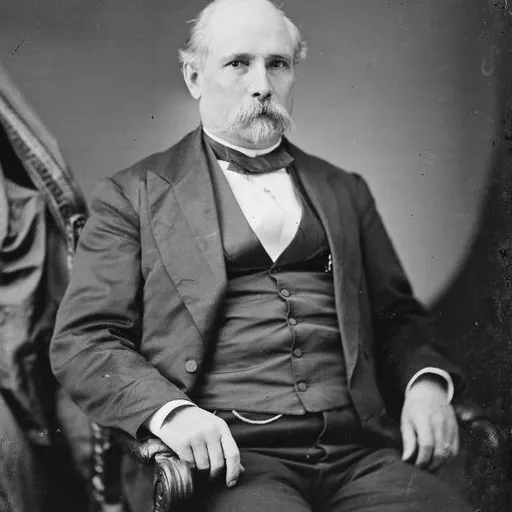
About James L. Alcorn
Lived 1816 – 1894 (aged 78). James L. Alcorn was an American politician and lawyer.
James Lusk Alcorn (November 4, 1816 – December 19, 1894) was a governor, and U.S. senator during the Reconstruction era in Mississippi. A Moderate Republican and Whiggish "scalawag", he engaged in a bitter rivalry with Radical Republican Adelbert Ames, who defeated him in the 1873 gubernatorial race. Alcorn was the first elected Republican governor of Mississippi. Alcorn briefly served as a Confederate brigadier-general of the Mississippi Militia. Among former Confederates who joined the postbellum Republican Party, only James Longstreet had been of higher rank than Alcorn.
Early life and career Alcorn was born near Golconda, Illinois Territory, As his law practice flourished and his property holdings in the Mississippi Delta increased, he became a wealthy man. In 1850, he built a three-story house at his Mound Place Plantation in Coahoma County, where he resided with his family. By 1860, he enslaved nearly one hundred people and held lands valued at a quarter of a million dollars. Alcorn served in the Mississippi House of Representatives and Mississippi Senate during the 1840s and 1850s being one of the leaders of the then Whigs in the state.
He founded the levee system and was chosen president of the levee board. He ran for Congress in 1856 but was defeated. In 1857, Alcorn was nominated for governor by the Whigs but declined. Alcorn joined the Mississippi Unionists to thwart Quitman's plans. Like many other Whig planters, Alcorn opposed secession, pleading with the secessionists to reflect on the realities of the national balance of power. He foretold a horrific picture of a beaten Southern United States, "when the northern soldier would tread her cotton fields, when the slave should be made free and the proud Southerner stricken to the dust in his presence." Alcorn attended the January 1861 Mississippi state secession convention, initially advocating for a cautious approach, but he later shifted to the secessionist side as a consensus developed in favor of leaving the Union. Alcorn was elected to the Committee of Fifteen that drafted the Ordinance of Secession and as he cast his vote he addressed the convention, saying: "I have thought that a different course in regard to the settlement of this great controversy should have been adopted, and to that end I have labored and spoken. But the die is cast—the Rubicon is crossed—and I enlist myself with the army that marches on Rome. I vote for the ordinance."
American Civil War When secession was declared, Alcorn was appointed by the Mississippi secession convention as a militia brigadier-general. After the resignation of several major generals of the Mississippi State Troops, including Jefferson Davis, Earl Van Dorn, and Charles Clark, Alcorn was next in line for promotion to major-general of the state's armed forces, but was passed over because his political foe John J. Pettus was the governor of Mississippi. Alcorn served in the army for about eighteen months of inconspicuous field service, mainly tasked with recruitment. When his brigade entered the Confederate States Army, Jefferson Davis refused to commission him on account of political differences.
During the war, Alcorn spent a fortune raising and supplying troops. Additionally, in 1863 his plantation was raided by General Leonard Ross' troops during the Yazoo Pass Expedition, part of the Vicksburg Campaign. However, he managed to preserve part of his wealth during the war by trading cotton with the North. In November 1863, Alcorn wrote to his wife: "I have been very busy hiding & selling my cotton. I have sold in all one hundred & eleven bales, I have now here ten thousand dollars in paper (Green backs) and one thousand dollars in gold." After the war, he was estimated to be among the fifty wealthiest men in the South.
Alcorn lost two sons to the war. His older son, Milton Stewart Alcorn, committed suicide in 1879 after returning home from the war partially deaf and a drunkard. An inscription on the monument at the family cemetery attributes James' death to the "insane war of rebellion" (apparently his father's words). Seventeen-year-old Henry "Hal" Alcorn ran away during the war to join the military against his father's wishes, became ill, and was left behind and captured. He was held in Camp Chase and made his way to Richmond, Virginia after the surrender. He died of typhoid fever en route to Mississippi.
Postbellum career
Alcorn was elected to the U.S. Senate in 1865. However, he was prohibited from being seated in Congress, like all those disqualified from office for insurrection or rebellion against the United States for their participation in the Confederacy. Alcorn served as governor until 1871.
Alcorn resigned from the governorship to become a U.S. senator, with service from 1871 to 1877, when he was succeeded by L. Q. C. Lamar. he denounced the federal cotton tax as robbery, and defended separate schools for both races in Mississippi. Although a former enslaver, he characterized slavery as "a cancer upon the body of the nation" and expressed the gratification he and many other Southerners felt over its destruction.
New South politics
Alcorn's estrangement from Senator Adelbert Ames, his northern-born colleague, deepened in 1871, as African-Americans became convinced that the former governor was not taking the problem of white terrorism seriously enough. Alcorn resisted federal action to suppress the Ku Klux Klan, instead contending that state authorities were sufficient to handle the task. By 1873, the quarrel had deepened into an intense animosity. Both men ran for governor. Ames was supported by the Radicals and most African Americans, while Alcorn won the votes of most of the scalawags, moderately Whiggish whites. Ames won by a vote of 69,870 to 50,490. Alcorn withdrew from active politics in the state and accused the new governor of being incapable and an enemy of the people. When a second African-American senator, Blanche Bruce, was elected in 1874, Alcorn refused to follow the customary procedure of introducing his new colleague to the Senate. Bruce was instead welcomed by New York senator Roscoe Conkling, the leader of the congressional "Stalwart" wing.
In 1875, when Reconstruction was fighting for its life against a campaign of violence from the Democrats, Alcorn emerged and led a white force against black Republicans at Friar's Point. The aftermath led to at least five black people being killed.
During the Reconstruction period, Alcorn was an advocate of modernizing the South. Although a believer in white supremacy, he supported civil and political rights for African-Americans. In a letter to his wife (Amelia Alcorn, née Glover, of Rosemount Plantation in southern Alabama), he states that white Southerners must make African Americans their friend or the path ahead will be "red with blood and damp with tears." Alcorn founded the Mississippi levee system and was instrumental in rebuilding the structures after the Civil War.
After he retired from politics, he was active in levee affairs. He was a delegate to the Mississippian constitutional convention of 1890, Alcorn commissioned a statue of himself, and after his death, it was placed on his grave.
Honors Alcorn County, Mississippi is named in his honor, as is the historically black Alcorn State University, the first black land-grant university.
Don’t just read it —
keep it.
Full-length biographies made to live with: read them, listen on the way to work, watch them tonight.
- E-book
- Audio
- Video
Instant download · yours to keep · every purchase keeps this site free
Important facts
People in James L. Alcorn's life
Named in this biography and alive at the same time


Related people
Same field, nearest in time





Contemporaries
People whose lives overlapped James L. Alcorn's





Frequently asked questions
Who was James L. Alcorn?
American politician (1816–1894)
When was James L. Alcorn born?
James L. Alcorn was born on 4 November 1816 in Golconda.
When did James L. Alcorn die?
James L. Alcorn died on 19 December 1894 in Friars Point, Eagles Nest.
What was James L. Alcorn's occupation?
James L. Alcorn was a politician and lawyer.
What nationality was James L. Alcorn?
James L. Alcorn was American.
Sources & further reading
Cite this page
APA: Biography.guide. (2026). James L. Alcorn. https://biography.guide/james-l-alcorn/
MLA: "James L. Alcorn." Biography.guide, https://biography.guide/james-l-alcorn/.
Chicago: "James L. Alcorn." Biography.guide. https://biography.guide/james-l-alcorn/.
Data last updated: 2026-09-21 · Spot an error? Report a correction.
Portrait: Wikimedia Commons · author & licence
Page generated 2026-09-27 05:00 UTC