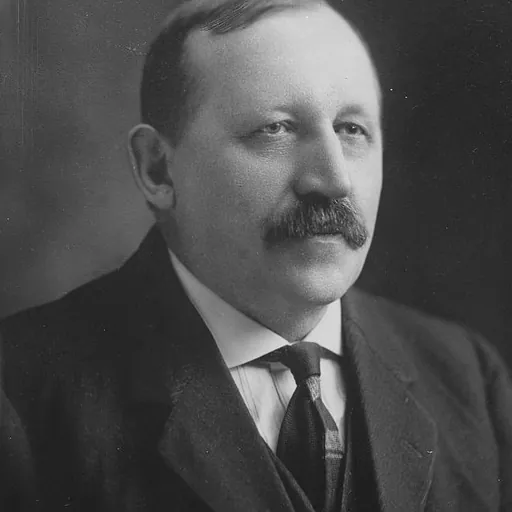
About James Hudson Maurer
Lived 1864 – 1944 (aged 79). James Hudson Maurer was an American politician and trade unionist.
James Hudson Maurer (April 15, 1864 – March 16, 1944) was a prominent American socialist politician and trade unionist who twice ran for the office of vice president of the United States on the ticket of the Socialist Party of America. He served three non-consecutive terms in the Pennsylvania House of Representatives between 1911 and 1919, and as President of the Pennsylvania Federation of Labor from 1912 to 1928.
Biography Early years Maurer was born in Reading, Pennsylvania, on April 15, 1864, and was one of three brothers. His father, James D. Maurer, was a shoemaker who later served as a Police officer in Reading. Maurer first went to work at the age of 6 as a newsboy, becoming an assistant to a plumber at the age of 10, later becoming a full-fledged plumber. The Maurers were of Pennsylvania Dutch ethnic extraction and the family had ancestors in America dating back nearly two centuries. In the early 1890s, he joined the People's Party, a populist political organization which attempted in particular to advance the cause of the country's farmers. He was introduced to socialist ideas near the end of the decade, taking nearly a year to read Karl Marx's Capital before joining the Socialist Labor Party of America (SLP) in 1899. Maurer helped to organize Section Hamburg, Pennsylvania SLP, in February of that year.
From 1901, Maurer was a member of the Plumbers and Steamfitters Union. Throughout his later life, he was strongly supportive of the American Federation of Labor and he came to strongly disapprove of the SLP's efforts to establish a competing socialist trade union to the AF of L, the Socialist Trade and Labor Alliance, and left the SLP to join the Socialist Party of America (SPA) in 1901 over this issue. He ran for governor of Pennsylvania on the Socialist Party ticket in 1906, receiving nearly 26,000 votes.
In November 1910, Maurer was elected as a Socialist to the Pennsylvania House of Representatives, serving during 1912. During his term in the legislature, Maurer fought for the passage of a plan for Old Age Pensions and attempted to prevent the establishment of a State Constabulary, which was seen as a mechanism for the armed and organized breaking of strikes.
Hillquit later recalled that Wilson was at first "inclined to give us a short and perfunctory hearing" but as the Socialists made their case to him, the session "developed into a serious and confidential conversation". Wilson told the group that he had already considered a similar plan but chose not to put it into effect because he was not sure of its reception by other neutral nations. "The fact is," Wilson claimed, "that the United States is the only important country that may be said to be neutral and disinterested. Practically all other neutral countries are in one way or another tied up with some belligerent power and dependent on it."
On July 30, 1917, a public Maurer speaking event in Seattle was the scene of a near riot when his speech on the topic "Is Conscription Constitutional?" was broken up by khaki-clad soldiers. At an "open air mass meeting" held under the auspices of the People's Council of America, Maurer had spoken for about 15 minutes when a group of soldiers began heckling him. Maurer briefly tried to shame the hecklers into silence, but instead the soldiers rushed the speaker's platform and forcibly brought his oration to a close. According to a contemporary news report, only the quick action of a local socialist activist, Kate Sadler, prevented the tense situation from degenerating into a riot, when she leaped to her feet, scolded the young soldiers, and abruptly launched into a short fundraising speech that defused the situation and allowed for an orderly termination of the meeting.
Maurer's outspoken opposition to the war hampered his support among his legislative constituents and he found his re-election efforts further challenged by a ban on public meetings enacted in an effort to slow the spread of deadly influenza. As a result, Maurer was defeated in his November 1918 bid to win another term in the legislature at Reading.
Post-war political career Maurer (in box, center), Philip Murray, Mother Jones and William Z. Foster surrounded by steel workers and unionists in uniform during the 1919 General Steel Strike In his capacity as head of the Pennsylvania Federation of Labor, Maurer was very active in the steel strike of 1919 in Pittsburgh, helping to organize workers to win the right of collective bargaining with their employers. Maurer was elected to the Reading City Council in November 1927, part of a sweep by the Socialist Party which won the administration of the city. but was defeated in 1931 in a landslide Fusion victory.
Norman Thomas and James H. Maurer as candidates for President and Vice President, 1928.
In 1928, Maurer was selected by the party convention to join Norman Thomas on the Socialist Party's presidential ticket. He ran a second time for governor of Pennsylvania in 1930. In 1932, he was selected once again as Thomas' running mate in the SPA's presidential campaign. In 1934, Maurer made his final electoral run as a candidate for US Senate from Pennsylvania.
In 1938, the Social Democratic Federation-affiliated Rand School Press published Maurer's autobiography, It Can Be Done.
Maurer retained his faith in socialism into the New Deal of President Franklin D. Roosevelt, writing in 1938:
Death Maurer died on March 16, 1944, in Reading, Pennsylvania. Maurer's family were Lutherans.
Works Unemployment and the Mechanical Man Our strike-breaking governments n.d.
(with Charles Maurer) The American Cossack, Pennsylvania Federation of Labor, 1915. Things We Care About. (with others) [New York : People's Council of America for Democracy and Peace, 1917.
A Heart to Heart Talk with Trade Unionists Chicago: Socialist Party National Office, 1920. Report on the Workers' Educational Classes in Pennsylvania during 1920-1921 Reading, PA: Peoples Printing Company, 1921. The Open Shop? Harrisburg, Pa., Pennsylvania Federation of Labor 1921. Report of the Pennsylvania commission on old age pensions. February, 1921 Harrisburg, Penna., J.L.L. Kuhn, Printer to the commonwealth, 1921. Report of the Pennsylvania Commission on Old Age Pensions, January, 1927. Harrisburg, PA: 1927. Unemployment and the mechanical man Chicago: Socialist Party of America, 1930. Socialism vs. capitalism Brooklyn: Socialist Party, Kings County, 1932.
Don’t just read it —
keep it.
Full-length biographies made to live with: read them, listen on the way to work, watch them tonight.
- E-book
- Audio
- Video
Instant download · yours to keep · every purchase keeps this site free
Important facts
People in James Hudson Maurer's life
Named in this biography and alive at the same time


Related people
Same field, nearest in time


Contemporaries
People whose lives overlapped James Hudson Maurer's




Frequently asked questions
Who was James Hudson Maurer?
American trade unionist
When was James Hudson Maurer born?
James Hudson Maurer was born on 15 April 1864 in Reading.
When did James Hudson Maurer die?
James Hudson Maurer died on 16 March 1944 in Reading.
What was James Hudson Maurer's occupation?
James Hudson Maurer was a politician and trade unionist.
What nationality was James Hudson Maurer?
James Hudson Maurer was American.
Sources & further reading
· Wikipedia: James Hudson Maurer
Cite this page
APA: Biography.guide. (2026). James Hudson Maurer. https://biography.guide/james-hudson-maurer/
MLA: "James Hudson Maurer." Biography.guide, https://biography.guide/james-hudson-maurer/.
Chicago: "James Hudson Maurer." Biography.guide. https://biography.guide/james-hudson-maurer/.
Data last updated: 2026-09-20 · Spot an error? Report a correction.
Portrait: Wikimedia Commons · author & licence
Page generated 2026-09-27 04:58 UTC