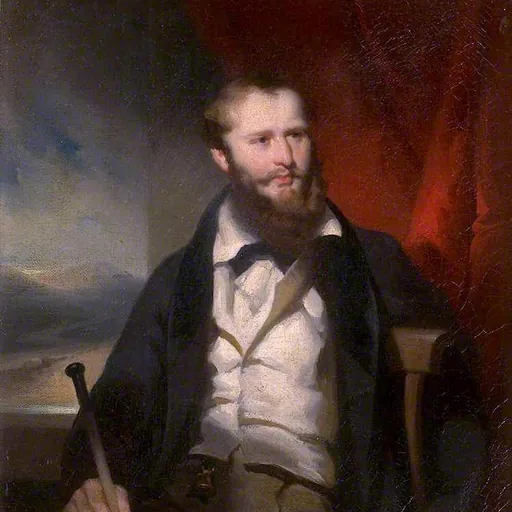
About James Holman
Lived 1787 – 1857 (aged 69). James Holman was a British writer and naval officer.
James Holman FRS (15 October 1786 – 29 July 1857), known as the "Blind Traveller," was a British adventurer, author and social observer, best known for his writings on his extensive travels. Completely blind and experiencing pain and limited mobility, he undertook a series of solo journeys that were unprecedented both in their extent of geography and method of "human echolocation". In 1866, the journalist William Jerdan wrote that "From Marco Polo to Mungo Park, no three of the most famous travellers, grouped together, would exceed the extent and variety of countries traversed by our blind countryman." In 1832, Holman became the first blind person to circumnavigate the globe. He continued travelling, and by October 1846 had visited every inhabited continent.
Life and travels
Holman was born in Exeter, the son of an apothecary. He entered the British Royal Navy in 1798 as first-class volunteer, and was appointed lieutenant in April 1807. In 1810, while on the Guerriere off the coast of the Americas, he was invalided by an illness that first affected his joints, then finally his vision. At the age of 25, he was rendered totally and permanently blind.
In recognition of the fact that his condition was duty-related, he was in 1812 appointed to the Naval Knights of Windsor, with a lifetime grant of care in Windsor Castle. This position demanded he attend church service twice daily as his only duty in return for room and board, but the quietness of such a life harmonized so poorly with his active habits and keen interests, physically making him ill, that he requested multiple leaves of absence on health grounds, first to study medicine and literature at the University of Edinburgh, then to go abroad on a Grand Tour from 1819 to 1821 when he journeyed through France, Italy, Switzerland, the parts of Germany bordering on the Rhine, Belgium and the Netherlands. On his return he published The Narrative of a Journey through France, etc. (London, 1822). This last work was never published, and likely has not survived.
Recognition Holman was elected a Fellow of the Royal Society (UK), and of the Linnaean Society (UK). Charles Darwin, in The Voyage of the Beagle, cited Holman's writings as a source on the flora of the Indian Ocean. On Fernando Po Island, now part of Equatorial Guinea, the British Government named the Holman River in his honour, commemorating his contributions to fighting the slave trade in the region during the 1820s.
Holman Prize Since 2017 the San Francisco-based LightHouse for the Blind and Visually Impaired has awarded an annual Holman Prize, named in Holman's honour. Three blind people are each given up to $25,000 to support them in an adventurous project.
Gallery
Don’t just read it —
keep it.
Full-length biographies made to live with: read them, listen on the way to work, watch them tonight.
- E-book
- Audio
- Video
Instant download · yours to keep · every purchase keeps this site free
Important facts
People in James Holman's life
Named in this biography and alive at the same time

Related people
Same field, nearest in time




Contemporaries
People whose lives overlapped James Holman's



Frequently asked questions
Who was James Holman?
British Royal Navy officer (1787-1857)
When was James Holman born?
James Holman was born on 15 October 1787 in Exeter.
When did James Holman die?
James Holman died on 28 July 1857 in London.
What was James Holman's occupation?
James Holman was a writer and naval officer.
What nationality was James Holman?
James Holman was British.
Sources & further reading
Cite this page
APA: Biography.guide. (2026). James Holman. https://biography.guide/james-holman/
MLA: "James Holman." Biography.guide, https://biography.guide/james-holman/.
Chicago: "James Holman." Biography.guide. https://biography.guide/james-holman/.
Data last updated: 2026-09-20 · Spot an error? Report a correction.
Portrait: Wikimedia Commons · author & licence
Page generated 2026-09-27 04:57 UTC