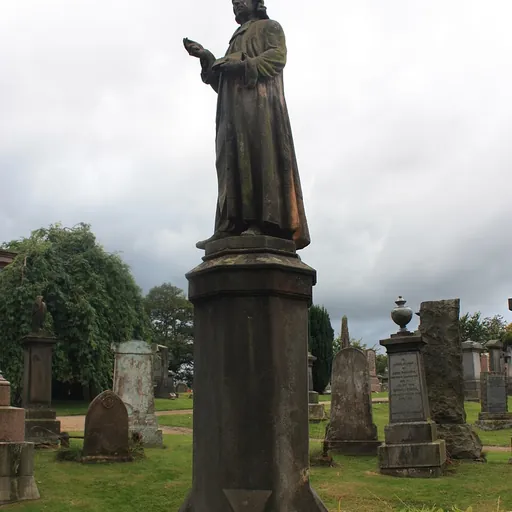
About James Guthrie
Lived 1612 – 1661 (aged 48–49). James Guthrie was a christian minister.
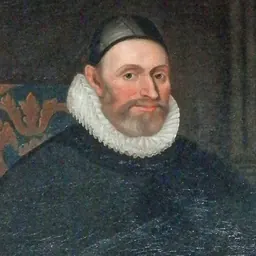
James Guthrie (c. 1612 – 1 June 1661), was a Scottish Presbyterian minister and martyr. A supporter of the Scottish Reformation, he refused to follow the episcopal church of the king of England, and preached as a Covenanter; he was executed for treason in Edinburgh.
Early life and education
Guthrie, the eldest son of the laird of Guthrie, Forfarshire, was born about 1612. He was educated at St. Leonard's College, St. Andrews, where he graduated with an MA, and became one of the regents, distinguished for his lectures on philosophy.
At this time Guthrie was an episcopalian, and is said to have been zealous for prelacy and the ceremonies. Yet on 16 December 1638 the strongly antiprelatic assembly at Glasgow put him in the list of those ready for ecclesiastical vacancies. In January 1639 Samuel Rutherford was made divinity professor at the University of St Andrews, and under his influence Guthrie became a Presbyterian.
First charge at Lauder In 1642 he was ordained minister of Lauder, Berwickshire.
By and by, when the Engagers returned to power, the Act of Classes was repealed, and a new army was levied which, to a large extent, was officered and filled by men who were regarded as unfaithful to the Covenant. In favour of this proceeding, however, the Church, forsaking the higher sphere, issued certain Resolutions, which were strenuously protested against by a large and influential minority. Such was the origin of the controversy between the Resolutioners and Protesters, which raged with unabated animosity for many years.
Those in favour of the loosening of the conditions for fighting were known as Resolutioners, a name derived from their approval of the resolutions of Commission and Parliament for the levy of 23 December.
The Church of Scotland was now unhappily split into two contending sections. Old friends who had fought side by side in earlier days became opponents, and there was much bitterness and occasionally misrepresentations, due in some cases to misunderstandings, exaggerated reports or false rumours. Of the Resolutioners, Robert Douglas was, by head and shoulders, the acknowledged leader. His ministerial supporters included David Dickson, Robert Baillie, and James Wood. Among the Protesters the most outstanding ministers were James Guthrie, Samuel Rutherfurd, Andrew Cant, Patrick Gillespie, and John Livingstone; and, of the elders, Wariston and Sir John Cheisly; the two most strenuous fighters being Guthrie and Wariston. Samuel Rutherford is known to have stayed with Guthrie in Stirling.
Guthrie's political and theological views
Guthrie was theologically and politically aligned with Archibald Johnston, whose 3-volume diaries were lost until 1896, and not fully published until 1940.
From the first, Guthrie ranged himself amongst the Protesters, and, indeed, was generally regarded as one of their principal leaders. By this time he had been translated to Stirling, where he had, as his colleague, Mr. Bennett, a man of kindred spirit, with whom, on the questions of the day, he was generally in agreement. Hew Scott's later edition says Guthrie came to Stirling around November 1650 although Kilpatrick discusses 1649. Not satisfied with expressing in a letter to the Commission of Assembly their dissatisfaction with the aforesaid Resolutions, they continued to preach against them and to denounce them as involving the nation in sin. For this they were cited to appear before the Committee of Estates at Perth, where Charles II was now holding his Court, and, having done so, they refused to acknowledge the King's right to interfere with them in the discharge of their ministerial functions.
"This our protestation' they said, "we make, not from any disrespect to the King's Majesty or your Lordships' authority, nor from any purpose to decline or disobey the same in anything civil, but from the tender regard which we have and owe unto the liberties and privileges of the Church of Jesus Christ, which both the King's Majesty and your Lordships and we are in so solemn a way bound to maintain and preserve inviolable."
In 1650 Guthrie treated General John Middleton with a high-handedness which sealed his own fate. Middleton, who joined Charles II immediately on his landing on 23 June, took the lead in a project for a royalist army in the north. On 17 October Guthrie, by the "Western Remonstrance", withdrew from the royalist cause; on 14 December he sent a letter to the general assembly at Perth denouncing Middleton as an enemy of the Covenant, and proposing his excommunication. Guthrie was appointed to pronounce the sentence next Sunday, and, despite a letter from the assembly bidding him delay the act, carried out the original order. At the next meeting of the commission (2 January 1651) Middleton was loosed from the sentence after public penance. He never forgave the affront.
The same meeting of commission which ordered Middleton's excommunication had passed a unanimous resolution authorising the acceptance of the military services of all but "obstinate" enemies of the covenant. Guthrie and his colleague, David Bennett, preached against this resolution. The two were required by His Majesty and the Committee of Estates to repair to Perth, 19 February 1651, to answer for preaching against the Public Resolutions agreed to by Church and State in order to a levy, but they refused. While acknowledging the king's civil authority, protested against his ecclesiastical jurisdiction, and declined to submit to what they called "a heighe prowoking the eiyes of the Lord's glorie". The attack on the resolution was led at the next meeting of the General Assembly at St. Andrews (16 July) by John Menzies, divinity professor in the Marischal College, Aberdeen, Guthrie strongly supported him. The assembly met by adjournment at Dundee (22 July), when a protestation against the action of the commission was read, those who had signed it absenting themselves, as from an unlawful assembly. The church was now divided into "resolutioners" and "protesters". Guthrie and two others were deposed by the assembly on 30 July; but for the alarm of Oliver Cromwell's approach, which dispersed the assembly, other "protesters" would have been similarly dealt with. A rupture took place in nearly every presbytery; the "protesters" met by themselves, and held their own synod in Edinburgh. They even turned for protection to Cromwell. On 8 August 1654 Guthrie was appointed by the English Privy Council one of the 'triers' and a visitor for the universities.
A conference between "resolutioners" and "protesters" at Edinburgh was rendered abortive by the attitude of Guthrie and Warriston. At a riot in Stirling on the election (1656) of a successor to Bennett, Guthrie was attacked with stones by "resolutioners". Kirk Session records from the time still survive. Both parties appealed to Cromwell in London in 1656. The champion of the "resolutioners" was James Sharp, afterwards archbishop, whose arguments led Cromwell to refuse the plea of the "protesters" for a commission in their favour. The cause of the "protesters" was further weakened by the defection of some of them (including Menzies) to independency, a development which increased Guthrie's opposition to Cromwell's government.
After the Restoration Guthrie's place of execution: Mercat Cross on Edinburgh's Royal Mile. Execution of Rev James Guthrie next to Edinburgh's Mercat Cross (then located on the High Street); the second man, after the Duke of Argyll, to be executed for high treason after the Restoration of 1660. Martyrs' Monument (inscription). The central section mentions Guthrie's head which was put on public display at the Nether Bow port.
Site of the Netherbow Port on The Royal Mile where Guthrie's skull remained for 28 years.
The Restoration rendered the prospects of the "protesters" hopeless. Guthrie and nine others met in Edinburgh (23 August 1660) and drew up a "humble petition" to the king setting forth their loyalty, and reminding him of his obligations as a covenanter. The meeting was ordered to disperse, and as the warning was unheeded arrests were made. Guthrie was imprisoned in Edinburgh Castle and on 25 September his stipend was sequestrated. He was transferred to Dundee on 20 October, and thence to Stirling, where he remained till his trial. On 20 February 1661 he was arraigned for high treason before the parliament, Middleton presiding as commissioner. The indictment had six counts.
The charges against Guthrie were six in number: (1) His contriving, consenting to, and exhibiting before the Committee of Estates the paper called The Western Remonstrance. (2) His contriving, writing, and publishing the abominable pamphlet called "The Causes of God's wrath." (3) His contriving, writing and subscribing the paper called "The Humble Petition," of the 23 of August last, when he was apprehended. (4) His convocating of the King's lieges at several times, without warrant or authority, to the disturbance of the peace of the State and of the Church. (5) His refusal, by appeal and protest presented at Perth, to acknowledge the King as judge in certain matters. (6) Some treasonable expressions alleged to have been used by him in a meeting, in 1650 or 1651.
On 20 February 1661, his indictment being read, Guthrie delivered an excellent speech, which may be found in Wodrow's History. Expressing the hope that the Lord Commissioner Middleton, who was known to have a grudge against him) would "patiently and without interruption" hear him, he reminded his judges that the law of God, referred to in the indictment, is the supreme law, not only of religion, but also of righteousness, and that all laws and Acts of Parliament are to be understood and expounded in the light of our solemn vows and covenants.
The contriving of the "western remonstrance" and the rejection of the king's ecclesiastical authority were, from a legal point of view, the most formidable charges. In the preparation of his defence he surprised his counsel by the accuracy of his knowledge of Scots law. The trial was not concluded until 11 April. Guthrie's closing appeal made a strong impression. He is celebrated as one of the first of the martyrs of the covenant, James Renwick being one of the last. The two are thus commemorated in the inscription upon the 'martyrs' monument' in the Greyfriars' churchyard, Edinburgh, the Westminster Abbey of Scotland:
But as for them, no cause was to be found Worthy of death but only they were found, Constant and steadfast, zealous witnessing For the Prerogatives of CHRIST their KING Which Truths were seal'd by famous Guthrie's head, And all along to Mr. Renwick's blood, They did endure the wrath of enemies Reproaches, torments, deaths and injuries But yet they're those who from such troubles came And now triumph in glory with the LAMB.
The monument marks Renwick's burial-place, being fixed to the wall close to the spot where criminals were interred.
The Scottish parliament reversed the attainder on 22 July 1690. His name ("famous Guthrie's head") is commemorated in the rude lines on the "martyrs' monument" in Greyfriars Churchyard, Edinburgh. By his party he was called "Sickerfoot" ("Sure-foot").
Works Guthrie published: The Causes of the Lord's Wrath, 1653 Protesters no Subverters, Edinburgh, 1658, 4to. Some Considerations contributing unto the Discoverie of the Dangers that threaten Religion, Edinburgh, 1660, 12mo; reprinted, Glasgow, 1738, 8vo. Sermon (his last) at Stirling (Matt. xiv. 22), 1660 (not seen); reprinted as A Cry from the Dead, &c., Glasgow, 1738, 8vo. Posthumous publications of his work: Two Speeches … before the Parliament, 1661, 4to. True and Perfect Speech … before his Execution, 1661, 4to. A Treatise of Ruling Elders and Deacons, Edinburgh, 1699, 24mo. A Cry from the Dead Glasgow, 1738 The Great Danger of Backsliding … from Covenanted Reformation-Principles: a Sermon dated 21 April 1660, with Guthrie's speech before Parliament, Edinburgh, 1739. Sermons, Edinburgh, 1846, 12mo.
Don’t just read it —
keep it.
Full-length biographies made to live with: read them, listen on the way to work, watch them tonight.
- E-book
- Audio
- Video
Instant download · yours to keep · every purchase keeps this site free
Important facts
People in James Guthrie's life
Named in this biography and alive at the same time


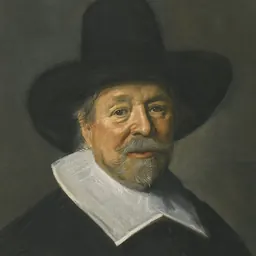
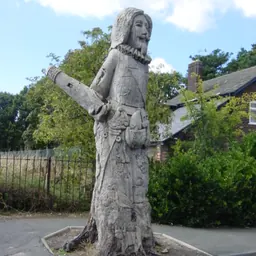

Related people
Same field, nearest in time
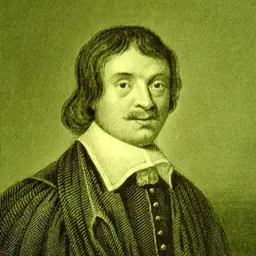
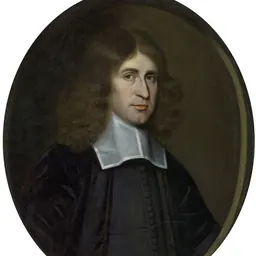


Contemporaries
People whose lives overlapped James Guthrie's






Frequently asked questions
Who was James Guthrie?
Minister of the Church of Scotland
When was James Guthrie born?
James Guthrie was born in 1612.
When did James Guthrie die?
James Guthrie died on 1 June 1661 in Edinburgh.
What was James Guthrie's occupation?
James Guthrie was a christian minister.
Sources & further reading
· DBpedia: James Guthrie (minister)
Cite this page
APA: Biography.guide. (2026). James Guthrie. https://biography.guide/james-guthrie-christian-minister/
MLA: "James Guthrie." Biography.guide, https://biography.guide/james-guthrie-christian-minister/.
Chicago: "James Guthrie." Biography.guide. https://biography.guide/james-guthrie-christian-minister/.
Data last updated: 2026-09-24 · Spot an error? Report a correction.
Portrait: Wikimedia Commons · author & licence
Page generated 2026-09-27 05:09 UTC