
James F. Blake
American bus driver defied by Rosa Parks
About James F. Blake
Lived 1912 – 2002 (aged 89). James F. Blake was an American bus driver, known for Rosa Parks.
James Frederick Blake (April 14, 1912 – March 21, 2002) was an American bus driver in Montgomery, Alabama, whom Rosa Parks defied in December 1955, prompting the Montgomery bus boycott.
Early life Born on April 14, 1912, Blake was drafted into the Army on December 23, 1943, at Fort McClellan in Anniston, Alabama.
Blake worked as a bus driver for Montgomery Bus City Lines until 1974. After retiring, he became a member of the Morningview Baptist Church. Furious, Times contacted the National Association for the Advancement of Colored People (NAACP) and the bus company but received no response. She also sent unpublished letters to newspapers in Montgomery and Atlanta. For the next six months, Times retaliated against the bus company by driving by bus stops to offer free rides to waiting black passengers. In effect, Times began a boycott of the bus company six months before the NAACP and Rosa Parks began the better-known boycott of that company.
In 1955, Montgomery's black leaders were preparing to make a legal case against racial discrimination on the city bus system. Rosa Parks was selected to be the central figure in a challenge to the Jim Crow laws which supported segregation.
In 1943, Parks had boarded a bus driven by Blake. She entered the front door of that bus and paid her fare; as Parks continued on to take a seat, Blake told her to disembark and enter the bus again from the back door, a rule imposed by some drivers. When she got off to re-enter through the back however, Blake drove the bus away. Parks vowed to herself she would never ride with Blake again.
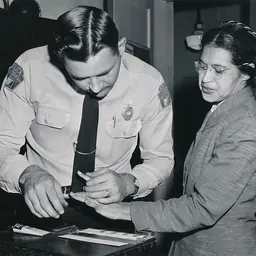
Blake and Parks encountered each other again on December 1, 1955 (Parks having forgotten to check who was driving the bus on this occasion), when Blake ordered Parks and three other black people to move to the back of his Cleveland Avenue bus (number 2857) in order to make room for a white passenger. By Parks' account, Blake said, "Y'all better make it light on yourselves and let me have those seats." When she refused, Blake first contacted the bus company and called his boss remarking, "I called the company first, just like I was supposed to do," Blake recalled in a later interview with the Washington Post. "I got my supervisor on the line. He said, 'Did you warn her, Jim?' I said, 'I warned her.' And he said, and I remember it just like I'm standing here, 'Well then, Jim, you do it, you got to exercise your powers and put her off, hear?' And that's just what I did."
After being arrested, Parks was fined $10 plus $4 in court fees (a total of around $170 as of 2026). Later, Blake contacted the police and signed the warrant for her arrest (Chapter 6, Section 11, of the city code gave drivers police powers for the racial assignment of seats.) The arrest sparked the Montgomery bus boycott and led to Browder v. Gayle, the 1956 court case on the basis of which a United States District Court abolished segregation in transportation for the jurisdiction in which Montgomery, Alabama, is located.
Commenting on the event afterwards, Blake stated, "I wasn't trying to do anything to that Parks woman except do my job. She was in violation of the city codes, so what was I supposed to do? That damn bus was full and she wouldn't move back. I had my orders. I had police powers—any driver for the city did. So the bus filled up and a white man got on, and she had his seat and I told her to move back, and she wouldn't do it."
Personal life Blake continued working at the bus company until he retired in 1974. Blake did not like to say much to the media or his family about the Parks matter, such as in 1989 when he was approached by a reporter of The Washington Post and yelled about wanting to close the book on the matter because of the "lies" printed about Blake while alleging that black people had called his house for weeks after the Parks incident. Blake joined the Morningview Baptist Church in 1980. Both the children's pastor of the church and Blake's wife defended him upon his death for his virtues as a churchgoing family man. Blake died of a heart attack at his Montgomery home on March 21, 2002, at age 89. He and his wife had been married for 68 years.
Rosa Parks was reported to have said in her condolences, "[I'm] sure his family will miss him."
Don’t just read it —
keep it.
Full-length biographies made to live with: read them, listen on the way to work, watch them tonight.
- E-book
- Audio
- Video
Instant download · yours to keep · every purchase keeps this site free
Important facts
People in James F. Blake's life
Named in this biography and alive at the same time


Related people
Same field, nearest in time



Contemporaries
People whose lives overlapped James F. Blake's






Frequently asked questions
Who was James F. Blake?
American bus driver defied by Rosa Parks (1912-2002)
When was James F. Blake born?
James F. Blake was born on 14 April 1912 in Montgomery.
When did James F. Blake die?
James F. Blake died on 21 March 2002 in Montgomery.
What was James F. Blake's occupation?
James F. Blake was a bus driver.
What was James F. Blake known for?
James F. Blake was known for Rosa Parks.
What nationality was James F. Blake?
James F. Blake was American.
Sources & further reading
Cite this page
APA: Biography.guide. (2026). James F. Blake. https://biography.guide/james-f-blake/
MLA: "James F. Blake." Biography.guide, https://biography.guide/james-f-blake/.
Chicago: "James F. Blake." Biography.guide. https://biography.guide/james-f-blake/.
Data last updated: 2026-09-22 · Spot an error? Report a correction.
Page generated 2026-09-27 05:28 UTC