James E. McInerney Jr.
United States Air Force officer
About James E. McInerney Jr.
Lived 1930 – 2014 (aged 84). James E. McInerney Jr. was a military leader and military personnel.
Major General James E. McInerney Jr. (3 August 1930 – 14 October 2014) was a United States Air Force (USAF) officer.
Early life and education McInerney was born in Springfield, Massachusetts, on 3 August 1930, the eldest of five children born to United States Army officer James E. McInerney and Rose Adikes McInerney. He graduated from Georgia Military Academy.
Military career He enlisted in the United States Army in September 1947 and served as a parachute infantryman until June 1948 when he entered United States Military Academy (USMA) at West Point. He graduated in June 1952 and then attended primary, basic and advanced flying schools.
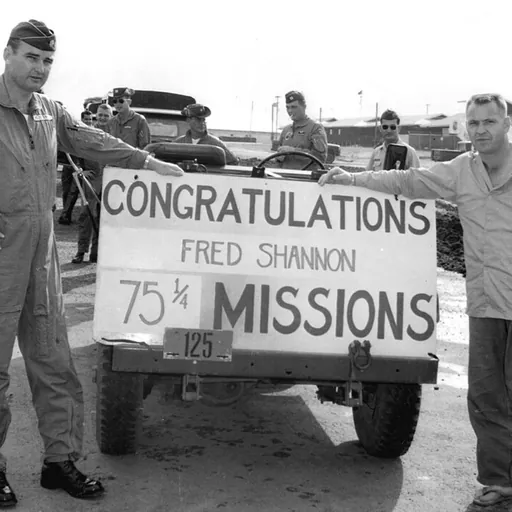
On 11 August 1967, McInerney and his electronic warfare officer Captain Fred Shannon led the Wild Weasel flight covering the first airstrike against the heavily-defended Paul Doumer Bridge in Hanoi, North Vietnam. During the strike, McInerney and Shannon destroyed two SA-2 SAM sites and suppressed four others. They flew through intense anti-aircraft artillery fire and dodged the three SA-2s launched at their flight. The strike force completely severed the bridge, and not a single aircraft was lost. For their heroism and skill, McInerney and Shannon were each awarded the Air Force Cross. He completed 101 combat missions over North Vietnam.
He helped establish the American Air Museum at Imperial War Museum, Duxford, for which he was made a Commander of the British Empire in June 2000.
He died on 14 October 2014 at Walter Reed National Military Medical Center. He was buried at West Point Cemetery with his wife Mary Catherine who died in July 2011, his mother and father (USMA 1923), and his younger brothers John (USMA 1959) and Richard (USMA 1960).
USAF Command pilot badgeUSAF Parachutist badge Air Force Cross Air Force Distinguished Service Medalwith bronze oak leaf clusterSilver Starwith two bronze oak leaf clustersDistinguished Flying Crosswith silver and bronze oak leaf clustersBronze Star MedalMeritorious Service Medalwith bronze oak leaf clusterAir Medalwith three silver and one bronze oak leaf clustersAir Medal(second ribbon required for accouterment spacing)Air Force Commendation MedalAir Force Presidential Unit Citationwith bronze oak leaf clusterAir Force Outstanding Unit Awardwith Valor device and three bronze oak leaf clustersNational Defense Service Medalwith service starKorean Service MedalArmed Forces Expeditionary MedalVietnam Service Medalwith two bronze campaign starsKorean Defense Service MedalAir Force Overseas Short Tour Service Ribbonwith bronze oak leaf clusterAir Force Overseas Long Tour Service Ribbonwith three bronze oak leaf clustersAir Force Longevity Service Awardwith silver and bronze oak leaf clustersSmall Arms Expert Marksmanship RibbonSouth Korean Order of National Security MeritCheonsu MedalRepublic of Vietnam Gallantry Crosswith bronze starCommander of the Most Excellent Order of the British EmpireRepublic of Vietnam Gallantry Cross Unit CitationUnited Nations Korea MedalVietnam Campaign Medal
Air Force Cross citation
Citation The President of the United States of America, authorized by Title 10, Section 8742, United States Code, takes pleasure in presenting the Air Force Cross to Lieutenant Colonel James Eugene McInerney, Jr., United States Air Force, for extraordinary heroism in military operations against an opposing armed force as Pilot of an F-105 airplane in the 13th Tactical Fighter Squadron, 388th Tactical Fighter Wing, Korat Royal Thai Air Base, Thailand, 7th Air Force, in action as Leader of a flak suppression flight in action against the Paul Doumer Bridge, a major north-south transportation link on Hanoi’s Red River in North Vietnam, on 11 August 1967. On that date, Colonel McInerney suppressed six active surface-to-air missile sites defending a strategic highway and railroad bridge. Despite concentrated barrages of anti-aircraft fire and three missiles directed against his flight, Colonel McInerney displayed the highest degree of courageous leadership in destroying two missile sites and forcing the other four into sporadic operation. As a direct result of his actions, the strike force suffered no losses and imposed extensive damage to this vital target. Through his extraordinary heroism, superb airmanship, and aggressiveness in the face of hostile forces, Lieutenant Colonel McInerney reflected the highest credit upon himself and the United States Air Force.
Don’t just read it —
keep it.
Full-length biographies made to live with: read them, listen on the way to work, watch them tonight.
- E-book
- Audio
- Video
Instant download · yours to keep · every purchase keeps this site free
Important facts
People in James E. McInerney Jr.'s life
Named in this biography and alive at the same time


Related people
Same field, nearest in time




Contemporaries
People whose lives overlapped James E. McInerney Jr.'s

Frequently asked questions
Who was James E. McInerney Jr.?
United States Air Force officer
When was James E. McInerney Jr. born?
James E. McInerney Jr. was born on 3 August 1930.
When did James E. McInerney Jr. die?
James E. McInerney Jr. died on 14 October 2014.
What was James E. McInerney Jr.'s occupation?
James E. McInerney Jr. was a military leader and military personnel.
Sources & further reading
· Wikipedia: James E. McInerney Jr.
· DBpedia: James E. McInerney Jr.
Cite this page
APA: Biography.guide. (2026). James E. McInerney Jr.. https://biography.guide/james-e-mcinerney-jr/
MLA: "James E. McInerney Jr.." Biography.guide, https://biography.guide/james-e-mcinerney-jr/.
Chicago: "James E. McInerney Jr.." Biography.guide. https://biography.guide/james-e-mcinerney-jr/.
Data last updated: 2026-09-21 · Spot an error? Report a correction.
Portrait: Wikimedia Commons · author & licence
Page generated 2026-09-27 04:59 UTC