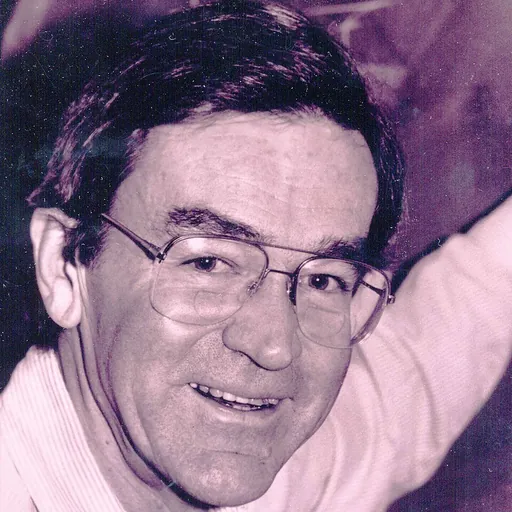
About James Bjorken
Lived 1934 – 2024 (aged 90). James Bjorken was an American physicist, theoretical physicist and university teacher, known for Bjorken scaling, Charm quark and Intrabeam scattering.
James Daniel "BJ" Bjorken (June 22, 1934 – August 6, 2024) was an American theoretical physicist. He was a Putnam Fellow in 1954, received a BS in physics from MIT in 1956, and obtained his PhD from Stanford University in 1959. Bjorken was a visiting scholar at the Institute for Advanced Study in the fall of 1962. He was also emeritus professor in the SLAC Theory Group at the Stanford Linear Accelerator Center, and was a member of the Theory Department of the Fermi National Accelerator Laboratory (1979–1989).
Bjorken was awarded the Dirac Medal of the ICTP in 2004; and, in 2015, the Wolf Prize in Physics and the EPS High Energy and Particle Physics Prize.
Early life and education James Bjorken's father, J. Daniel Bjorken, was an immigrant from Sweden near Lake Siljan. He changed his surname from "Björkén" to Bjorken upon arriving in the US; he moved to Chicago to work as an electrical engineer, which was where he met his future wife, Edith. James Bjorken grew up in Chicago and enjoyed mathematics, chemistry, the French horn, and watching the Chicago Cubs play at Wrigley Field. After graduating from Maine East High School in 1952, he decided to attend Massachusetts Institute of Technology (MIT) over the University of Chicago. Despite being offered more financial aid to attend the University of Chicago, his parents advised him that he should move further away to find his independence.
At MIT, he quickly decided to major in physics; one of the main reasons was his enjoyment of the lectures that Hans Mueller gave. Another of his influences at MIT was Sidney Drell, who became his mentor. After graduating in 1956, he attended Stanford University, graduating with his PhD in 1959 and staying on as a postdoctoral researcher for several years. the prototypical QCD spin sum rule. It states that in the Bjorken scaling domain, the integral of the spin structure function of the proton minus that of the neutron is proportional to the axial charge of the nucleon. Specially: , where is the Bjorken scaling variable, is the first spin structure function of the proton (neutron), and is the nucleon axial charge that characterizes the neutron β-decay. The sum rule was experimentally verified within better than a 10% precision.
Bjorken was also among the first to point out the phenomena of jet quenching in heavy ion collisions in 1982.
Richard Feynman subsequently reformulated this concept into the parton model, used to understand the quark composition of hadrons at high energies. The predictions of Bjorken scaling were confirmed in the early late 1960s electroproduction experiments at SLAC, in which quarks were seen for the first time. The general idea, with small logarithmic modifications, is explained in quantum chromodynamics by "asymptotic freedom".
Bjorken co-authored, with Sidney Drell, a classic companion volume textbook on relativistic quantum mechanics and quantum fields.
Personal life and death In 1967, Bjorken married Joan Goldthwaite; they had two children and were married until her death in 1983. He lived in Sky Londa, California.
Publications
Books
Selected papers J. D. Bjorken (1968). "Current Algebra at Small Distances", in Proceedings of the International School of Physics Enrico Fermi Course XLI, J. Steinberger, ed., Academic Press, New York, pp. 55–81. Online, SLAC-PUB-338
Full list of papers INSPIRE-HEP -- Bjorken
Don’t just read it —
keep it.
Full-length biographies made to live with: read them, listen on the way to work, watch them tonight.
- E-book
- Audio
- Video
Instant download · yours to keep · every purchase keeps this site free
Important facts
People in James Bjorken's life
Named in this biography and alive at the same time





Related people
Same field, nearest in time




Contemporaries
People whose lives overlapped James Bjorken's



Frequently asked questions
Who was James Bjorken?
American physicist (1934–2024)
When was James Bjorken born?
James Bjorken was born on 22 June 1934 in Chicago.
When did James Bjorken die?
James Bjorken died on 6 August 2024 in Redwood City.
What was James Bjorken's occupation?
James Bjorken was a physicist, theoretical physicist and university teacher.
What was James Bjorken known for?
James Bjorken was known for Bjorken scaling, Charm quark, Intrabeam scattering and Jet quenching.
What nationality was James Bjorken?
James Bjorken was American.
Sources & further reading
Cite this page
APA: Biography.guide. (2026). James Bjorken. https://biography.guide/james-bjorken/
MLA: "James Bjorken." Biography.guide, https://biography.guide/james-bjorken/.
Chicago: "James Bjorken." Biography.guide. https://biography.guide/james-bjorken/.
Data last updated: 2026-09-21 · Spot an error? Report a correction.
Portrait: Wikimedia Commons · author & licence
Page generated 2026-09-27 04:58 UTC