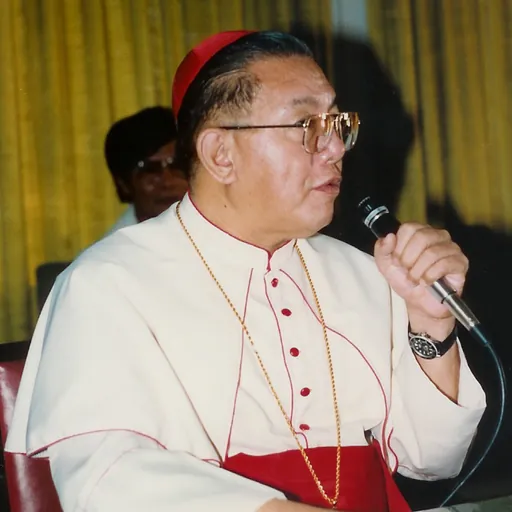
About Jaime Sin
Lived 1928 – 2005 (aged 76). Jaime Sin was a Filipino catholic priest and catholic bishop.
Jaime Lachica Sin (August 31, 1928 – June 21, 2005) was a Filipino Catholic prelate who served as the 30th archbishop of Manila from 1974 until his retirement in 2003. He was elevated to the rank of cardinal by Pope Paul VI in 1976.
Born in New Washington, Aklan, Sin began his ministry as a priest in the Diocese of Capiz and later served as Archbishop of Jaro. He rose to national prominence as Archbishop of Manila during the martial law era under President Ferdinand Marcos. Initially adopting a conciliatory stance toward the government, Sin became increasingly vocal in his criticism of the Marcos administration, particularly following a military raid on the Sacred Heart Novitiate in Novaliches. He later played a pivotal role in the 1986 People Power Revolution by broadcasting a radio appeal for civilians to gather along Epifanio de los Santos Avenue (EDSA) to support military defectors against Marcos. In 2001, Sin issued a similar call to action, demanding the resignation of President Joseph Estrada during the Second EDSA Revolution.
Sin's continued political influence during the subsequent Aquino, Ramos, and Estrada administrations frequently drew scrutiny. Beyond his political involvement, Sin assisted Trappist monks in acquiring land for their monastery, established the Domus Mariae Foundation for social housing, and founded the Lorenzo Mission Institute and Lorenzo Ruiz Mission Society to train seminarians and priests ministering to Chinese Filipinos. The cardinal also hosted Pope John Paul II during his 1981 and 1995 pastoral visits to the Philippines, the latter being for World Youth Day.
He retired as archbishop on September 15, 2003. Sin died on June 21, 2005, at the age of 76, and was accorded state honors.
Early life and education Sin was born on August 31, 1928, in New Washington, Capiz, on the island of Panay. Born into a wealthy family, he was the fourteenth of sixteen children of Juan Sin, a merchant of Chinese descent, and Máxima Lachica, a native Aklanon. Known affectionately as "Jim" or "Ame," Sin shared a close bond with his mother, whose piety deeply influenced him. He showed an early interest in the priesthood, often preaching mock sermons as a child, and enrolled at the St. Vincent Ferrer Seminary in Iloilo at the age of 12. Following three years of missionary work, he served as the inaugural rector of St. Pius X Seminary in Lawaan Hills, Roxas City, from 1957 to 1967. During this tenure, he worked as principal, dean of studies, professor, and diocesan consultant. On February 29, 1960, Pope John XXIII elevated him to the rank of domestic prelate (now honorary prelate) on February 29, 1960, which granted him the title of monsignor.
On January 29, 1973, during the semiannual meeting of the Catholic Bishops' Conference of the Philippines (CBCP) in Baguio City, Sin delivered an address to a Church hierarchy that was divided on how to interact with the Marcos administration. In his speech, given just four months into martial rule, Sin asserted that the Church operates independently of any specific government but must actively serve as the "conscience of mankind." This implied that the Church could continue its mission under an authoritarian government while reserving the right to intervene in secular affairs involving moral matters and fundamental human rights. Sin was formally installed on March 19, 1974. One of his first acts as archbishop was to restructure the archdiocese's charity arm that same year, rebranding Catholic Charities established by his predecessor Cardinal Rufino Santos, as Caritas Manila.
Alongside his duties as archbishop, Sin held prominent leadership roles within the national Church. He served as the vice president of the Catholic Bishops' Conference of the Philippines (CBCP) starting in January 1974, and was subsequently elected as its president in 1977, and re-elected in 1979. He later chaired the CBCP's commissions on Mass Media and the Pontificio Collegio Filippino in 1982.
On May 24, 1976, Pope Paul VI elevated Sin to the College of Cardinals, appointing him cardinal priest of the titular church of Santa Maria ai Monti. Following his elevation to the cardinalate, Sin became deeply involved in the Roman Curia. He was made a permanent member of the Synod of Bishops in Rome in October 1977. Throughout the late 1970s and 1980s, the Vatican appointed him to numerous administrative bodies. His memberships included the Sacred Congregations for the Evangelization of Peoples, Catholic Education, Bishops, the Clergy, and Divine Worship and the Sacraments. Additionally, he served on the Prefecture for the Economic Affairs of the Holy See, the Secretariat for Non-Christians, the Pontifical Commission for Social Communications, and the Council for Public Affairs of the Church. This was due to his name being the inaptronym for a Catholic Cardinal due to it being a play on cardinal sin.
Sin participated as a cardinal elector in the August and October conclaves of 1978, which elected Pope John Paul I and Pope John Paul II, respectively. According to reports, when it became apparent that Cardinal Albino Luciani would receive the required number of votes during the August conclave, Sin told him, "You will become the new pope." During Sin's subsequent homage, John Paul I reportedly replied, "You were a prophet, but my reign will be a short one." John Paul I passed away less than 40 days later.
In 1981, the cardinal hosted Pope John Paul II during the pontiff's first pastoral visit to the Philippines.
Martial law and EDSA Revolution
Early critical collaboration During his installation as archbishop in March 1974, Sin’s address highlighted the socioeconomic disparities exacerbated by martial law. He renewed the call for a "revolution of love" that he had first made during his episcopacy in Jaro. Addressing the separation of church and state, Sin argued that separation did not equate to isolation.
Sin was considered part of the moderate faction among Philippine bishops. While a traditionalist minority preferred to keep the Church out of secular matters, and a radical minority actively supported marginalized groups through more vocal opposition, Sin and the moderate majority adopted a framework of "critical collaboration" with the Marcos administration. and in his homily he preached the loss of freedom had "reduced the Filipino to being an exile in his own country." Later that afternoon, Enrile called Sin, expressing fear for his life and asking for help.
This broadcast, along with Butz Aquino's earlier radio appeal, mobilized thousands of civilians. Led by priests and nuns, crowds gathered along Epifanio de los Santos Avenue (EDSA) and effectively launched the People Power Revolution. On February 23, Sin reportedly received intelligence that Marcos had ordered his arrest and detainment on Caballo Island. Despite the threat, he declined Villegas's suggestion to relocate to a safe house.
Sin temporarily distanced himself from domestic politics and traveled abroad, including a tour of the Soviet Union and a visit to China, his father's birthplace. The institute was named in honor of Saint Lorenzo Ruiz, a Chinese Filipino who is recognized as the Philippines' protomartyr. Later that year, Sin publicly criticized Ramos, referring to him as a "Marcos clone." The cardinal actively opposed several government initiatives, including population control measures involving condoms Months prior to that, impoverished supporters of Estrada's anti-poverty campaign had stormed presidential palace Neither the Vatican nor the Archdiocese of Manila ever officially confirmed these reports.
Retirement and final years During his final years, Sin's declining health prevented him from intervening in or sanctioning political actions regarding the corruption allegations against President Arroyo. In a parting statement, the former archbishop remarked, "As I enter a new chapter in my twilight years, I can say with gratitude that I have given my very best to God and country... I beg pardon from those I might have led astray or hurt. Please remember me kindly."
Sin's galero, a hat traditionally given to and worn by cardinals, hangs on display from the ceiling of the Manila Cathedral.
The cardinal's later years were marked by severe ill health, including kidney and heart problems, as well as diabetes.
President Gloria Macapagal Arroyo accorded him a state funeral On June 28, following a funeral Mass attended by thousands, Sin was buried alongside his predecessors in the crypt of the Manila Cathedral.
Honors and legacy
Orders
Honorary degrees Sin received several honoris causa degrees from institutions in the Philippines and abroad:
Public views
Reproductive health In 1996, Sin opposed the Ramos administration's program to curb HIV/AIDS rates by distributing condoms, branding the initiative as "intrinsically evil." The cardinal was broadly against artificial birth control, including the use of condoms. He reportedly stated that condoms were "only fit for animals." other_elements=25px Behind the shield is a double-traversed archiepiscopal cross in gold (Or). symbolism=The escallops and pilgrim's staff are attributes of James the Great, Sin's patron saint. The three roses represent Our Lady of the Holy Rosary as the Mystical Rose, the patroness of Sin's hometown. The cross and rose-garlanded heart symbolize Sin's "willingness to carry the cross" and, if need be, to "be affixed to it." helm=35px A cardinal's galero with cords and thirty tassels, arranged in five rows of one, two, three, four, and five on either side of the shield.
Don’t just read it —
keep it.
Full-length biographies made to live with: read them, listen on the way to work, watch them tonight.
- E-book
- Audio
- Video
Instant download · yours to keep · every purchase keeps this site free
Important facts
more
Cardinal SinPeople in Jaime Sin's life
Named in this biography and alive at the same time





Related people
Same field, nearest in time


Contemporaries
People whose lives overlapped Jaime Sin's


Frequently asked questions
Who was Jaime Sin?
Roman Catholic Archbishop of Manila
When was Jaime Sin born?
Jaime Sin was born on 31 August 1928 in Aklan.
When did Jaime Sin die?
Jaime Sin died on 21 June 2005 in Metro Manila.
What was Jaime Sin's occupation?
Jaime Sin was a catholic priest and catholic bishop.
What nationality was Jaime Sin?
Jaime Sin was Filipino.
Sources & further reading
Cite this page
APA: Biography.guide. (2026). Jaime Sin. https://biography.guide/jaime-sin/
MLA: "Jaime Sin." Biography.guide, https://biography.guide/jaime-sin/.
Chicago: "Jaime Sin." Biography.guide. https://biography.guide/jaime-sin/.
Data last updated: 2026-09-21 · Spot an error? Report a correction.
Portrait: Wikimedia Commons · author & licence
Page generated 2026-09-27 05:00 UTC