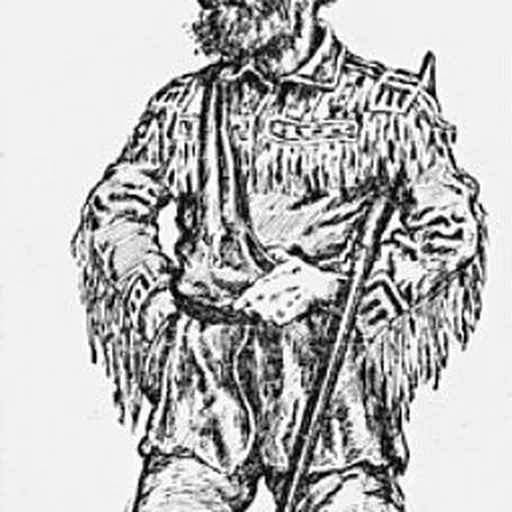
Jacques La Ramee
French-Canadian and Métis coureur des bois
About Jacques La Ramee
Lived 1784 – 1821 (aged 36–37). Jacques La Ramee was an explorer, coureur des bois and trapper.
Jacques La Ramée (June 8, 1784 – 1821) was a French-Canadian and Métis coureur des bois, frontiersman, trapper, fur trader, hunter, explorer, and mountain man who lived in what is now the U.S. state of Wyoming, having settled there in 1815. His name appears in several spellings, including La Ramee, Laramée, LaRamée, La Ramie, La Rami, La Remy, and Laramie. La Ramée is credited as an early explorer of what is now called the Laramie River of Wyoming and Colorado. The city of Laramie, Wyoming, with an Americanized spelling, was later named for him.
Early life Jacques La Ramée was born on June 8, 1784, in Yamaska, Quebec, British Canada, to Joseph Fissiau dit Laramée and Jeanne Mondou.
Volume VI of the North West Company registry records two Laramée brothers, Jacques and Joseph in 1811 who worked for the company. A variant of the name La Ramée was first documented in the western United States in 1798, referring to a canoe man who worked until 1804. This may have been Francois Laramée, who is also listed in the registry of the NW company.
According to Lakota writer and oral historian Susan Bordeaux Bettelyoun, her father, fur trader James Bordeaux, was La Ramée's cousin and discovered his body after his death.
Fur trader and explorer According to historian C. G. Coutant, Jacques La Ramée worked as a voyageur and fur trader for the North West Company and John Jacob Astor's American Fur Company. Employees of the North West Company and its rival, the Hudson's Bay Company, were in competition, and disputes at times turned violent. In 1821 the two feuding companies merged.
La Ramée was known for his character and peaceful reputation. He organized a group of independent trappers, who set out in 1815 to find the headwaters of the North Platte River in the United States Unorganized Territory of present-day Wyoming. Coutant writes that La Ramée and his band of trappers befriended many Native American tribes, who would trade pelts to them for European goods. This enterprise established the free trapper rendezvous in Wyoming, where trappers represented themselves without middle-men or an umbrella company. According to journalist Jim McKee (citing Robert Stuart from 1812), free trappers would rendezvous each May on the Oregon Trail pathway along the shore of the North Platte River. La Ramée was a leader and was considered the trappers' spokesperson. He assigned trapping areas among the free traders. For five years these events attracted more trappers and traders, and a trade market was established, in addition to routes to and from supply depots. He was never seen alive again. When he did not show up for the rendezvous, organizers initiated a search for him. According to Susan Bordeaux Bettelyoun, also known as Red Cormorant Woman (Lakota), her father, the fur trader James Bordeaux, was La Ramée's cousin who discovered his body after his death.
Laramidia, an island continent in the Late Cretaceous, was named after the Laramide orogeny, which in turn was named after the Laramie Mountains.
In popular culture James A. Michener's 1974 historical novel, Centennial, featured "Pasquinel", a French Métis coureur des bois from Montreal. He was portrayed as an early frontier mountain man and trapper in 1795 Colorado, then part of the Spanish Upper Louisiana Territory of Mexico. NBC television produced a mini-series adaptation of the same name, airing it in 1978–1979. Pasquinel was portrayed by American TV actor, Robert Conrad. The character of Pasquinel was loosely based on La Ramée.
Don’t just read it —
keep it.
Full-length biographies made to live with: read them, listen on the way to work, watch them tonight.
- E-book
- Audio
- Video
Instant download · yours to keep · every purchase keeps this site free
Important facts
People in Jacques La Ramee's life
Named in this biography and alive at the same time


Related people
Same field, nearest in time



Contemporaries
People whose lives overlapped Jacques La Ramee's

Frequently asked questions
Who was Jacques La Ramee?
French-Canadian and Métis coureur des bois
When was Jacques La Ramee born?
Jacques La Ramee was born on 8 June 1784 in Quebec City.
When did Jacques La Ramee die?
Jacques La Ramee died in 1821 in Laramie River.
What was Jacques La Ramee's occupation?
Jacques La Ramee was an explorer, coureur des bois and trapper.
What nationality was Jacques La Ramee?
Jacques La Ramee's recorded nationality: Province of Quebec.
Sources & further reading
Cite this page
APA: Biography.guide. (2026). Jacques La Ramee. https://biography.guide/jacques-la-ramee/
MLA: "Jacques La Ramee." Biography.guide, https://biography.guide/jacques-la-ramee/.
Chicago: "Jacques La Ramee." Biography.guide. https://biography.guide/jacques-la-ramee/.
Data last updated: 2026-09-23 · Spot an error? Report a correction.
Portrait: Wikimedia Commons · author & licence
Page generated 2026-09-27 05:07 UTC