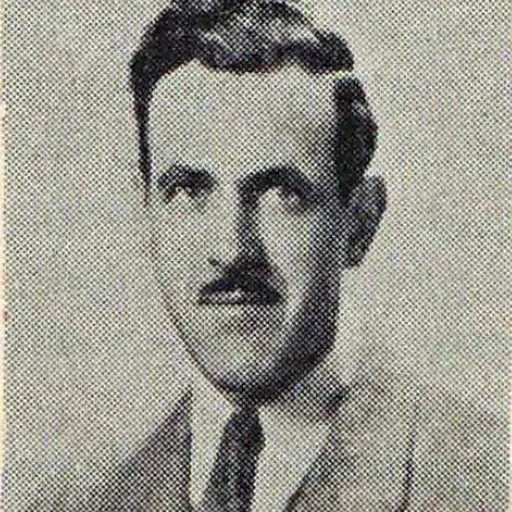
About Jacques Ducharme
Lived 1910 – 1993 (aged 83). Jacques Ducharme was an American social historian, writer and novelist.
Jacques Armand Ducharme (June 29, 1910 – December 30, 1993) was an American novelist, copy editor, and historian of French Canadian ancestry who wrote The Delusson Family, the first nationally distributed Franco American novel, and the first of the genre published in English, as well as The Shadows of the Trees, one of the first English-language history books covering the Great Migration of émigrés from Quebec to New England, and their history in that part of the United States.
Early life Jacques Ducharme was born in Holyoke, Massachusetts to Pierre Honoré Tetreault-Ducharme and Malvina Katie Proulx, on June 29, 1910. Growing up in Holyoke, he attended the parish school of Notre-Dame du Perpetual Secours, receiving a bilingual education which he would continue as a student at Assumption College in Worcester, graduating with a Bachelor of Arts in 1932.
Journalist and writer
After leaving Assumption, Ducharme would go to study at Sorbonne in Paris, beginning a career as a freelance writer, editor and teacher, a career he would keep after returning to States. Published in 1939, it represented the first English-language Franco American novel, to some controversy at the time from the genre's traditionally New England French-speaking audience.
Ducharme's book would enjoy modest sales for a debut author, of about 4,500 copies in its first years. The novel would also garner a certain praise from one of Quebec and New England's most prominent critic's Louis Dantin. Although Dantin had previously once exclaimed there "was no such thing as 'Franco-American literature'", his review in the July 1939 issue of Le Jour not only used the term, but praised Ducharme– understanding that the novel was, in part, an effort to reach audiences outside the community– To the audience she [the novel] speaks to, ignorant of Canadian life, she might be a revelation. What may seem futile and hackneyed to us will seem curious, exotic. And the work thus will have achieved its goal, to make known and esteemed in American circles the solid qualities of the French-Canadian race. Is it the author's fault if, for us, her compatriots, she does not teach us enough?
Indeed, in his own reflection, given in the French language, before the Société Historique Franco-Américaine in Boston, Ducharme would recount how his own publishers in New York were only aware of the Cajuns of Louisiana, and how the Franco-Americans of New England were unknown to them. In writing The Delusson Family, Ducharme stated he sought to bring the story of his people to the broader American audience.
The Delusson Family, would also enjoy certain national popularity in Catholic circles as well as after being picked up by the Catholic Book Club of America, the Jesuit magazine. The novel, while not having an official French translation, was subsequently published the following year in a Dutch version, translated by poet and critic .
In the year after publishing The Delusson Family, Ducharme turned to his prior experience publishing articles for the Worcester Evening Post and bought the Franco-American weekly La Justice, in Holyoke, operating it as editor-publisher for 14 months before selling it to its head printer.
Within a year of the publication of Town and the City, Dion-Lévesque had also drawn comparisons between the two books, placing Ducharme as a predecessor of Kerouac, and asking Kerouac about the role of the Franco-American culture in his books. Kerouac would reply "I did not try to elaborate on it, the Franco-American fact... it is something I do however in my novel in preparation", noting his Martin family was an amalgamation of the community he had known in Lowell. Between the two, Ducharme would outsell Kerouac with his initial run of The Delusson Family in 1939, with about 4,500 copies sold.
Ethnographer and historian
Ultimately Ducharme would sell La Justice due to the fluctuations in advertising revenue that led to him spending more time soliciting ads than editing the weekly paper, It was around that same time that he began developing The Shadows of the Trees, his second and last volume, an ethnography of sorts on the Franco-Americans of New England. Choosing the title as an homage to Robert P. T. Coffin's The Kennebec, initially Ducharme sought a Guggenheim Fellowship for his work, having previously received some support from the foundation. He would end up, however, working at an aircraft plant for wartime production in Hartford to support this project, which included weeks of driving across all corners of New England and parts of Quebec to interview different prominent figures in the French-Canadian diaspora.
Ducharme would formally sign his contract with Harper in 1941. During his research, he remarked it was possible to go days at a time in his travels without speaking or reading any English, but nevertheless he felt that he was documenting a fading culture, remarking to the Société Historique Franco-Américaine-
Ducharme would publish his work The Shadows of the Trees in 1943 to mixed reactions, both for its use of English, seen as a liability to Franco-American proponents of survivance, and views that the French language could be as much a part of American culture as English. For Ducharme, the choice of English for the book and his previous novel represented a new epoch in Franco-American literature, as his was a much broader audience than those who spoke French, the audience of the collective body of Franco-American literature up until that time. Nevertheless, his positive attitude toward bilingualism was also criticized by Anglophones as well, with Henry Beston remarking in his New York Times review of the book- "I do not happen to agree with his position on linguistic separatism to me (a New England neighbor), the policy seems wrong on this side of the frontier." Beston would however acknowledge the account represented one of many in a people adjusting to Americanism, despite such disagreement, and added that it was a unique addition to American history in the English language, as few such-books were written in a language besides New England French.
Later life and advocacy
Shortly after publishing The Shadows of the Trees, Ducharme would work for the Springfield Republican as a book reviewer, and in the last year of the Second World War, enlisted in the Office of Strategic Services, as a press officer in the European theatre. Building on his experience with the OSS during wartime, Ducharme briefly served as an American correspondent for a number of French journals started at its end, including Le Maine libre and La Nouvelle République. While remaining an active advocate of Franco-American culture, he did not publish any more books, and only briefly saw a reprise in his writing career writing a short piece for The Saturday Review in 1956, Knowledge Without Pain, commenting on the achievements of modern science. Ducharme would remain at IBM for the remainder of his career, retiring in 1975, after which he returned to New England, moving to Stratford, Connecticut in November of that year.
In retirement he would continue to take part in Franco-American literary preservation during the Revival era, speaking at length at a 1976 conference on the subject hosted by the National Materials Development Center for French and Portuguese, which had used grants to republish a number of novels and later the first New England French-language novel in half a century with L'Heritage in 1983. Jacques Ducharme died on December 30, 1993, in Hartford, Connecticut.
Works The Delusson Family (1939) The Shadows of the Trees (1943) Knowledge Without Pain (1957), in The Saturday Review Après Trente Ans (1976), in Les Franco-Américains: La promesse du passé, les réalités du présent
Don’t just read it —
keep it.
Full-length biographies made to live with: read them, listen on the way to work, watch them tonight.
- E-book
- Audio
- Video
Instant download · yours to keep · every purchase keeps this site free
Important facts
People in Jacques Ducharme's life
Named in this biography and alive at the same time

Related people
Same field, nearest in time





Contemporaries
People whose lives overlapped Jacques Ducharme's






Frequently asked questions
Who was Jacques Ducharme?
American novelist
When was Jacques Ducharme born?
Jacques Ducharme was born on 29 June 1910 in Holyoke.
When did Jacques Ducharme die?
Jacques Ducharme died on 30 December 1993 in Hartford.
What was Jacques Ducharme's occupation?
Jacques Ducharme was a social historian, writer and novelist.
What nationality was Jacques Ducharme?
Jacques Ducharme was American.
Sources & further reading
Cite this page
APA: Biography.guide. (2026). Jacques Ducharme. https://biography.guide/jacques-ducharme/
MLA: "Jacques Ducharme." Biography.guide, https://biography.guide/jacques-ducharme/.
Chicago: "Jacques Ducharme." Biography.guide. https://biography.guide/jacques-ducharme/.
Data last updated: 2026-09-23 · Spot an error? Report a correction.
Portrait: Wikimedia Commons · author & licence
Page generated 2026-09-27 05:05 UTC