
Jacques Bunimowitsch
Lithuanian-German Jewish artist
About Jacques Bunimowitsch
Lived 1859 – 1915 (aged 55–56).
Jacques Bunimowitsch (1859-ca. 1915?; Yiddish: יעקב בונעמאוויטש; romanized: Yakov Bunimovitsh; Lithuanian: Jokūbas Bunimovičius) was a Lithuanian Jewish portrait artist who flourished in Frankfurt during the final two decades of the 19th century.
Early life Bunimowitsch's surname was Bunimovitz, which was the Yiddish pronunciation of the name; his name was later Germanized to Bunimowitsch. He was likely the younger brother of the industrialist and financeer Israel Bunimovitz (b. 1848; otherwise, a cousin); the Bunimovitz family descended from a lineage in Valozhyn (an ancestor, Aharon Bunimovitz, was the Rosh ha-kahal of Valozhyn (Volozhin) and sofer to Rabbi Chaim Volozhiner, and Jacques was a member of the Vilnius branch of that family, which arrived with Binyamin Bunimovitz of Valozhyn before 1848. Other members of this family include Irving Bunim.
Artistic education Bunimowitsch began his schooling at the Vilnius Academy of Arts during the period of 1873–74; two paintings completed during this time, Arkliai Arime and Kaimelio Gatve are examples of the Eastern European dynamic landscapes which were popular at the school at this time. His style of austere aristocratic portraiture was to come after, influenced by his subsequent teachers.
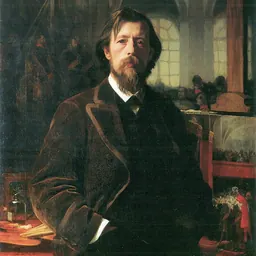
He then moved to Berlin to study under Anton von Werner at the Prussian Academy of Arts (he studied there from 1876 to 1879); Bunimowitsch apparently absorbed the genre of historical painting from von Werner, as well as the German historical painting that Von Werner practised; Bunimowitsch's portrait style can be seen as similar to von Werner's Portrait of the poet Joseph Victor von Scheffel (placement of the portrait, lighting, dressing in dark, facial staging, and so on). Likely, it was at this time when he painted a portrait of Frederick II, Grand Duke of Baden as a young teenager.
Following this, he moved to Vienna and studied at the Academy of Fine Arts Vienna under Christian Griepenkerl from 1880 until 1882. otherwise, perhaps Jacques got there first, and sent for his brother to relocate to Frankfurt.
Bunimowitsch painted fine portraits of prominent Jews and royalty, two of which are housed in The Leo Baeck Institute; these are a set of two portraits of Jakob and Henriette Goldschmidt; (her portrait looks away from the viewer, a technique known with posthumous portraiture). He may have painted a portrait of Nathan Rothschild, 1st Baron Rothschild about this time during a visit in his style of austere portraiture.
Bunimowitsch was awarded three Patents on appliances he invented. Gallery
Don’t just read it —
keep it.
Full-length biographies made to live with: read them, listen on the way to work, watch them tonight.
- E-book
- Audio
- Video
Instant download · yours to keep · every purchase keeps this site free
Important facts
People in Jacques Bunimowitsch's life
Named in this biography and alive at the same time



Contemporaries
People whose lives overlapped Jacques Bunimowitsch's


Frequently asked questions
Who was Jacques Bunimowitsch?
lithuanian-German Jewish artist
When was Jacques Bunimowitsch born?
Jacques Bunimowitsch was born in 1859.
When did Jacques Bunimowitsch die?
Jacques Bunimowitsch died in 1915.
Sources & further reading
· Wikipedia: Jacques Bunimowitsch
· DBpedia: Jacques Bunimowitsch
Cite this page
APA: Biography.guide. (2026). Jacques Bunimowitsch. https://biography.guide/jacques-bunimowitsch/
MLA: "Jacques Bunimowitsch." Biography.guide, https://biography.guide/jacques-bunimowitsch/.
Chicago: "Jacques Bunimowitsch." Biography.guide. https://biography.guide/jacques-bunimowitsch/.
Data last updated: 2026-09-20 · Spot an error? Report a correction.
Page generated 2026-09-27 05:16 UTC