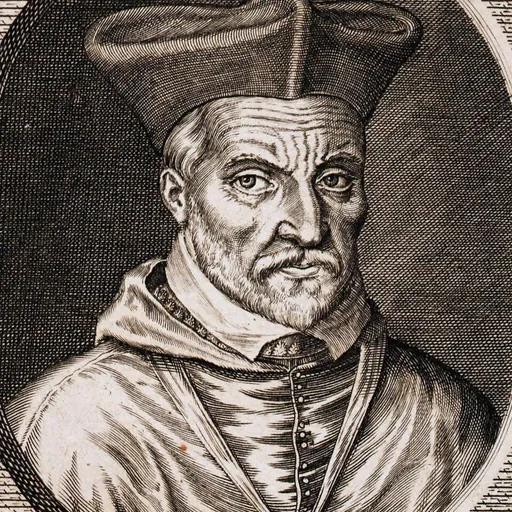
About Jacques Amyot
Lived 1513 – 1593 (aged 79). Jacques Amyot was a French catholic priest, catholic bishop, translator and writer.
Jacques Amyot (; 30 October 15136 February 1593), French Renaissance bishop, scholar, writer and translator, was born of poor parents, at Melun.
Biography Amyot found his way to the University of Paris, where he supported himself by serving some of the richer students. He was nineteen when he became M.A. at Paris, and later he graduated doctor of civil law at Bourges. Through Jacques Colure (or Colin), abbot of St. Ambrose in Bourges, he obtained a tutorship in the family of a secretary of state. By the secretary he was recommended to Margaret of France, Duchess of Berry, and through her influence was made professor of Greek and Latin at Bourges. Here he translated the Æthiopica of Heliodorus (1547), for which he was rewarded by Francis I with the abbey of Bellozane.
He was thus enabled to go to Italy to study the Vatican text of Plutarch, on the translation of whose Lives he had been some time engaged. On the way he turned aside on a mission to the Council of Trent. Returning home, he was appointed tutor to the sons of Henry II, by one of whom (Charles IX) he was afterwards made grand almoner (1561) and by the other (Henry III) was appointed, in spite of his plebeian origin, commander of the Order of the Holy Spirit. and here he continued to live in comparative quiet, repairing his cathedral and perfecting his translations, for the rest of his days, though troubled towards the close by the insubordination and revolts of his clergy. He was a devout and conscientious churchman, and had the courage to stand by his principles. It is said that he advised the chaplain of Henry III to refuse absolution to the king after the murder of the Guise princes. He was, nevertheless, suspected of approving the crime. His house was plundered, and he was compelled to leave Auxerre for some time. He died bequeathing, it is said, 1200 crowns to the hospital at Orléans for the twelve deniers he received there when "poor and naked" on his way to Paris.
It was indeed to Plutarch that Amyot devoted his attention. His other translations were subsidiary. The version of Diodorus he did not publish, although the manuscript had been discovered by him. Amyot took great pains to find and interpret correctly the best authorities, but the interest of his books today lies in the style. His translation reads like an original work. The personal method of Plutarch appealed to a generation addicted to memoirs and incapable of any general theory of history. Amyot's book, therefore, obtained an immense popularity, and exercised great influence over successive generations of French writers.
Don’t just read it —
keep it.
Full-length biographies made to live with: read them, listen on the way to work, watch them tonight.
- E-book
- Audio
- Video
Instant download · yours to keep · every purchase keeps this site free
Important facts
Related people
Same field, nearest in time



Contemporaries
People whose lives overlapped Jacques Amyot's






Frequently asked questions
Who was Jacques Amyot?
French writer (1513–1593)
When was Jacques Amyot born?
Jacques Amyot was born on 30 October 1513 in Melun, birthplace of Jacques Amyot.
When did Jacques Amyot die?
Jacques Amyot died on 6 February 1593 in Auxerre.
What was Jacques Amyot's occupation?
Jacques Amyot was a catholic priest, catholic bishop, translator and writer.
What nationality was Jacques Amyot?
Jacques Amyot was French.
Sources & further reading
Cite this page
APA: Biography.guide. (2026). Jacques Amyot. https://biography.guide/jacques-amyot/
MLA: "Jacques Amyot." Biography.guide, https://biography.guide/jacques-amyot/.
Chicago: "Jacques Amyot." Biography.guide. https://biography.guide/jacques-amyot/.
Data last updated: 2026-09-20 · Spot an error? Report a correction.
Portrait: Wikimedia Commons · author & licence
Page generated 2026-09-27 04:57 UTC