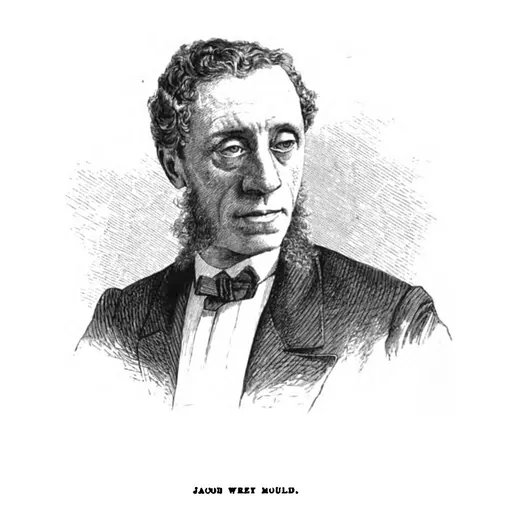
About Jacob Wrey Mould
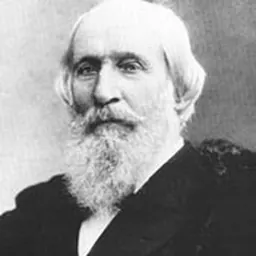
Lived 1825 – 1886 (aged 60–61). Jacob Wrey Mould was an American architect, musician, linguist, designer and illustrator.
Jacob Wrey Mould (7 August 1825 – 14 June 1886) was a British architect, illustrator, linguist and musician, noted for his contributions to the design and construction of New York City's Central Park. He was "instrumental" in bringing the British High Victorian style of architecture to the United States, and was a founding member of the American Institute of Architects.
Biography
Born in Chislehurst, Kent in 1825, Mould attended King's College School in 1842. For two years, he studied the Alhambra in Spain under Owen Jones, the "master of polychromy," with whom he later co-designed the "Turkish Chamber" of Buckingham Palace. Mould's subsequent designs were often influenced by his appreciation of the Moorish style of architecture.
Mould designed decorations for The Great Exhibition in London in 1851. He moved to the United States in 1852, and then was brought in on early plans for the great urban park in the heart of the city, Central Park. Working closely with creators Calvert Vaux and Frederick Law Olmsted, he designed many of the park's notable landmarks, including the "graceful" and "richly decorated" old Bandstand, Belvedere Castle, a great number of bridges, and the carvings on the Bethesda Terrace.
Though described as eccentric and ill-mannered, Mould was hired full-time as an assistant city architect in 1857, and from 1870 to 1871 was architect-in-chief for the Department of Public Works.
Mould's reputation was severely damaged in 1861 when it became public knowledge that he was living with a woman who was not his wife. Many of his friends stopped associating with him, including well-known lawyer and civic leader George Templeton Strong. Despite facing rejection from his old social circles, Strong and others tempered their criticism of Mould's character with acknowledgements of his artistic talent. Fortunately for Mould, the scandal did not damage his professional relationships with Olmsted or Vaux.
In 1874, Mould went to Lima, Peru, with Henry Meiggs, where he helped design a public park. He returned to New York in 1879, and resumed his duties for the Department of Public Works until his death in New York City on 14 June 1886 at age 60.
Besides being an architect and designer, Jacob Wrey Mould was a keen pianist and organist, and employed his talent for language in translating numerous foreign opera librettos into English. He is interred at Green-Wood Cemetery in Brooklyn, New York.
Don’t just read it —
keep it.
Full-length biographies made to live with: read them, listen on the way to work, watch them tonight.
- E-book
- Audio
- Video
Instant download · yours to keep · every purchase keeps this site free
Important facts
People in Jacob Wrey Mould's life
Named in this biography and alive at the same time



Related people
Same field, nearest in time

Contemporaries
People whose lives overlapped Jacob Wrey Mould's




Frequently asked questions
Who was Jacob Wrey Mould?
British-American architect
When was Jacob Wrey Mould born?
Jacob Wrey Mould was born in 1825 in Kent.
When did Jacob Wrey Mould die?
Jacob Wrey Mould died in 1886 in New York City.
What was Jacob Wrey Mould's occupation?
Jacob Wrey Mould was an architect, musician, linguist, designer and illustrator.
What nationality was Jacob Wrey Mould?
Jacob Wrey Mould was American.
Sources & further reading
Cite this page
APA: Biography.guide. (2026). Jacob Wrey Mould. https://biography.guide/jacob-wrey-mould/
MLA: "Jacob Wrey Mould." Biography.guide, https://biography.guide/jacob-wrey-mould/.
Chicago: "Jacob Wrey Mould." Biography.guide. https://biography.guide/jacob-wrey-mould/.
Data last updated: 2026-09-21 · Spot an error? Report a correction.
Portrait: Wikimedia Commons · author & licence
Page generated 2026-09-27 04:59 UTC