
Jacob C. White Jr.
American educator, intellectual, and civil rights activist
About Jacob C. White Jr.
Lived 1837 – 1902 (aged 64–65). Jacob C. White Jr. was an American educator, civil rights advocate and head teacher.
Jacob C. White Jr. (1837 – November 11, 1902) was an American educator, intellectual, and civil rights activist. Born to a successful and influential businessman, White received the finest education afforded to African Americans of the time and became intertwined in the dealings of Philadelphia's most prominent black leaders. He was the first black man in the city to be appointed as a school principal at Roberts Vaux Consolidated School. During his tenure between 1864 and 1896, White reformed the institute and became the leading figure in the field of urban education in Philadelphia.
Alongside his academic endeavors, White was significant in the sports field: he helped establish the Philadelphia Pythians, an early black baseball club. Following the shooting of his friend and fellow activist Octavius Catto in 1871, White became the top civil rights activist in the city and remained active in the community until his death in 1902.
Biography Early life and career Jacob White Jr. was born to Jacob White Sr. and Elizabeth White in 1837. His brother was George Bustill White and his sister-in-law was Emilie Davis. He was raised at 100 Old York Road in Jenkintown, a predominantly white neighborhood 10 miles (16 km) from downtown Philadelphia. According to an 1866 city directory, Jacob and George lived with their father at his home at 485 York Avenue. His father was a barber and physician who was well-respected in the black community, formerly the owner of a china shop that sold products manufactured by free black people, eschewing goods produced by slave labor. A savvy businessman, White Sr. enjoyed the benefits of profitable real estate investments, becoming an eminent figure in Philadelphia's exclusive inner circle of elite blacks. White Sr. engaged in several endeavors promoting education and was a long-time abolitionist; both of his passions were passed to the young White.
White was initially enrolled at the Lombardy Street Public School. After completing his grammar schooling, he matriculated at the Institute for Colored Youth (ICY) in 1853. Founded by the Society of Friends (Quakers), the ICY emphasized high moral standards for its students and offered a classical study of Latin, Greek, and trigonometry. While enrolled, White expressed an acute awareness of black society and psychological concepts in essays he presented. On May 24, 1855, he addressed Governor James Pollock at a special reception for the institute, touching on the issue of African-American citizenship. The same year, White was elected secretary of the Banneker Institute, a student instructional society that convened weekly to have scholarly discussions. White was his class's lone graduate from the ICY on May 6, 1857; he earned praise for his popularity among classmates and professors alike. Originally housed in the poorly ventilated basement of the Zoar Methodist Church, under White's leadership, the Vaux school moved to the building formerly housing the William D. Helley School and tripled in attendance. White's administration facilitated the integration of the educational system in Philadelphia, including the end of segregation at Central High School and Girls' Normal School. Satisfied with his accomplishments, White retired from the position in June 1896.
Philadelphia Pythians
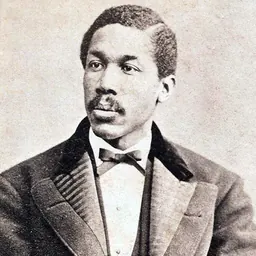
Friend and fellow rights activist, Octavius Catto, co-founded the Philadelphia Pythians with White.
During his tenure as a teacher at the ICY, White closely collaborated with Octavius Catto, an important civil rights activist and long-time friend of White's who shared a similar social group and views on education. Both men, former cricket players at the ICY, believed baseball was another outlet for African Americans to promote social reform and prove their right for full citizenship. In the spring of 1866, White and Catto established the Philadelphia Pythians, a baseball club composed mainly of men from the Knights of Pythias of North America, South America, Europe, Asia, Africa and Australia fraternal organization. Catto, a hard-hitting shortstop and second baseman, was the de facto captain on the field, while White became the team's secretary, responsible for scheduling games, arranging festivities, and recording statistics. Soon, Pythian games became a popular fixture of the black community.
On September 3, 1869, the Pythians played in the first recorded interracial baseball game. "Colonel" Thomas Fitzgerald of the Philadelphia City Item, a well-respected figure in baseball and a former owner of the Philadelphia Athletics, first proposed the idea in his newspaper to seek potential contenders. Their opponent, The Olympics, was Philadelphia's oldest ball club, having roots in the city dating back to 1832, playing town ball. Although the Pythians lost the contest 44–23, The Philadelphia Inquirer reported that the club "acquitted themselves in a very creditable manner, especially their outfielders, who made several very fine fly catches".
White and Catto petitioned, albeit unsuccessfully, to join white athletic organizations. Denied opportunities to integrate, the Pythians nonetheless developed a friendly relationship with the Philadelphia Athletics.
In June 1895, at an organizational meeting White was appointed the president of the board for the Douglass Memorial Hospital. Under his direction, he appropriated state funds for the hospital in 1898 from Alexander K. Pedrick of the State Senate. Having succeeded in procuring the funds, White resigned from his position but maintained a seat on the board until his death on November 11, 1902.
Don’t just read it —
keep it.
Full-length biographies made to live with: read them, listen on the way to work, watch them tonight.
- E-book
- Audio
- Video
Instant download · yours to keep · every purchase keeps this site free
Important facts
People in Jacob C. White Jr.'s life
Named in this biography and alive at the same time


Related people
Same field, nearest in time



Contemporaries
People whose lives overlapped Jacob C. White Jr.'s



Frequently asked questions
Who was Jacob C. White Jr.?
American educator, intellectual, and civil rights activist
When was Jacob C. White Jr. born?
Jacob C. White Jr. was born in 1837 in Philadelphia.
When did Jacob C. White Jr. die?
Jacob C. White Jr. died in 1902 in Philadelphia.
What was Jacob C. White Jr.'s occupation?
Jacob C. White Jr. was an educator, civil rights advocate and head teacher.
What nationality was Jacob C. White Jr.?
Jacob C. White Jr. was American.
Sources & further reading
· Wikipedia: Jacob C. White Jr.
Cite this page
APA: Biography.guide. (2026). Jacob C. White Jr.. https://biography.guide/jacob-c-white-jr/
MLA: "Jacob C. White Jr.." Biography.guide, https://biography.guide/jacob-c-white-jr/.
Chicago: "Jacob C. White Jr.." Biography.guide. https://biography.guide/jacob-c-white-jr/.
Data last updated: 2026-09-20 · Spot an error? Report a correction.
Page generated 2026-09-27 05:27 UTC