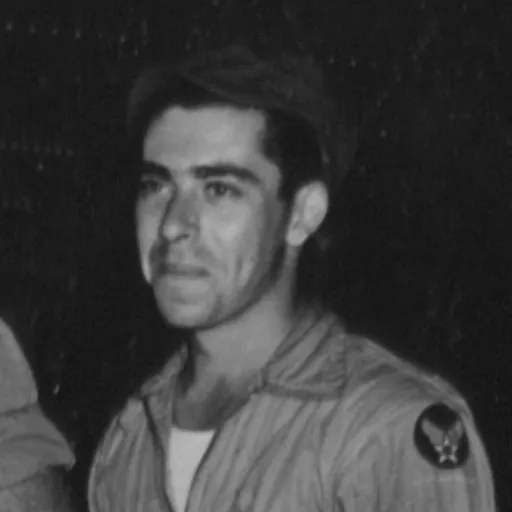
About Jacob Beser
Lived 1921 – 1992 (aged 71). Jacob Beser was an American military personnel.
Jacob Beser (May 15, 1921 – June 17, 1992) was a lieutenant in the United States Army Air Forces who served during World War II. Beser was the radar specialist aboard the Enola Gay on August 6, 1945, when it dropped the Little Boy atomic bomb on Hiroshima. Three days later, Beser would become a crewmember aboard Bockscar when the Fat Man bomb was dropped on Nagasaki. He was the only person to have served as a strike crew member of both of the 1945 atomic bomb missions.
Background Jacob Beser grew up in Baltimore, Maryland. He attended the Baltimore City College (high school) and graduated in June 1938. Beser then studied mechanical engineering at The Johns Hopkins University, also in Baltimore, but dropped out the day after the attack on Pearl Harbor to enlist in the Army Air Forces. He was Jewish and extremely restless to get into the fight against Hitler.
Because of his training and educational background, Beser was sent to Los Alamos and worked on the Manhattan Project in the area of weapons firing and fusing. There, he met or worked with various luminaries such as Robert B. Brode, Norman Ramsey, Niels Bohr, Enrico Fermi, Edward Doll, and General Leslie Groves.
Mission The 509th Composite Group, which Beser served in, was the army unit tasked with deploying the atomic bombs. To practice for the mission, they used practice bombs called "pumpkins", designed to be similar to the Fat Man atomic bomb. The unit began training on December 17, 1944, at the Wendover Army Air Field in Utah, before being deployed to the island of Tinian in May 1945. The unit's First Ordnance Squadron was responsible for handling the bombs.
On August 6, 1945, the first atomic bomb to be used in combat was dropped by a B-29 Superfortress bomber, the Enola Gay, over the Japanese city of Hiroshima, killing 70,000 people, including 20,000 Japanese combatants and 20,000 Korean slave laborers. The thirteen-hour mission to Hiroshima, under the command of pilot Colonel Paul Tibbets, began at 0245 Tinian time. By the time the Enola Gay rendezvoused with its two accompanying B-29 Superfortresses at 0607 over Iwo Jima, the group was three hours from the target area. "Little Boy's" detonation was triggered by radar sensors on the bomb that measured its altitude as it fell. Beser's job was to monitor those sensors and ensure that there was no interference that could have detonated it prematurely. The bomb fell away from the aircraft at 09:15:17 Tinian time. Beser did not watch the bomb detonate but he heard the bomb's radar signals switch on and then cut off at the moment the intense light generated by its detonation filled the plane.
Three days later, in a second B-29 Superfortress bomber, Bockscar, Beser repeated this task over Nagasaki with Fat Man, the plutonium implosion bomb that became the second and last atomic bomb used in combat. Beser was the only crew member to accompany both atomic bomb missions, and along with the commanding officers/pilots, had a scientific understanding of the new weapons' potential and destructiveness, as a result of his earlier high school and university education.
Later life In 1946, Beser was one of the founding members of Sandia National Laboratories, in New Mexico. He came home to Baltimore and in the mid-1950s began a long career working on defense projects for Westinghouse.
Beser was asked about his atomic bomb missions in numerous interviews, and responded like the following:
He wrote a book about the experiences of participating in both flights; Hiroshima & Nagasaki Revisited was written in 1988.
Beser was an amateur ("ham") radio operator, holding the callsign W3NOD.
He was inducted into the "Hall of Fame" of his alma mater high school, Baltimore City College, the third oldest public high school in America.
Military decorations His decorations include:
USAAF Technical Observer BadgeSilver StarDistinguished Flying CrossAir MedalAir Force Outstanding Unit Awardwith "V" deviceAmerican Campaign MedalAsiatic-Pacific Campaign Medalwith bronze campaign starWorld War II Victory Medal
Silver Star citation
Beser, Jacob First Lieutenant, U.S Army Air Forces 393d Bombardment Squadron, 509th Composite Group, 20th Air Force Date of Action: August 6, 1945 Headquarters, 20th Air Force, General Orders No. 69 (September 22, 1945) Citation:
Don’t just read it —
keep it.
Full-length biographies made to live with: read them, listen on the way to work, watch them tonight.
- E-book
- Audio
- Video
Instant download · yours to keep · every purchase keeps this site free
Important facts
People in Jacob Beser's life
Named in this biography and alive at the same time




Related people
Same field, nearest in time



Contemporaries
People whose lives overlapped Jacob Beser's

Frequently asked questions
Who was Jacob Beser?
US Air Force officer (1921-1992)
When was Jacob Beser born?
Jacob Beser was born on 15 May 1921 in Baltimore.
When did Jacob Beser die?
Jacob Beser died on 17 June 1992 in Pikesville.
What was Jacob Beser's occupation?
Jacob Beser was a military personnel.
What nationality was Jacob Beser?
Jacob Beser was American.
Sources & further reading
Cite this page
APA: Biography.guide. (2026). Jacob Beser. https://biography.guide/jacob-beser/
MLA: "Jacob Beser." Biography.guide, https://biography.guide/jacob-beser/.
Chicago: "Jacob Beser." Biography.guide. https://biography.guide/jacob-beser/.
Data last updated: 2026-09-21 · Spot an error? Report a correction.
Portrait: Wikimedia Commons · author & licence
Page generated 2026-09-27 05:00 UTC