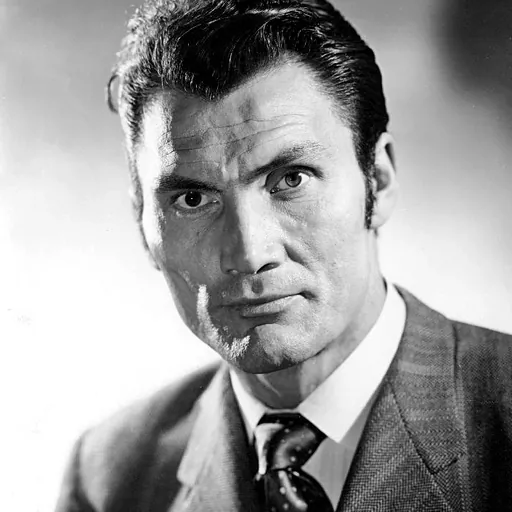
About Jack Palance
Lived 1919 – 2006 (aged 87). Jack Palance was an American film actor, stage actor, television actor, boxer, model and actor.
Walter Jack Palance ( ; born Volodymyr Palahniuk; February 18, 1919 – November 10, 2006) was an American actor. He was nominated for three Academy Awards, all for Best Actor in a Supporting Role, for his roles in Sudden Fear and Shane (1953), and winning almost 40 years later for City Slickers (1991).
Born in Lattimer Mines, Pennsylvania, the son of Ukrainian immigrants, Palance served in the United States Army Air Forces during World War II. He attended Stanford University before pursuing a career in the theater, winning a Theatre World Award in 1951. He made his film acting debut in Elia Kazan's Panic in the Streets (1950), and earned Oscar nominations for Sudden Fear and Shane, his third and fourth film roles. He also won an Emmy Award for a 1957 teleplay Requiem for a Heavyweight.
Subsequently, Palance played a variety of both supporting and leading film roles, often appearing in crime dramas and Westerns. Beginning in the late 1950s, he would work extensively in Europe, notably in a memorable turn as a charismatic-but-corrupting Hollywood mogul in Jean-Luc Godard's 1963 film Contempt. He played the title character in the 1973 television film Bram Stoker's Dracula, which influenced future depictions of the character. During the 1980s, he became familiar to a new generation of audiences by hosting the television series Ripley's Believe It or Not! (1982–86). His newfound popularity spurred a late-career revival, and he played high-profile villain roles in the blockbusters Young Guns (1988) and Tango & Cash (1989), and culminating in his Oscar and Golden Globe–winning turn as Curly in City Slickers.
Off-screen, he was involved in efforts in support of the Ukrainian American community and served as a chairman of the Hollywood Trident Foundation.
Early life Palance was born Volodymyr Palahniuk on February 18, 1919, in Lattimer Mines, Pennsylvania, the son of Anna (née Gramiak) and Ivan Palahniuk, an anthracite coal miner. his father a native of Ivane-Zolote in southwestern Ukraine (modern Ternopil Oblast) and his mother from the Lviv Oblast. One of six children, he worked in coal mines during his youth before becoming a professional boxer in the late 1930s.
Boxing under the name Jack Brazzo, Palahniuk lost his only recorded match, in a four-round decision on points, to the future heavyweight contender Joe Baksi in a Pier-6 brawl rough fight. Other sources record him winning 15 consecutive club fights, with 12 knockouts. Years later he recounted: "Then I thought, 'You must be nuts to get your head beat in for $200.' The theater seemed a lot more appealing."
World War II Palance enlisted in the United States Army Air Forces during World War II, and was trained as a pilot. He was discharged in 1944 after undergoing reconstructive surgery, which contributed to his distinctively gaunt appearance.
After the war, Palance enrolled at Stanford to study journalism, but switched to drama. During his university years, he worked as a short order cook, waiter, soda jerk, lifeguard at Jones Beach State Park, and photographer's model.
It was around this time that he changed his name to Walter Jack Palance, reasoning that most people could not pronounce his birth name and deriving his new surname from the original one. In an episode of What's My Line?, he described how no one could pronounce his last name, and how it was suggested that he be called Palansky. From that he decided just to use Palance instead.
Early acting career A Streetcar Named Desire In New York City, Palance studied method acting under Michael Chekhov, while working as a sportswriter. He made his Broadway debut in 1947 as a Russian soldier in The Big Two, directed by Robert Montgomery.
Palance's acting break came as Marlon Brando's understudy in A Streetcar Named Desire, and he eventually replaced Brando on stage as Stanley Kowalski.
Palance appeared in two plays in 1948 with short runs, A Temporary Island and The Vigil. He made his television debut in 1949.
Film career Palance made his big-screen debut in Panic in the Streets (1950), directed by Elia Kazan, who had directed Streetcar on Broadway. He played a gangster, and was credited as "Walter (Jack) Palance".
That year he was featured in Halls of Montezuma (1951), about United States Marines during World War II. He returned to Broadway for Darkness at Noon (1951) by Sidney Kingsley, which was a minor hit.
Two Oscar nominations Palance was second-billed in just his third film, opposite Joan Crawford in the thriller Sudden Fear (1952). His character is a former coal miner, as Palance's father had been. Palance received an Oscar nomination for Best Supporting Actor.
He was nominated in the same category the following year for his role as hired gunfighter Jack Wilson in Shane (1953). The film was a huge hit, and Palance became an established film name.
Stardom Palance played a villain in Second Chance opposite Robert Mitchum, and was a Native American in Arrowhead (both 1953). He got a chance to play a heroic role in Flight to Tangier (1953), a thriller.
He played the lead in Man in the Attic (1953), an adaptation of The Lodger. He was Attila the Hun in Sign of the Pagan with Jeff Chandler, and Simon Magus in the Ancient World epic The Silver Chalice (both 1954) with Paul Newman (who disowned his participation in the film).
He had the star part in I Died a Thousand Times (1955), a remake of High Sierra, and was cast by Robert Aldrich in two star parts: The Big Knife (1955), from the play by Clifford Odets, as a Hollywood star; and Attack (1956), as a tough soldier in World War II. In 1955, he had an operation for appendicitis.
Palance was in a Western, The Lonely Man (1957), playing the father of Anthony Perkins, and played a double role in House of Numbers (1957). In 1957, Palance won an Emmy Award for best actor for his portrayal of Mountain McClintock in the Playhouse 90 production of Rod Serling's Requiem for a Heavyweight.
International star Warwick Films hired Palance to play the hero in The Man Inside (1958), shot in Europe. He was reunited with Robert Aldrich and Jeff Chandler when they worked on Ten Seconds to Hell (1959), filmed in West Germany, playing a bomb disposal expert. Palance on the set with Sharon Tate during the filming of Barabbas (1961). He made Beyond All Limits (1959) in Mexico, and Austerlitz (1960) in France, then did a series of films in Italy: Revak the Rebel, Sword of the Conqueror, The Mongols, The Last Judgment, and Barabbas (all 1961), and Night Train to Milan and Warriors Five (both 1962). Jean-Luc Godard persuaded Palance to take on the role of Hollywood producer Jeremy Prokosch in the nouvelle vague movie Le Mépris (1963) with Brigitte Bardot. Although the main dialogue was in French, Palance spoke mostly English.
Return to Hollywood Palance returned to the U.S. to star in the TV series The Greatest Show on Earth (1963–64). The series only lasted one season, and the 30th and final episode. "You're All Right, Ivy," which starred Buster Keaton, also marked Palance's debut as a director. "For Keaton it was one of his peaks as an actor, an unforgettable role, and for Palance, an artist and a poet as well as an actor, it was the only time in his life that he ever tried directing anything."
In 1964, his presence at a recently integrated movie theater in Tuscaloosa, Alabama, prompted a riot from segregationists who assumed Palance was there to promote civil rights.
He played a gangster in Once a Thief (1965) with Alain Delon. In the following year he appeared in the television film Alice Through the Looking Glass, directed by Alan Handley, in which he played the Jabberwock, and had a featured role opposite Lee Marvin and Burt Lancaster in the Western adventure The Professionals. Palance guest-starred in The Man from U.N.C.L.E., and the episodes were released as a film, The Spy in the Green Hat (1967). He went to England to make Torture Garden (1967), and made Kill a Dragon (1968) in Hong Kong.
Palance provided narration for the 1967 documentary And Still Champion! The Story of Archie Moore. He was in the TV film The Strange Case of Dr. Jekyll and Mr. Hyde produced by Dan Curtis, during the making of which he fell and injured himself.
In 1969, Palance recorded a country music album in Nashville, released on Warner Bros. Records. It featured his self-penned song "The Meanest Guy that Ever Lived". The album was re-released on CD in 2003 by the Water label (Water 119). His films were often international co-productions by this time: They Came to Rob Las Vegas, The Mercenary (both 1968), The Desperados, and Marquis de Sade: Justine (both 1969).
Palance had a part in the Hollywood blockbuster Che! (1969) playing Fidel Castro opposite Omar Sharif in the title role, but the film flopped. Palance went back to action films and Westerns: Battle of the Commandos (1970), The McMasters (1970) and Compañeros (1970).
Palance had another role in Monte Walsh (1970), from the author of Shane, opposite Lee Marvin, but the film was a box-office disappointment. So too was The Horsemen (1971) with Sharif, directed by John Frankenheimer. He supported Bud Spencer in It Can Be Done Amigo and Charles Bronson in Chato's Land (both 1972), and had the lead in Sting of the West (1972) and Brothers Blue (1973).
In Great Britain he appeared in a highly acclaimed TV film, Bram Stoker's Dracula (1973), in the title role; it was directed by Dan Curtis. Three years earlier, comic book artist Gene Colan had based his interpretation of Dracula for the acclaimed Marvel Comics comic book series The Tomb of Dracula on Palance, explaining, "He had that cadaverous look, a serpentine look on his face. I knew that Jack Palance would do the perfect Dracula."
Palance went back to Hollywood for Oklahoma Crude (1973) then to England to star in Craze (1974). He starred in the television series Bronk between 1975 and 1976 for MGM Television, and starred in the TV films The Hatfields and the McCoys (1975) and The Four Deuces (1976).
Italy In the late 1970s, Palance was mostly based in Italy. He supported Ursula Andress in Africa Express and The Sensuous Nurse, Lee Van Cleef in God's Gun, and Thomas Milian in The Cop in Blue Jeans (all 1976). He was in Black Cobra Woman; Safari Express, a sequel to Africa Express; Mister Scarface; and Blood and Bullets (all 1976). He traveled to Canada to make Welcome to Blood City (1977) and the US for The One Man Jury (1978), Portrait of a Hitman and Angels Revenge (both 1979).
Palance later said his Italian sojourn was the most enjoyable of his career. "In Italy, everyone on the set has a drinking cubicle, and no one is ever interested in working after lunch", he said. "That's a highly civilized way to make a movie."
Return to the U.S. and Ripley's Believe It or Not! In 1980, Jack Palance narrated the documentary The Strongest Man in the World by Canadian filmmaker Halya Kuchmij, about Mike Swistun, a circus strongman who had been a student of Houdini. Palance attended the premiere of the film on June 6, 1980, at the Winnipeg Art Gallery. He appeared in The Ivory Ape (1980), Without Warning (1980), Hawk the Slayer (1980), and the slasher film, Alone in the Dark (1982).
In 1982, Palance began hosting a television revival of Ripley's Believe It or Not!. The weekly series ran from 1982 to 1986 on the American ABC network. The series also starred three different co-hosts from season to season, including Palance's daughter Holly Palance, actress Catherine Shirriff and singer Marie Osmond. Ripley's Believe It or Not! was in rerun syndication on the Sci-fi Channel (UK) and the Sci-fi Channel (U.S.) during the 1990s. He appeared in the films Gor and Bagdad Café (both 1987).
Later career Career revival
Palance had never been out of work since his career began, but his success on Ripley's Believe It or Not! and the international popularity of Bagdad Cafe (1987) created a new demand for his services in big-budget Hollywood films.
He made memorable appearances as villains in Young Guns (1988) as Lawrence Murphy, Tango & Cash (1989) and Tim Burton's Batman (1989). He also performed on Roger Waters' first solo album release, The Pros and Cons of Hitch Hiking (1984), and was in Outlaw of Gor (1988) and Solar Crisis (1990).
City Slickers Palance was then cast as cowboy Curly Washburn in the 1991 comedy City Slickers, directed by Ron Underwood. He quipped:I don't go to California much any more. I live on a farm in Pennsylvania, about 100 miles from New York, so I can go into the city for dinner and a show when I want to. I also have a ranch about two hours from Los Angeles, but I don't go there very often at all...But I will always read a decent script when it is offered, and the script to City Slickers made sense. Curly (his character in the film) is the kind of man I would like to be. He is in control of himself, except for deciding the moment of his own death. Besides all that, I got paid pretty good money to make it.
Four decades after his film debut, Palance won an Academy Award for Best Supporting Actor on March 30, 1992, for his performance as Curly. Stepping onstage to accept the award, the actor looked down at Oscar host Billy Crystal (who was also his co-star in the movie) and joked, mimicking one of his lines from the film, "Billy Crystal ... I crap bigger than him." He then dropped to the floor and demonstrated his ability, at the age of 73, to perform one-armed push-ups.
The audience loved the moment and host Crystal turned it into a running gag. At various points in the broadcast, Crystal announced that Palance was "backstage on the StairMaster", had bungee-jumped off the Hollywood sign, had rendezvoused with the space shuttle in orbit, had fathered all the children in a production number, had been named People magazine's "Sexiest Man Alive", and had won the New York primary election. At the end of the broadcast Crystal said he wished he could be back next year, but "I've just been informed Jack Palance will be hosting."
Years later, Crystal appeared on Inside the Actors Studio and fondly recalled that, after the Oscar ceremony, Palance approached him during the reception: "He stopped me and put his arms out and went, 'Billy Crystal, who thought it would be you?' It was his really funny way of saying thank you to a little New York Jewy guy who got him the Oscars."
In 1993, during the opening of the Oscars, a spoof of that Oscar highlight featured Palance appearing to drag in an enormous Academy Award statuette with Crystal again hosting, riding on the rear end of it. Halfway across the stage, Palance dropped to the ground as if exhausted, but then performed several one-armed push-ups before regaining his feet and dragging the giant Oscar the rest of the way across the stage.
He appeared in Cyborg 2 (1993); Cops & Robbersons (1994) with Chevy Chase; City Slickers II: The Legend of Curly's Gold (1994); and on TV in Buffalo Girls (1995). He also voiced Rothbart in the 1994 animated film The Swan Princess.
Final years Palance's final films included Ebenezer (1998), a TV Western version of Charles Dickens's classic A Christmas Carol, with Palance as Scrooge; Treasure Island (1999); Sarah, Plain and Tall: Winter's End (2000); and Prancer Returns (2001).
Palance, at the time chairman of the Hollywood Trident Foundation, walked out of a Russian Film Festival in Hollywood in 2004. After being introduced, Palance said, "I feel like I walked into the wrong room by mistake. I think that Russian film is interesting, but I have nothing to do with Russia or Russian film. My parents were born in Ukraine: I'm Ukrainian. I'm not Russian. So, excuse me, but I don't belong here. It's best if we leave." Palance was awarded the title of "People's Artist" by Vladimir Putin, president of Russia; however, Palance refused it.
Palance enjoyed raising cattle on his ranch in the Tehachapi Mountains. He gave up eating red meat after working on his ranch, commenting that he couldn't eat a cow.
He acknowledged a lifelong attachment to his Pennsylvania heritage and visited there when able. Shortly before his death, he sold his farm in Butler Township and put his art collection up for auction.
Death Palance died at the age of 87 from natural causes at his daughter Holly's house in Montecito, California, on November 10, 2006. Following his death, a memorial service was held at St. Michael's Ukrainian Catholic Church in Hazleton, Pennsylvania.
Legacy
Palance has a star on the Hollywood Walk of Fame at 6608 Hollywood Boulevard.
In 1992, he was inducted into the Western Performers Hall of Fame at the National Cowboy & Western Heritage Museum in Oklahoma City, Oklahoma.
According to writer Mark Evanier, comic book creator Jack Kirby modeled his character Darkseid on the actor.
The Lucky Luke 1956 comic Lucky Luke contre Phil Defer by Morris features a villain named Phil Defer who is a caricature of Jack Palance.
The song "And now we dance" by punk band The Vandals features the lyrics, "Come on and do one hand pushups just like Jack Palance."
American comedian Bill Hicks incorporated a reference to Palance in one of his most famous routines, likening Palance's character in Shane to how he views the United States' role in international warfare.
Novelist Donald E. Westlake stated that he sometimes imagined Palance as the model for the career-criminal character Parker he wrote in a series of novels under the name Richard Stark.
In 2023, Palance was inducted into the Luzerne County Arts & Entertainment Hall of Fame. He was included among the inaugural class of inductees.
Filmography Films Year Title Role Director Notes 1950 Panic in the Streets "Blackie" Elia Kazan 1951 Halls of Montezuma "Pigeon" Lane Lewis Milestone 1952 Sudden Fear Lester Blaine David Miller Nominated—Academy Award for Best Supporting Actor 1953 Shane Jack Wilson George Stevens Second Chance "Cappy" Gordon Rudolph Maté Arrowhead Toriano Charles Marquis Warren Flight to Tangier Gil Walker Man in the Attic Slade Hugo Fregonese 1954 Sign of the Pagan Attila Douglas Sirk The Silver Chalice Simon The Magician Victor Saville 1955 Kiss of Fire "El Tigre" Joseph M. Newman I Died a Thousand Times Roy Earle / Roy Collins Stuart Heisler The Big Knife Charles Castle Robert Aldrich 1956 Attack Lieutenant Joe Costa – Fox Company 1957 The Lonely Man Jacob Wade Henry Levin House of Numbers Arnie Judlow / Bill Judlow Russell Rouse 1958 The Man Inside Milo March John Gilling 1959 Ten Seconds to Hell Eric Koertner Robert Aldrich Beyond All Limits Jim Gatsby Roberto Gavaldón 1960 Austerlitz General Franz von Weyrother Abel Gance The Barbarians Revak Rudolph Maté 1961 Sword of the Conqueror Alboin Carlo Campogalliani The Mongols Ogotaï Andre de Toth The Last Judgment Matteoni Vittorio De Sica Barabbas Torvald Richard Fleischer 1962 Night Train to Milan Bauer / Schneider Marcello Baldi Warriors Five Jack Leopoldo Savona 1963 Contempt Jeremy Prokosch Jean-Luc Godard 1965 Once a Thief Walter Pedak Ralph Nelson 1966 The Professionals Raza Richard Brooks 1967 Torture Garden Ronald Wyatt Freddie Francis (segment 4 "The Man Who Collected Poe") Kill a Dragon Rick Masters Michael Moore 1968 Madigan's Millions Matteo Cirini Stanley Prager (voice of Riccardo Garrone in the English-language version, uncredited) They Came to Rob Las Vegas Douglas Antonio Isasi-Isasmendi The Mercenary "Curly" Ricciolo Sergio Corbucci 1969 The Desperados Parson Josiah Galt Henry Levin A Bullet for Rommel Major John Heston León Klimovsky Marquis de Sade: Justine Father Antonin Jesús Franco Che! Fidel Castro Richard Fleischer Legion of the Damned Colonel Charley MacPherson Umberto Lenzi 1970 The McMasters Kolby Alf Kjellin Monte Walsh Chet Rollins William A. Fraker Compañeros John Sergio Corbucci 1971 Horsemen Tursen John Frankenheimer 1972 It Can Be Done, Amigo Sonny Bronston Maurizio Lucidi Chato's Land Captain Quincey Whitmore Michael Winner Sting of the West Buck Santini Enzo G. Castellari And So Ends The Narrator (voice) Robert Young 1973 Brothers Blue Captain Hillman Luigi Bazzoni Oklahoma Crude Hellman Stanley Kramer 1974 Craze Neal Mottram Freddie Francis Dan Curtis' Dracula Count Dracula Dan Curtis 1975 The Four Deuces Victor "Vic" Morono William H. Bushnell The Great Adventure William Bates Gianfranco Baldanello Africa Express Robert Preston / William Hunter Michele Lupo The Sensuous Nurse Mr. Kitch Nello Rossati 1976 God's Gun Sam Clayton Gianfranco Parolini The Cop in Blue Jeans Norman Shelley / Richard J. Russo Bruno Corbucci Black Cobra Woman Judas Carmichael Joe D'Amato Safari Express Van Daalen Duccio Tessari Mister Scarface "Scarface" Manzari Fernando Di Leo Blood and Bullets Duke Alfonso Brescia 1977 Welcome to Blood City Frendlander Peter Sasdy 1978 The One Man Jury Lieutenant Wade Charles Martin 1979 Angels' Brigade Mike Farrell Greydon Clark The Shape of Things to Come Omus George McCowan Portrait of a Hitman Jim Buck Allan A. Buckhantz Cocaine Cowboys Raphael Ulli Lommel 1980 Without Warning Joe Taylor Greydon Clark Hawk the Slayer Voltan Terry Marcel 1982 Alone in the Dark Frank Hawkes Jack Sholder 1987 Gor Xenos Fritz Kiersch Bagdad Café Rudi Cox Percy Adlon 1988 Young Guns Lawrence Murphy Christopher Cain Outlaw of Gor Xenos John Cardos 1989 Batman Carl Grissom Tim Burton Tango & Cash Yves Perret Andrei Konchalovsky 1990 Solar Crisis Colonel Travis James Richards Richard C. Sarafian 1991 City Slickers "Curly" Washburn Ron UnderwoodAcademy Award for Best Supporting ActorAmerican Comedy Award for Funniest Supporting Actor in a Motion PictureGolden Globe Award for Best Supporting Actor – Motion Picture Nominated—Chicago Film Critics Association Award for Best Supporting Actor 1992 Eli's Lesson Old Pilot Peter D. Marshall 1993 Cyborg 2 Mercy Michael Schroeder 1994 Cops & Robbersons Detective Jake Stone Michael Ritchie City Slickers II: The Legend of Curly's Gold Duke Washburn Paul Weiland The Swan Princess Rothbart Richard Rich Voice, animated film 1998 The Incredible Adventures of Marco Polo Beelzebub George Erschbamer 1999 Treasure Island Long John Silver Peter Rowe 2001 Prancer Returns Old Man Richards Joshua Butler Direct to DVD 2003 Between Hitler and Stalin The Narrator Slavko Nowytski Voice
Television
Series Year Title Role Notes 1950 Lights Out Unknown Role Episode: "The Man Who Couldn't Remember"1952 Westinghouse Studio One Unknown Role Episode: "The King in Yellow" Curtain Call Unknown Role Episode: "Azaya" Westinghouse Studio One Unknown Role Episode: "Little Man, Big World" The Gulf Playhouse Unknown Role Episode: "Necktie Party" 1953 Danger Unknown Role Episode: "Said the Spider to the Fly" The Web Unknown Role Episode: "The Last Chance" Suspense Tom Walker Episode: "The Kiss-Off" The Motorola Television Hour Scott Malone / Kurt Bauman Episode: "Brandenburg Gate" Suspense Unknown Role Episode: "Cagliostro and the Chess Player" 1955 What's My Line Himself 1 episode 1956 Playhouse 90 Harlan "Mountain" McClintock Episode: "Requiem for a Heavyweight"Emmy Award for Best Single Performance by an Actor Dick Powell's Zane Grey Theatre Dan Morgan Episode: "The Lariat" opposite Constance Ford 1957 Playhouse 90 Monroe Stahr "The Last Tycoon" Manolete "The Death of Manolete" 1963 The Greatest Show on Earth Circus Manager Johnny Slate Series – top billing, 30 episodes 1964 What's My Line Himself Mystery guest 1965 Convoy Harvey Bell Episode: "The Many Colors of Courage" 1966 Run for Your Life Julian Hays Episode: "I Am the Late Diana Hays" Alice Through the Looking Glass Jabberwock (Live Theatre) The Man from U.N.C.L.E. Louis Strago 2 episodes "The Concrete Overcoat Affair: Parts I and II" (reedited as The Spy in the Green Hat) 1971 Net Playhouse President Jackson "Trail of Tears" 1973 The Sonny & Cher Comedy Hour Himself 1975–1976 Bronk Lieutenant Alex "Bronk" Bronkov Series – top billing, 25 episodes 1979 Buck Rogers in the 25th Century Kaleel Episode: "Planet of the Slave Girls" Unknown Powers Presenter / The Narrator 1981 Tales of the Haunted Stokes Episode: "Evil Stalks This House" 1982–1986 Ripley's Believe It or Not! Himself / Host Series 2001 Night Visions Jake Jennings Segment: "Bitter Harvest"
Movies/miniseries Year Title Role Notes 1956 Requiem for a Heavyweight Harlan "Mountain" McClintock 1966 Alice Through the Looking Glass Jabberwock 1968 The Strange Case of Dr. Jekyll and Mr. Hyde Dr. Henry Jekyll / Mr. Edward Hyde 1974 Bram Stoker's Dracula Count Dracula The Godchild Rourke 1975 The Hatfields and the McCoys Anderson "Devil Anse" Hatfield 1979 The Last Ride of the Dalton Gang Will Smith 1980 The Ivory Ape Marc Kazarian The Golden Moment: An Olympic Love Story "Whitey" Robinson 1981 Evil Stalks This House Stokes 1992 Keep the Change Overstreet 1994 Twilight Zone: Rod Serling's Lost Classics Dr. Jeremy Wheaton (segment "Where the Dead Are") 1995 Buffalo Girls Bartle Bone 1997 I'll Be Home for Christmas Bob 1998 Ebenezer Ebenezer Scrooge 1999 Sarah, Plain and Tall: Winter's End John Witting 2001 Living With the Dead Allan Van Praagh 2004 Back When We Were Grownups Paul "Poppy" Davitch (final film role)
Stage Year Title Role Venue Ref. 1947 The Big Two Russian soldier Booth Theatre, Broadway 1948 A Temporary Island Mr. Boutourlinsky Maxine Elliott's Theatre, Broadway 1948 The Vigil Simon Royale Theatre, Broadway 1948 A Streetcar Named Desire Stanley Kowalski (understudy, replacement) Ethel Barrymore Theatre, Broadway 1951 Darkness at Noon Gletkin Alvin Theatre, Broadway Royale Theatre, Broadway 1955 Julius Caesar Cassius American Shakespeare Theatre, Connecticut 1955 The Tempest Caliban American Shakespeare Theatre, Connecticut 1951 Outstanding New York City Stage Debut Darkness at Noon WorldFest Flagstaff 1998 Lifetime Achievement Award Online Film & Television Association Award 2004 Best Supporting Actor in a Motion Picture or Miniseries Back When We Were Grownups 20/20 Award 2012 Best Supporting Actor City Slickers
Discography Palance, Warner Bros, 1969
Don’t just read it —
keep it.
Full-length biographies made to live with: read them, listen on the way to work, watch them tonight.
- E-book
- Audio
- Video
Instant download · yours to keep · every purchase keeps this site free
Important facts
Family & relationships
People in Jack Palance's life
Named in this biography and alive at the same time







Related people
Same field, nearest in time



Contemporaries
People whose lives overlapped Jack Palance's


Frequently asked questions
Who was Jack Palance?
American actor (1919–2006)
When was Jack Palance born?
Jack Palance was born on 18 February 1919 in Lattimer.
When did Jack Palance die?
Jack Palance died on 10 November 2006 in Montecito.
What was Jack Palance's occupation?
Jack Palance was a film actor, stage actor, television actor, boxer, model and actor.
What nationality was Jack Palance?
Jack Palance was American.
Sources & further reading
Cite this page
APA: Biography.guide. (2026). Jack Palance. https://biography.guide/jack-palance/
MLA: "Jack Palance." Biography.guide, https://biography.guide/jack-palance/.
Chicago: "Jack Palance." Biography.guide. https://biography.guide/jack-palance/.
Data last updated: 2026-09-23 · Spot an error? Report a correction.
Portrait: Wikimedia Commons · author & licence
Page generated 2026-09-27 05:05 UTC