
About J. Warren Madden
Lived 1890 – 1972 (aged 82). J. Warren Madden was an American lawyer and judge.
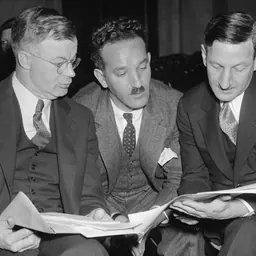
Joseph Warren Madden (January 17, 1890 – February 17, 1972) was an American lawyer, judge, civil servant, and educator. He served as a judge of the United States Court of Claims and was the first Chairman of the National Labor Relations Board (serving from August 27, 1935 to August 26, 1940). His father was a somewhat wealthy farmer. His legal specialties were domestic relations, property law, and torts, and he had no background in labor law. In 1917, he was appointed a Professor of Law at the Ohio State University Moritz College of Law. During this time, he served on several federal commissions, including an arbitration panel which settled a strike by 1,800 streetcar conductors in Pittsburgh, Pennsylvania, in 1934.
During his time on the NLRB, Madden was often opposed by the American Federation of Labor (AFL), which believed that Madden was using the National Labor Relations Act (NLRA; the primary federal law governing labor relations in the United States) and the procedures and staff of the NLRB to favor the AFL's primary competitor, the Congress of Industrial Organizations (CIO). The NLRB and NLRA were under intense pressure from employers, the press, Congressional Republicans, and conservative Democrats. From the time it was established in August 1935, management lawyers had challenged the constitutionality of the NLRA and the authority of the NLRB to act. But the Board and Justice Department also realized that the Court's Lochner era legal philosophy made it unlikely that the Court would uphold the Act. Subsequently, Madden strove to resolve minor cases before they could become court challenges, and worked to delay appeals as long as possible until the best possible case could be brought to the Court. The ruling marked the Court's abandonment of Lochner era jurisprudence and led to a series of cases upholding New Deal legislation.
Madden continued to strategically guide the NLRB's legal efforts to strengthen the courts' view of the NLRA and the Board's actions. But other unions sought to organize workers on an industry-wide basis (industrial unionism) to create more powerful unions as well as to take advantage of changes in the workplace that mass production and increases in corporate size were making. Initially, the NLRB held in 1937 that workers themselves should determine whether they wished to be organized by craft or industry, a compromise acceptable to both the AFL and the CIO. The AFL, never a strong proponent of the NLRA, had proposed amending the law in early 1936. The allegations were true, in at least one case: Nathan Witt, the NLRB's executive secretary and the man to whom Madden had delegated most administrative functions, was a member of the Communist Party of the United States. Witt had extensive influence among the staff, was close to Board Member Edwin S. Smith, and had influenced procedural matters on the Board in favor of the CIO in at least a few instances. Leiserson forced Madden to appoint a personnel director and a trial examiner to reduce Witt's power, and unsuccessfully sought Witt's dismissal and a significant reduction in the Board's legal staff.
On March 7, 1940, the Smith Committee proposed legislation which would have abolished the NLRB, reconstituted it, and radically amended the NLRA. Leiserson came out in favor of the changes, and accused Madden of administrative incompetence. President Roosevelt opposed the bill, although he conceded that perhaps the Board's membership should be expanded to five from three.
On March 21, the press reported that a study by four NLRB regional directors highly critical of Madden's administration of the Board had been suppressed (an action Madden vehemently denied).
The Smith bill won several early tests in the House, which also voted to substantially cut the NLRB's budget. Smith won a snap vote in the House Rules Committee permitting him to bring his bill directly to the floor for a vote and bypass the committee process (where Roosevelt and his House allies had intended to bottle up the bill). In an attempt to defuse the legislative crisis, Madden fired 53 staff and forced another five to resign, and decentralized the NLRB's trial process to give regional directors and field agents more authority. But the House easily passed the Smith bill by a vote of 258 to 129 on June 7, 1940. To protect the NLRB, Roosevelt convinced Senator Elbert D. Thomas, Chairman of the Senate Committee on Education and Labor, to hold no hearings or votes on the bill, and the legislation died. He was confirmed by the United States Senate on January 2, 1941, and received his commission on January 7, 1941. But Roosevelt's confidantes were urging the president to "dump Madden" as a political liability On October 9, 1940, Secretary of Labor Perkins announced Madden would go to Canada to study that country's problems in boosting defense production. Finally, on November 15, 1940, President Roosevelt nominated Harry A. Millis to the post of Chairman of the NLRB, and nominated Madden to a seat on the United States Court of Claims.
Although the United States Senate Committee on the Judiciary favorably reported Madden's nomination to the floor (almost without discussion or comment), Republican Senators Robert A. Taft and Arthur H. Vandenberg, along with other Republicans, attempted to hold up the nomination on procedural grounds as a means of expressing their anger at what they believed was Madden's pro-labor administration of the National Labor Relations Act. Senator Taft intended to deny Madden's nomination a vote on the Senate floor, arguing that the Judiciary Committee had approved the nomination via telephone voice vote and telegram rather than at a face-to-face meeting.
Although J. Warren Madden had served on the NLRB for only five years, at least one observer concluded that Madden "chose to make a record of vigorous enforcement of the Act unmatched in the history of administrative agencies."
Wartime service
Madden was permitted to temporarily leave the bench in 1945 to assist the United States Department of War and the United States Army in various legal capacities associated with the Allied administration of occupied Germany in the wake of World War II. and for his service received the Medal of Freedom in 1947. He also was part of a team which traveled with Generals Dwight Eisenhower and Lucius D. Clay to the Potsdam Conference to provide legal assistance. Madden was often designated to sit on various United States courts of appeals when workload or vacancies threatened to impede an appellate court's function or his expertise was required. In 1958, sitting on an appellate court, Madden wrote an opinion which held that United States courts had no jurisdiction over claims by American banks that they had lost money in the Russian Revolution of 1917.
Later service and death
Madden and his wife, Margaret L. Madden, lived in San Francisco, California, where he taught at the University of California, Hastings College of the Law. Madden died in his sleep of natural causes on February 17, 1972, in San Francisco. He was survived by his wife and four children.
Don’t just read it —
keep it.
Full-length biographies made to live with: read them, listen on the way to work, watch them tonight.
- E-book
- Audio
- Video
Instant download · yours to keep · every purchase keeps this site free
Important facts
People in J. Warren Madden's life
Named in this biography and alive at the same time

Related people
Same field, nearest in time


Contemporaries
People whose lives overlapped J. Warren Madden's


Frequently asked questions
Who was J. Warren Madden?
American judge (1890-1972)
When was J. Warren Madden born?
J. Warren Madden was born on 17 January 1890 in Waddams Township.
When did J. Warren Madden die?
J. Warren Madden died on 17 February 1972 in San Francisco.
What was J. Warren Madden's occupation?
J. Warren Madden was a lawyer and judge.
What nationality was J. Warren Madden?
J. Warren Madden was American.
Sources & further reading
Cite this page
APA: Biography.guide. (2026). J. Warren Madden. https://biography.guide/j-warren-madden/
MLA: "J. Warren Madden." Biography.guide, https://biography.guide/j-warren-madden/.
Chicago: "J. Warren Madden." Biography.guide. https://biography.guide/j-warren-madden/.
Data last updated: 2026-09-20 · Spot an error? Report a correction.
Page generated 2026-09-27 05:28 UTC