
About J. F. R. Jacob
Lived 1923 – 2016 (aged 92–93). J. F. R. Jacob was an Indian politician.
Early life Jacob was born in Calcutta to a deeply religious Baghdadi Jewish family originally from Iraq which had settled in Calcutta in the mid-19th century. His father, Elias Emanuel, was an affluent businessman. After his father became sick, Jacob was sent at the age of nine to Victoria Boys' School, a boarding school in Kurseong near Darjeeling. From then on, he went home only during school holidays. He was initially posted to northern Iraq in anticipation of a possible German attempt to seize the oil fields of Kirkuk, and was promoted war-substantive lieutenant on 7December. In the wake of Japan's defeat, he was assigned to Sumatra. After World War II, he attended and graduated from artillery schools in England and the United States, specialising in advanced artillery and missiles. As the first commanding officer, he raised 3 Field Regiment on 14 May 1956. On 20 May 1964, he was given command of an artillery brigade, with the acting rank of brigadier. During the Indo-Pakistani War of 1965, he commanded an Infantry Division, which later became the 12th Infantry Division, in the state of Rajasthan.
Jacob was promoted to substantive brigadier on 17January 1966, On 2 October 1967, he was promoted to the acting rank of major general and was given command of an infantry division, with promotion to the substantive rank on 10 June 1968. On 29 April 1969, he was appointed the chief of staff (COS) of the Eastern Command, by General Sam Manekshaw (later Field Marshal). As the COS, Jacob's immediate superior was Lieutenant General Jagjit Singh Aurora, the General officer commanding-in-chief (GOC-in-C) Eastern Command. Jacob was soon tasked with dealing with the mounting insurgency in Northeast India.
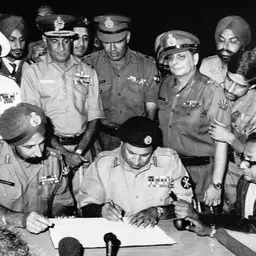
Bangladesh Liberation War A. A. K. Niazi signing the instrument of surrender under the gaze of J. S. Aurora. Standing immediately behind (L-R) Nilkanta Krishnan, Hari Chand Dewan, Sagat Singh, Jacob (with. Krishnamurthy peeping over his shoulder). Newscaster, Surajit Sen of All India Radio, is seen holding a microphone on the right Jacob gained prominence during his stint as the chief of staff of the Eastern Command; the command helped to defeat the Pakistan Army in East Pakistan during the 1971 Bangladesh Liberation War. Jacob was awarded a commendation of merit for his role. The action led to over 10million refugees entering India, fuelling tensions between India and Pakistan. By the monsoon season Jacob—as chief of staff—was tasked with drawing the contingency plans in case of a conflict. After consulting with his superior officers, Jacob developed a plan for engaging Pakistan in a "war of movement" in the difficult and swampy terrain of East Pakistan. Senior Indian Army officers were reluctant to execute an aggressive invasion for fears of early ceasefire demands by the United Nations and a looming threat posed by China. Gen. Jacob made Niazi surrender publicly at the Dhaka racecourse in front of the people of Dhaka, and provided a guard of honour.
The war was a significant victory for India, with nearly ninety thousand Pakistani soldiers surrendering to the Indian Army despite only three thousand Indian soldiers in the immediate area of Dhaka.
For his role in the war, Jacob was awarded the Param Vishisht Seva Medal (PVSM) for distinguished service of the most exceptional order.
Later military career On 17 June 1972, Jacob was promoted to the acting rank of lieutenant general and was appointed as the General Officer Commanding of XVI Corps (newly created), with promotion to substantive lieutenant-general on 5 August 1973. His final appointment was as GOC-in-C, Eastern Command, which he held from 1974 until 31 July 1978, when he retired from the Army following 36years of service and having reached the mandatory retirement age.
From 19 April 1998 till 26 November 1999, he served as the Governor of Goa. While Governor of Goa, he was also the administrator during president's rule, due to instability in the Goa assembly. As administrator, he was recognised as an efficient administrator. He contributed to the preservation of Goa's natural green cover by declaring Mhadei [] and Netravati [] as wildlife sanctuaries.
From 27 November 1999 till 8 May 2003, he served as the Governor of Punjab, and Administrator of Chandigarh. During this period, he successfully setup the IT Park in Chandigarh and invited N. R. Narayana Murthy, Chairman of Infosys, to set up a development center there. Thereafter, other IT companies also set up operations in the Chandigarh IT Park, thus increasing employment avenues in the city. He also conceptualised the Chandigarh War Memorial, which was designed by the students of the Chandigarh College of Architecture and inaugurated by President A. P. J. Abdul Kalam on 17 August 2006.
He was a supporter of improved India–Israel relations. When the Bharatiya Janata Party became part of the ruling coalition government of India in 1998, one of their first priorities was to improve relations with Israel, with which India has had formal diplomatic relations since 1992.
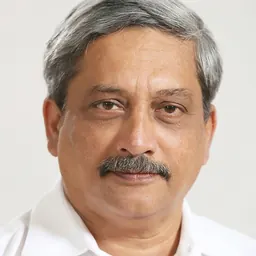
Death Defence Minister Manohar Parrikar lays a wreath at Lt. Gen. Jacob's grave in New Delhi on 14 January 2016. On 13 January 2016, at around 8.30 am local time, Jacob died at New Delhi's Army Research and Referral Hospital due to pneumonia. He was laid to rest the following day in Delhi's Jewish cemetery on Humayun Road. His funeral was attended by India's defence minister, information minister, and foreign delegations.
In April 2019, Israel honoured Jacob with a commemorative plaque on the Ammunition Hill Wall of Honour.
Major publications
Jacob was the author of these books: Surrender at Dacca: Birth of a Nation An Odyssey in War and Peace: An Autobiography
Honours and awards
The Bangladesh government, in 2012, in recognition of his contribution to the creation of Bangladesh, conferred him with the Friends of Liberation War Honour.
Dates of rank Insignia !! Rank !! Component !! Date of rank
Don’t just read it —
keep it.
Full-length biographies made to live with: read them, listen on the way to work, watch them tonight.
- E-book
- Audio
- Video
Instant download · yours to keep · every purchase keeps this site free
Important facts
People in J. F. R. Jacob's life
Named in this biography and alive at the same time



Related people
Same field, nearest in time




Contemporaries
People whose lives overlapped J. F. R. Jacob's
Frequently asked questions
Who was J. F. R. Jacob?
Soldier, statesman
When was J. F. R. Jacob born?
J. F. R. Jacob was born in 1923 in Kolkata.
When did J. F. R. Jacob die?
J. F. R. Jacob died on 13 January 2016 in New Delhi.
What was J. F. R. Jacob's occupation?
J. F. R. Jacob was a politician.
What nationality was J. F. R. Jacob?
J. F. R. Jacob was Indian.
Sources & further reading
Cite this page
APA: Biography.guide. (2026). J. F. R. Jacob. https://biography.guide/j-f-r-jacob/
MLA: "J. F. R. Jacob." Biography.guide, https://biography.guide/j-f-r-jacob/.
Chicago: "J. F. R. Jacob." Biography.guide. https://biography.guide/j-f-r-jacob/.
Data last updated: 2026-09-20 · Spot an error? Report a correction.
Page generated 2026-09-27 05:24 UTC