
J. Delano Ellis
Pastor, Administrator, Military Chaplain, Bishop, Establishmentarian, Educator and Father-in-God to thousands.
About J. Delano Ellis
Lived 1944 – 2020 (aged 75). J. Delano Ellis was an American priest.
Jesse Delano Ellis II, commonly known as J. Delano Ellis, (December 11, 1944 – September 19, 2020) was an American Protestant religious leader and progenitor of unity among African American Pentecostals with Trinitarian and nontrinitarian affinities through the Joint College of African-American Pentecostal Bishops.
Ordained an elder at the age of 19 within the Church of God in Christ, and elevated as bishop at the age of 26, He served as the senior pastor of the Pentecostal Church of Christ in Cleveland, Ohio, beginning on May 14, 1989.
Through Ellis, many Trinitarian and Oneness Pentecostal denominations claim to derive "western and eastern streams of apostolic succession" as described in the appendix to his book, The Bishopric – A Handbook on Creating Episcopacy in the African-American Pentecostal Church. According to Ellis, claims of succession stemmed from the Church of England, the Methodist Episcopal Church, and the Church of God in Christ; he also claimed apostolic succession through the Syro-Chaldean Church. Through Catholic, Orthodox, and Anglican understandings, his claims to apostolic succession are rejected. During his childhood, his mother was placed in a mental health institution; and he then lived with his grandmother and great aunt.
During his teen years, Ellis attempted to establish a relationship with his father by attending a Nation of Islam mosque. Ellis began attending the Christian Tabernacle Church of God in Christ under the pastorate of Bishop R.T. Jones Sr. One night at the church Ellis professed Christianity and claimed his father physically abused him for rejecting Islam (see also: apostasy in Islam).
In his early adulthood, Ellis joined the United States Air Force and attended the Church of the Nazarene. In the Church of God in Christ, Ellis organized the Adjutant's Corp. He served as the third Chief Adjutant of the National Adjutancy of the Church of God in Christ. Establishing the Adjutant's Corp for the Church of God in Christ, Ellis used his education and exposure to Anglicanism which culminated in the denomination and other Pentecostal bodies adopting Anglican vestments.
In 1989, Ellis was asked to lead a Oneness Pentecostal congregation outside of the Church of God in Christ. He determined Oneness Pentecostalism and Trinitarianism weren't entirely different conceptions, yet rejected distinctions between the persons of the Trinity. He came to believe there was no scriptural support for the doctrine of Trinitarian Christianity. Ellis soon after founded the United Pentecostal Churches of Christ (today the United Covenant Churches of Christ). He was also elected as chairman of the organization, and elected and vested as a metropolitan archbishop.
Through this organization, Ellis introduced apostolic succession to many within the African-American Christian tradition, and the college reappropriated the history and purpose of vestments and the episcopacy for their Protestant traditions in contrast with their initial users in Roman Catholicism and Anglicanism. Reappropriating the original and historic meanings, Ellis and the college taught the chimere was a prophetic garment; in contrast, the chimere was originally part of academic dress before adoption by Anglican bishops. Scarlet or red chimeres were also traditionally only worn by bishops with doctorates of divinity, while all others wore black. Ellis and the Joint College also taught the fascia was the "towel used to wash His [Jesus] disciples feet," Leaders within the episcopal college also promoted the five-fold ministry of the Apostolic-Prophetic movement, and the ordination of women.
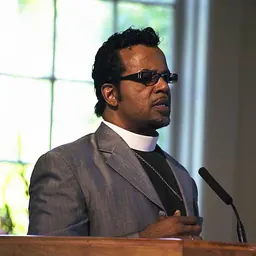
During theological disputes on Christian universalism within the Joint College due to Carlton Pearson's influence, Ellis and the college's board denounced Pearson as a heretic for advocating universalism. Under his administration, the Joint College of African-American Pentecostal Bishops also controversially admitted and certified gay bishop O.C. Allen of the Vision Church of Atlanta in 2012.
In 2015, Ellis served as a co-consecrator for Marvin Sapp's episcopal consecration within the Global United Fellowship.
Controversy, later life In 1995, Ellis was fired after briefly serving as a city police chaplain for his comments toward Muslims, stating Islam was "bloody and dangerous" at worst. In 2001, Ellis resigned from a local faith committee over antisemitic controversy. He was a grand prior and 33rd degree mason.
After 30 years of leadership at the Pentecostal Church of Christ in Cleveland, Ellis abdicated his pastorate in 2019, and his wife, Dr. Sabrina Ellis, was appointed the new senior pastor. The Potter's House Church founder Thomas Dexter Jakes preached at his funeral. Following his death, Bishop Woodson of the PCC's Mid-South Episcopal Diocese was elected as new presiding prelate for the Pentecostal Churches of Christ. Some believe that Wesley was secretly elevated as bishop by Greek Orthodox bishop Erasmus of Arcadia in 1763. Others believe Wesley's stance that apostolic succession could be transmitted through presbyters, and that he was a scriptural episkopos.
Ellis also noted that in 1964 he had been ordained presbyter by Bishop Ozro Thurston Jones of the Church of God in Christ, and he notes his episcopal consecration in 1970 by Bishop Brumfield Johnson of the Mount Calvary Holy Church of America. His book cited no episcopal apostolic lineage for this 1970 consecration either.
"Eastern streams of succession" were traced by Ellis from the Syro-Chaldean Church in the East, via Archbishop Bertram S. Schlossberg (Mar Uzziah), Archbishop-Metropolitan of the Syro-Chaldean Church of North America, also known as the Evangelical Apostolic Church of North America; in 1995, Ellis claimed that the Evangelical Apostolic Church of North America entered into collegial fellowship with the United Pentecostal Churches of Christ. At a holy convocation of the United Pentecostal Churches of Christ, Bishop Robert Woodward Burgess, II (allegedly representing Archbishop Schlossberg, who was living in Jerusalem) had allegedly assisted at the elevation of a number of additional bishops.
According to Ellis, Archbishop Schlossberg and Bishop Burgess claimed to possess lineages from bishops Prazsky (Slavonic Orthodox lineage) and Gaines (Russian and Ukrainian Orthodox lineage). They also claimed this succession converges in Schlossberg and Burgess, as well as numerous lineages deriving via Hugh George de Willmott Newman (Mar Georgius). In his book, Ellis mentioned the Slavonic and Russian/Ukrainian lineages via Prazsky and Gaines, but the only one of Newman's many lineages that he cites is the Syro-Chaldean.
Explaining his claims to apostolic succession in the book, Ellis however stated that his clergy do not contend for succession as though it was the sole method to legitimize themselves. According to Ellis, members of his denomination and the Joint College of African-American Pentecostal Bishops, "use this means to herald the privilege of the unbroken chain of Historical Succession."
According to Michael Ramsey—once the Archbishop of Canterbury (1961–1974)—the validity of someone's apostolic succession pertains to continuity of teaching, preaching, governing, ordination and grace. In Catholic theology, apostolic succession effects the power and authority to administer the sacraments except for baptism and matrimony; thus, apostolic succession is necessary for the valid celebration of the sacraments. Through the Anglican and Catholic understandings of holy orders and the sacramental character imprinted upon those ordained, and those who claim to be within an episcopal apostolic succession; Anglican and Catholic theologians historically reject Ellis and the Joint College's claims, as he converted to Oneness Pentecostalism, breaking theological continuity. In contrast, also with the early Church Fathers and Roman Catholicism, which rejects women's ordination, Ellis and the college also affirmed the ordination of women.
Don’t just read it —
keep it.
Full-length biographies made to live with: read them, listen on the way to work, watch them tonight.
- E-book
- Audio
- Video
Instant download · yours to keep · every purchase keeps this site free
Important facts
People in J. Delano Ellis's life
Named in this biography and alive at the same time




Related people
Same field, nearest in time




Contemporaries
People whose lives overlapped J. Delano Ellis's


Frequently asked questions
Who was J. Delano Ellis?
Pastor, Administrator, Military Chaplain, Bishop, Establishmentarian, Educator and Father-in-God to thousands.
When was J. Delano Ellis born?
J. Delano Ellis was born on 11 December 1944 in Philadelphia.
When did J. Delano Ellis die?
J. Delano Ellis died on 19 September 2020 in Cleveland.
What was J. Delano Ellis's occupation?
J. Delano Ellis was a priest.
What nationality was J. Delano Ellis?
J. Delano Ellis was American.
Sources & further reading
Cite this page
APA: Biography.guide. (2026). J. Delano Ellis. https://biography.guide/j-delano-ellis/
MLA: "J. Delano Ellis." Biography.guide, https://biography.guide/j-delano-ellis/.
Chicago: "J. Delano Ellis." Biography.guide. https://biography.guide/j-delano-ellis/.
Data last updated: 2026-09-20 · Spot an error? Report a correction.
Page generated 2026-09-27 05:17 UTC