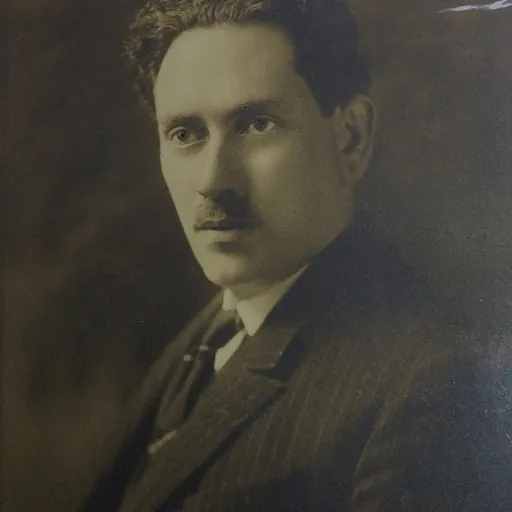
About Izso Glickstein
Lived 1889 – 1947 (aged 57). Izso Glickstein was a singer and hazzan.
Izso G. Glickstein was a fourth-generation Russian-American cantor or hazzan (September 20, 1889 – April 17, 1947) ; other last names Gleuckstein, Glueckstein; other first names Izzo, Isidore, Isadore, Iczek, Isaak, Isaac, Yitzchak, Yitzchok; other middle names Garai, Garay, Gary. Glickstein immigrated from Hungary to the United States through Ellis Island on May 4, 1923. He became a naturalized citizen on June 7, 1928.
Glickstein was a cantor, ranked with Cantor Josef "Yossele" Rosenblatt. He served as Chief Cantor at multiple synagogues including Europe's largest, the Great Synagogue or Dohány Street Synagogue of Budapest. Bernstein described Glickstein as a "fabulous cantor" and his "favorite cantor." He hosted radio programs on Boston's WNAC to popularize Hebrew music. He performed in hundreds of concerts, was the President of the New England Cantor's Association, and made multiple recordings of cantorial music.
A movie was made about Glickstein and his granddaughter called My Grandfather's Prayers, which premiered on January 25, 2020. Two videos were made about his cantorial music. Short biographies were published in 1923 and 1924, and a larger one in 1933.
Early life and lineage Izso G. Glickstein was born on September 20, 1889, in Kishinev, Russia (now Chișinău, Moldova). He was the oldest son of Gittel (née Paskar) and cantor and rabbi Ezekiel Glickstein. Ezekiel was born in Hannopil, Russia (now in Ukraine). Ezekiel moved to Zhytomyr (also now in Ukraine) where he was an Orthodox cantor, and then to Kishinev for rabbinical education. At an early age, Izso started singing in grandfather Moshe's choir. Izso recalled this as one of the greatest events in his life, and Izso came to be hailed by Moshe's congregation as a prodigy or "wonder child." It was also during this time that Izso heard the cantor Zaydl (Zeidel) Rovner (Jacob Samuel Maragowsky) sing when he visited the Great Synagogue of Kishinev. This is when Izso formed his aspiration to become a great cantor.
Izso Glickstein's cantorial lineage is summarized below, with details on his cantorial posts described at Chief Cantor Positions in Europe and Mishkan Tefila.
The Great Synagogue, Kisinev, RussiaHasidic
Town outside Kishinev
Rákoscsaba, Hungary
Peabody, Massachusetts, USOrthodox Orthodox
Orthodox
Dohány Street Synagogue, Budapest, Hungary (aka The Great Synagogue, Tabac Temple)
Győr Synagogue, Hungary (city of Raab, Hungary in German)
Temple Mishkan Tefila, Boston, Massachusetts, USNeolog Neolog
Neolog
Conservative
Education Izso Glickstein and his younger brothers studied Talmud and learned Hebrew melodies in the oral tradition from their father Ezekiel and grandfather Moshe from an early age. Glickstein entered public school in Rákoscsaba and sang in the Orthodox Rumbach Street Synagogue for the cantor Jacob Bachman. But at the age of 12, Glickstein's voice changed and he stopped singing. Instead, he concentrated on high school and Talmudic studies in a Budapest yeshiva. By the age of 18, Glickstein had graduated from both forms of education at the top of his class. The following year, at age 20 (1909), a wealthy merchant living in Rákoscsaba sponsored Glickstein's attendance for a year at the Franz Liszt Academy of Music (then, the National Academy of Music) in Budapest. During his first year, Glickstein won an additional three-year scholarship from the school and completed four years of study (1909 to 1913). During his tenure at the Liszt Academy, Glickstein studied under Jenő Hubay as did Fritz Reiner and Joseph Szigeti, another prodigy. Marriage was important professionally for Glickstein; unmarried cantors were frowned upon in Hungarian synagogues. thumb Cantor Izso Glickstein (top center) with students in Celldomolk between 1916 and 1920.
Chief cantor positions in Europe
Celldömölk Glickstein's first cantorial post came in 1916 at Celldömölk, Hungary at a Neolog synagogue where he also taught Yeshiva students. Two years later, Izso and Gizella fled Celldömölk after the first phase of the White Terror struck on August 23, 1919. Soldiers broke into the synagogue, captured the rabbi, desecrated the synagogue, and robbed, raped, and murdered congregants.
Dohány Izso and Gizella fled to Budapest. Izso became uber cantor at the Dohány Street Synagogue or the Great Synagogue in 1920. In 1907 Mishkan Tefila moved to Moreland Street and embraced what became known as Conservative Judaism. In 1910 the congregation installed Herman H. Rubenovitz as its rabbi, a graduate of Jewish Theological Seminary. The process of change at Michkan Tefila was slow for Rubenovitz. In 1914, his small congregation agreed by a vote of 67 to 54 to allow organ music and a mixed choir. With these changes, membership and funding started to grow.
In October 1922, Mishkan Tefila broke ground on a new 2,000-seat synagogue on Seaver Street in Roxbury. This would become the largest synagogue in New England for decades, complete with a large organ second only to Symphony Hall.
By 1923, the congregation approved and funded the recruitment of a European cantor. In the spring of 1923, Rubenovitz scouted Europe's synagogues, found Glickstein in Győr, and invited him to audition in Boston. The offer was countered by Győr's president with a paid two-year sabbatical, but Glickstein decided to immigrate to the United States. Glickstein auditioned at Mishkan Tefila on July 21 and was elected cantor on August 9, 1923. Then he was booked on the first ever radio broadcast of Hebrew music on Boston's WNAC. He sang at a neighboring temple, where he received a "most enthusiastic ovation" and his voice was described as "sweet and it is powerful." Then a "very large crowd was present" for High Holidays services at Mishkan Tefila.
After New Year services in 1923, Glickstein was elected as instructor of the Cantor's Seminary along with cantor Pinhas Minkowsky. He was featured in the Three World Famous Cantors tour across New England with Minkowsky and Isadore Adelsman. And he sang again in a WNAC Hanukkah broadcast.
High Holy Days Glickistein had an impact on the growth and popularity of Mishkan Tefila. He was regularly featured in its High Holy Days services. Starting in 1925, the new 2,000-seat Temple is filled. Glickstein directed music and the choir from 1923 to 1928.
1923: as described above. 1924: Featured vocalist, assisted by choir of 16. 1925: Officiates and sings in new Mishkan Tefila temple. Choir of 24. New organ is the largest and finest in any Temple in the country. Every seat is filled and many are turned away. 1926: Featured in ads along with a highly trained choir and a new organ (second in size only to Symphony Hall). 1928: The largest Jewish temple was taxed to capacity. 1929: Record crowd attends Yom Kippur services at the largest of all the new temples. 1931: Featured as our inimitable Cantor in page-one High Holidays ad.
Special events at Mishkan Tefila Mishkan Tefila offered high-profile events featuring Glickstein that were often open to the general public.
Thanksgiving Day service with mayor Malcolm Nichols speaking. Meeting featuring speaker Maurice Samuel. Collaborative musical program with two other temples. Art exhibit. Jewish Brotherhoods meeting. New chapel dedication. Veterans of Foreign Wars program. Officiates Late Friday Evening programs. Evening program supporting the Zionism movement. Thanksgiving day service hosting six Jewish congregations. Service for Associated Jewish Philanthropies. Meeting hosting governor Frank G. Allen. New liturgical pieces composed by Zavil Silbert. Ludwig Lewisohn talk. Israel Goldstein talk. Rashi celebration Peace Day service. National Goodwill and Brotherhood week. Patriotic Service program. Memorial service for Franklin D. Roosevelt. Navy Memorial service.
High profile public performances Glickstein sang, chanted, or led prayers in the following public performances.
1924 Adath Jeshurun: Minkowsky funeral, attended by thousands. 1925 Symphony Hall: Hebrew University celebration. 1925 Mishkan Tefila: Building dedication. All 2,000 seats are filled. Congregation described as "one of the largest Jewish congregations in this part of the country." 1925 Chelsea: Concert advertised as "One of the biggest musical events this season." 1926 Symphony Hall: Featured soloist to honor poet Hayim Nahman Bialik. Sings El Moleh Rohamin, Prayers for the Dead. Atttendees include Albert Einstein, Ruben Brainen, Nahum Sokolow, Vladimir Jabotinsky, Menachem Ussischkin, Chaim Weizman, and David Yellin. 1928: Toastmaster for Zavil Kwartin at Hebrew Community Center in Winthrop. 1929 Lawrence Colonial Theater: Principal soloist of Yiddish folk songs, Hebrew melodies, and classical music. "Every seat at the Colonial Theater is expected to be sold out." 1930 Mishkan Tefila: Chants prayers for thousands at David A. Lourie funeral. Crowd overflow onto steps and into nearby cars. 1932 Temple Ohabei Shalom: Dinner for Nahum Sokolow. 1936 Mishkan Tefila: Rubenovitz Silver Jubilee. Event included piano selections by Leonard Bernstein. 1941 Mishkan Tefila: Address by Eleanor Roosevelt. Record attendance. 1944 Copley-Plaza: Chants for fallen United Nations soldiers. 1944 Dorchester: Max Hamlin (Jewish labor leader) funeral with 1,500 in attendance. 1944 Symphony Hall: Sings self-composed piece for full capacity crowd in Let Freedom Ring musical pageant. 1944 Associated Jewish Philanthropies: Honor roll and plaque dedicated.
Influence on Leonard Bernstein Leonard Bernstein was eight years old (1926) when he moved from Lawrence to Boston and began to attend Mishkan Tefilah. As noted in several Bernstein biographies, Hebrew music was a central early influence. Since Glickstein was cantor in 1926, and Braslavsky did not join Mishkan Tefila until 1928, Glickstein was Bernstein's first major influence of high quality ancient Hebrew music. As Bernstein said of his early years in the synagogue: "We had a fabulous cantor [Glickstein] who was a great musician and a beautiful man, very tall, very majestic. He would begin to sing the ancient tunes - they are not exactly melodies, because they are not really written down; they're traditional, handed down orally - and he had a tenor voice of such sweetness and such richness - with a dark baritone quality - and then the organ would start and then the choir would begin with its colors, and I just began to get crazed with choral music." Glickstein had been a prodigy and recognized the same in Bernstein. Glickstein was also part of an intimate circle that included Bernstein's parents.
Recognition Positions of distinction Glickstein was elected for multiple distinguished positions.
Jewish Ministers and Cantors Association: New England representative, board member, president. HIAS: executive committee, board member. New England Zionist District: Officer, president.
Quotes praising Glickstein Glickstein is described as "... one of the leading Jewish singers in America, ranking with Josef Rosenblatt and others of equal prominence. He is in America less than two years and during that short time has become exceedingly popular with Jewish music lovers. He is in great demand as concertist throughout the country." "Cantor Glickstein is one of the finest cantors ever heard in this city." "Cantor I. G. Glickstein of Temple Mishkan Tefila enthused the audience to the highest pitch with his golden voice." "A musical program, consisting of vocal numbers by the Temple Mishkan Tefila Quartet and Cantor G Glickstein, accompanied by Professor S. Braslavsky, were received with thunderous applause." "Cantor Itzo Glickstein of Temple Mishkan Tefila, Roxbury, one of the most talented and renowned cantors in the country, will be the featured soloist ..." "Cantor Glickstein was much applauded for his work in the solos." "Loud sobbing broke out during the impressive exercises, when, after the unveiling of the honor roll, the Hebrew chant for the dead was sung by Cantor I. G. Glickstein of Temple Mishkan Tefila, followed by taps for the five men who have died in the present struggle." Palestine pilgrimage announcement, bon voyage dinner and sendoff, and return celebration. Biography and photo published in Boston Transcript. 20th anniversary at Mishkan Tefila.
Public service Radio broadcasts Glickstein sang in the following Boston radio broadcasts.
WNAC. WLOE. Boston.
Charitable organizations Glickstein performed for charitable events throughout New England.
Bickur Cholim Association. Essex Institute. Hebrew Free School. HIAS. Home for Aged. Long Island Hospital. Palestine Foundation Fund. Starving Jews in Uman. United Jewish Campaign. United Palestine Appeal. Women's Scholarship Association.
Jewish synagogues and organizations Glickstein was a guest cantor or singer at the following Jewish synagogues and organizations in New England.
Agudath Askenazin Temple. Agudath Israel. Amos Lodge of B'nai Brith, where he is a member. Atereth Israel Synagogue. Besserabian Society. B'nai Brith. Chai Odom Synagogue. Community Church of Symphony Hall. Congregation Agudath Achim. Congregation Beth Hamidrash Hagodol. Daughters of Israel. Frauen Verein Convalescent Home. Good Brothers Synagogue in Worcester. Hebrew Teacher's College. Home for Jewish Children. New England Cantors' Association. Ohel Jacob Synagogue in East Boston. Tremont Temple. West End Jewish Community Center. Young Men's and Young Women's Hebrew Association of New England.
Zionist events Glickstein performed at the following Zionist gatherings.
Anti-Hitlerism. Balfouf declaration signing celebration. Brockton meeting on Palestine. Chelsea. New England Zionists.
Local meetings and entertainment Glickstein performed at local meetings and for entertainment events.
Elks Lodge. Ford Hall (later called Ford Hall Forum). Malden grand rabbi celebration. New England Cantors Association. People's Ort Federation. Portsmouth synagogue.
Death announcements After several months of illness in early 1947, Glickstein died on April 17, 1947. Local news outlets announced his death on page 1 and followed up on subsequent pages. The New York Times also carried an obituary.
The Boston Globe "Rev. Izso G. Glickstein, 55, cantor of Temple Mishkan Tefila for almost 25 years and noted interpreter of ancient jewish liturgy, died today at his home, 497 Warren st., Roxbury" (page 1). "One of the most active members of Greater Boston's Jewish community, he served for many years as president of the Jewish Ministers and Cantors Association of New England, chaplain at Long Island Hospital and served for a time as chaplain of Germania Lodge of Masons." "Noted for his interpretation of the ancient Jewish liturgy in keeping with the European tradition...Known in Greater Boston's Jewish community for his generosity and service in charitable causes..." "Twelve hundred persons attended funeral services for Cantor Izso G. Glickstein, 56, who died yesterday...There were eulogies by Rabbi Israel J. Kazis and cantor Leon Lange of New York."
The Jewish Advocate "Izso G. Glickstein, Cantor of Temple Mishkan Tefila for nearly a quarter of a century, passed away this morning at his home, 497 Warren street, Roxbury, after an illness of several months" (page 1). "The death of the beloved cantor is a great loss to a community he had served in many ways...In December of 1943 the Advocate Carnation, symbol of community esteem, was awarded Cantor Glickstein." "The Death of Cantor Izso G. Glickstein brings deep sorrow not only to his friends and admirers who appreciated his splendid musicianship, but to the general community which respected him for his kindness of heart and love for humanity."
The New York Times
"Izzo Glickstein, cantor for twenty-five years at Temple Mishman [sic] Tefila and president of the Cantors Association of New England, died today at his home in suburban Roxbury. His age was 55. Before coming to this country, he was chief cantor in Budapest, Hungary." Newspaper coverage of Glickstein's death was extensive across New England. For example: "Cantor Glickstein Dies in Boston" (Lynn, MA), "New England Cantor Association Head Dies" (North Adams, MA), and "Cantor Iszo Glickstein" (Portland, ME).
Tributes Multiple Jewish news outlets published tributes to Glickstein.
By Rabbi Herman H. Rubenovitz Rubenovitz recruited Glickstein to America and worked with him for 25 years. He wrote in his tribute:
"It was the Spring of 1923 that I first met Cantor Glickstein...After a brief conversation...I realized that he was the man for us...
"My first impression was more than confirmed in the course of the years that followed. I was associated with Cantor Glickstein for nearly a quarter of a century and throughout this eventful period which marked the opening of our new Temple, the expansion of our activities, the assumption of leadership by our Congregation in all religious and common affairs, he and I, together with Professor Braslavsky in the choir loft, worked together steadfastly and harmoniously to make of our services the finest jewel in the diadem of Temple Mishkan Tefila.
"In Cantor Izso G. Glickstein, we had a man gifted with a voice of remarkable power, range and beauty, but these gifts of themselves would not have made him the great Cantor that he was. In addition, he had those qualities of mind and heart which made it possible for him to penetrate to the very soul and spirit of our traditional prayers, and to interpret these in a manner which thrilled, exalted and inspired all of us. His renditions of the chants sung in connection with the Opening of the Ark, and the taking out of the Scrolls, was unforgettable, as was his singing of the beautiful soul-stirring music of the Avoda during the Musaph Service on Yom Kippur day.
"At the time when our persecuted, tortured brethren from Germany came fleeing to the shores of America and during those dreadful years when the sun of European civilization suffered an eclipse, Cantor Glickstein worked faithfully with me to give the unfortunates every possible aid and comfort. May his soul be bound up in the bond of eternal life and his example serve as inspiration to his children, his family and kin."
By Rabbi Israel J. Kazis Rabbi Kazis was the acting rabbi at Mishkan Tefila when Glickstein died. His tribute, in part:
"The passing of Cantor Izso G. Glickstein has left a deep void in Temple Mishkan Tefila and in the hearts of all who knew and loved him. He was a member of that great class of distinguished cantors whose interpretation of Jewish liturgical music added immeasurably to the beauty, meaning, and dignity of the religious service..."
"Cantor Glickstein gave of himself to every worthwhile cause in the community. He served as President of the Cantors Association in Boston for several terms, and was its honorary President at the time of his passing. He served as Chaplain of the Masonic Germania Lodge in Boston and as Chaplain of the Long Island Hospital. He was always ready to participate in the programs of the many organizations in our community. He thus served not only Temple Mishkan Tefila but the entire community..."
Personal life While Glickstein recovered form his WWI leg wound in 1915, he met and married Gizella Hochmann on June 25, 1916. Her father was Miksa Hochman (born in Obuda, Hungary) and her mother was Maria Bruck (born in Pest, Hungary). They moved from Pest to Rákoscsaba with their daughter Gizella, and the wedding took place there (now District 17 of Budapest). in 1926, Judith (Judy) in 1927, and Mishel (Mitch) in 1931. Glickstein served as Chief Cantor at Mishkan Tefila for almost 25 years until his death in 1947. To replace him, over 50 cantors from around the world were auditioned to replace him, and Wolf Garbarz was selected.
Glickstein's father, Ezekiel, moved from Hungary to the Boston area and settled in Peabody, MA, where he was a rabbi for an orthodox congregation for four years. Ezekiel died at Izso's home on October 11, 1928 at the age of 68. Glickstein's mother Gittel died on April 5, 1938, also in Glickstein's home.
Glickstein had three brothers in the US: Louis, Eugene, and Adolph. All three lived in the Boston area, as did his sister Esther (Glickstein) Landy. Dr. Louis H. Glickstein was born in Kishinev, Russia in 1894 and immigrated to the US in 1923. He was a cantor for High Holidays, a doctor of podiatry, and active in the Zionist movement along with Izso. He died in the Boston area in 1989. Esther (Glickstein) Landy was born in Kishinev, Russia in 1897, immigrated to the US in 1929, and married David Landy the same year. She died in 1991.
Eugene Glickstein was born in Rákoscsaba, Hungary in 1901 and immigrated to the US in 1923. He was a cantor and executive director at Mishkan Tefila. He moved to Portland, OR in 1954 and died there in 1977. Adolph Glickstein was born in Rákoscsaba, Hungary in 1903. In 1931 he was the youngest cantor in Boston. He was a cantor for the New England Branch of the Young People's League. Adolph substituted for Izso as cantor at Mishkan Tefila during his illness and after his death. Adolph died in 1981.
Discography Glickstein recorded two albums which were later reissued in cantor collections.
Don’t just read it —
keep it.
Full-length biographies made to live with: read them, listen on the way to work, watch them tonight.
- E-book
- Audio
- Video
Instant download · yours to keep · every purchase keeps this site free
Important facts
People in Izso Glickstein's life
Named in this biography and alive at the same time




Related people
Same field, nearest in time


Contemporaries
People whose lives overlapped Izso Glickstein's


Frequently asked questions
Who was Izso Glickstein?
(1889–1947)
When was Izso Glickstein born?
Izso Glickstein was born on 20 September 1889 in Chișinău.
When did Izso Glickstein die?
Izso Glickstein died on 17 April 1947.
What was Izso Glickstein's occupation?
Izso Glickstein was a singer and hazzan.
Sources & further reading
Cite this page
APA: Biography.guide. (2026). Izso Glickstein. https://biography.guide/izso-glickstein/
MLA: "Izso Glickstein." Biography.guide, https://biography.guide/izso-glickstein/.
Chicago: "Izso Glickstein." Biography.guide. https://biography.guide/izso-glickstein/.
Data last updated: 2026-09-23 · Spot an error? Report a correction.
Portrait: Wikimedia Commons · author & licence
Page generated 2026-09-27 05:06 UTC