
Ivor Hughes
British army officer and Serjeant-at-Arms
About Ivor Hughes
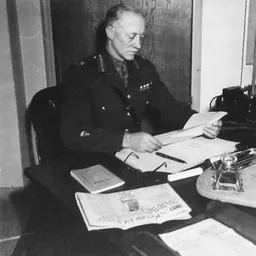
Lived 1897 – 1962 (aged 64). Ivor Hughes was a British military personnel and serjeant-at-Arms of the House of Commons (United Kingdom).
Major-General Sir Ivor Thomas Percival Hughes, (21 December 1897 – 16 August 1962) was a senior British Army officer who fought in both the world wars. During the Second World War he commanded the 44th (Home Counties) Division during the Battle of Alam el Halfa and the Second Battle of El Alamein in late 1942 and later became Serjeant-at-Arms of the House of Commons.
Early life and military career Ivor Hughes was born in Sussex, England, on 21 December 1897, the son of Revt. F. G. Hughes and was educated at Wellington College, Berkshire. He joined the British Army during the First World War and, after entering the Royal Military College, Sandhurst, graduated on 16 August 1916, being commissioned as a second lieutenant into the Queen's (Royal West Surrey Regiment). Soon afterwards he was sent to the Western Front, where he joined the 1st Battalion of his regiment, then serving in the 100th Brigade of the 33rd Division, later transferring to the 19th Brigade. He was to remain with the battalion for the rest of the war. During his service in Belgium and France he was, in addition to being twice wounded, mentioned in despatches and awarded the Military Cross (MC).
Between the wars Remaining in the army during the interwar period, Hughes was posted to the 2nd Battalion, Queen's in 1919 and, by now a lieutenant, went with the battalion to India, where he became the battalion's assistant adjutant. then attended the Staff College, Camberley from 1929 to 1930, where his fellow students included numerous future general officers, such as Neil Ritchie, Herbert Lumsden and George Erskine, Reginald Denning, Hugh Stable, Kenneth Crawford, Temple Gurdon, Neil McMicking, I. S. O. Playfair, Harold Redman, James Elliott, and Harold Freeman-Attwood.
After returning to his regiment, this time with the 2nd Battalion, for a year, he was posted to Scottish Command as a staff officer, from 1932 to 1934, later being sent to Dover, Kent as a brigade major to the 12th Brigade until 1935. He then left the army and became Assistant Serjeant-at-Arms of the House of Commons from 1935 to 1939. In 1937 he became second-in-command (2IC) of the 4th Battalion, Queen's, a Territorial Army (TA) unit, and in 1938 commanded the battalion, later overseeing its conversion to a searchlight regiment of the Royal Artillery, whereupon it was redesignated 63rd (Queen's) Searchlight Regiment, Royal Artillery. However, his duties at Westminster forced him to relinquish command in early 1939. The greatly depleted battalion eventually, along with most of the rest of the BEF, made their way back to Dunkirk, and were subsequently evacuated to England. and became General Officer Commanding (GOC) of the 44th Division, succeeding Major General Horrocks, who received another appointment to become GOC of the 9th Armoured Division.
However, in mid-August, the division was ordered by General Sir Harold Alexander, the newly appointed Commander-in-chief (C-in-C) Middle East Command, to join the British Eighth Army at El Alamein. Lieutenant General Bernard Montgomery, the new GOC Eighth Army, who knew the division well after having it under his command in England, had specifically requested that the 44th Division be sent forward. Arriving on 15 August, the division was assigned to XIII Corps, under Lieutenant General Brian Horrocks, Hughes' predecessor as GOC of the 44th Division, and began relieving elements of the 5th Indian Infantry Division on the Alam Halfa Ridge, and the 132nd Brigade was temporarily detached to Lieutenant General Bernard Freyberg's 2nd New Zealand Division. Although trying to retain his division, the 44th was disbanded soon after (officially on 31 January 1943), due to a shortage of infantry in North Africa and the Middle East, and most of the division's units were posted to other divisions, the 131st Brigade remaining with the 7th Armoured Division for the rest of the war, the 132nd Brigade being broken up, its battalions posted away to Indian Army units, and the 133rd Brigade also being broken up.
Postwar After retirement from the army, Hughes returned to his duties at Westminster which the war had forced him to abandon, and became Chairman of the Surrey Territorial and Auxiliary Forces Association from 1947 to 1949 before becoming Deputy Lieutenant of Surrey. From 1957 until his sudden death on 16 August 1962 – exactly 46 years since he received his commission – he was Serjeant-at-Arms of the House of Commons.
Don’t just read it —
keep it.
Full-length biographies made to live with: read them, listen on the way to work, watch them tonight.
- E-book
- Audio
- Video
Instant download · yours to keep · every purchase keeps this site free
Important facts
People in Ivor Hughes's life
Named in this biography and alive at the same time



Related people
Same field, nearest in time




Contemporaries
People whose lives overlapped Ivor Hughes's


Frequently asked questions
Who was Ivor Hughes?
British army officer and Serjeant-at-Arms (1897-1962)
When was Ivor Hughes born?
Ivor Hughes was born on 21 December 1897 in Sussex.
When did Ivor Hughes die?
Ivor Hughes died on 16 August 1962.
What was Ivor Hughes's occupation?
Ivor Hughes was a military personnel and serjeant-at-Arms of the House of Commons (United Kingdom).
What nationality was Ivor Hughes?
Ivor Hughes was British.
Sources & further reading
Cite this page
APA: Biography.guide. (2026). Ivor Hughes. https://biography.guide/ivor-hughes-military-personnel/
MLA: "Ivor Hughes." Biography.guide, https://biography.guide/ivor-hughes-military-personnel/.
Chicago: "Ivor Hughes." Biography.guide. https://biography.guide/ivor-hughes-military-personnel/.
Data last updated: 2026-09-20 · Spot an error? Report a correction.
Page generated 2026-09-27 05:15 UTC