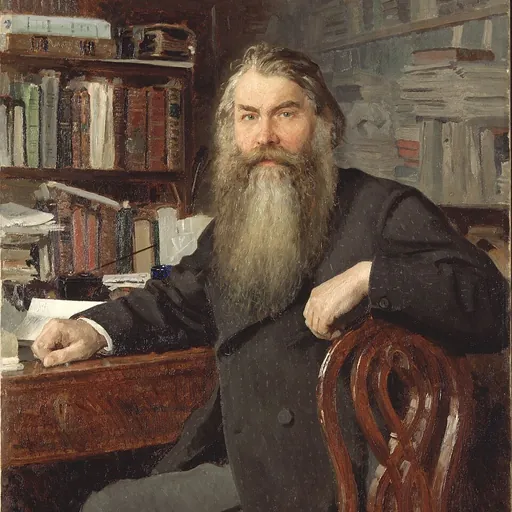
About Ivan Zabelin
Lived 1820 – 1908 (aged 88). Ivan Zabelin was a Russian anthropologist, archaeologist, historian, philosopher, local historian and art historian.
Ivan Yegorovich Zabelin (Иван Егорович Забелин; 29 September 1820 – 13 January 1909) was a Russian historian and archaeologist with a Slavophile bent who helped establish the National History Museum on Red Square and presided over this institution until 1906. He was the foremost authority on the history of the city of Moscow and a key figure in the 19th-century Russian Romantic Nationalism.
Biography Zabelin joined the Moscow Kremlin staff in 1837. Influenced by the early Muscovite "antiquaries" such as Ivan Snegirev and Pavel Stroyev, Zabelin was one of the first to investigate the history of Moscow's suburbs and monasteries. While working in the Armoury, Zabelin studied the history of metalworking and enamel work in medieval Russia. He was also considered an expert on icon-painting and Muscovite architecture.
In 1859 Count Sergei Stroganov invited Zabelin to excavate the Scythian tumulus graves in South Russia and the Crimea. He is credited with introducing stratigraphic methods in Russian field archaeology. It was he who excavated the Chertomlyk grave, one of the largest Scythian kurgans. His findings are now part of the Hermitage Museum collection. Zabelin joined forces with Count Aleksey Uvarov in establishing the Russian Archaeological Society (in 1846). He summed up his findings in The Antiquities of Herodotus's Scythia (1866, 1873).
In 1873 Zabelin quit archaeological pursuites and devoted himself to the study of Pre-Petrine, late medieval Muscovy. He headed the Moscow Society of History and Archaeology between 1872 and 1888 and was revered by the Romantic Nationalist artists such as Andrei Ryabushkin, Sergei Milyutin, and Viktor Vasnetsov. In 1894 Zabelin was elected into the Petersburg Academy of Sciences (honoris causa).
Zabelin believed that the "soul of the people" manifests itself not so much in the state institutions and political history (as his German colleagues held) but in the quotidian particulars of domestic life and family relations. He elaborated his views in the series of monographs detailing the "private life of Russian people" in the 16th and 17th centuries.
Zabelin's great trilogy "The Domestic Life of the Russian Tsars" (1862), "The Domestic Life of Russian Tsarinas" (1872) and "Great Boyars in Their Votchinas" (1871) is still consulted and quoted by modern historians. His magnum opus The History of the Russian Mode of Life from the Earliest Times was left unfinished.
Don’t just read it —
keep it.
Full-length biographies made to live with: read them, listen on the way to work, watch them tonight.
- E-book
- Audio
- Video
Instant download · yours to keep · every purchase keeps this site free
Important facts
People in Ivan Zabelin's life
Named in this biography and alive at the same time



Related people
Same field, nearest in time
Contemporaries
People whose lives overlapped Ivan Zabelin's



Frequently asked questions
Who was Ivan Zabelin?
Russian historian (1820–1909)
When was Ivan Zabelin born?
Ivan Zabelin was born on 17 September 1820 in Tver.
When did Ivan Zabelin die?
Ivan Zabelin died on 31 December 1908 in Moscow.
What was Ivan Zabelin's occupation?
Ivan Zabelin was an anthropologist, archaeologist, historian, philosopher, local historian and art historian.
What nationality was Ivan Zabelin?
Ivan Zabelin was Russian.
Sources & further reading
Cite this page
APA: Biography.guide. (2026). Ivan Zabelin. https://biography.guide/ivan-zabelin/
MLA: "Ivan Zabelin." Biography.guide, https://biography.guide/ivan-zabelin/.
Chicago: "Ivan Zabelin." Biography.guide. https://biography.guide/ivan-zabelin/.
Data last updated: 2026-09-21 · Spot an error? Report a correction.
Portrait: Wikimedia Commons · author & licence
Page generated 2026-09-27 05:01 UTC