
About Itala Mela
Lived 1904 – 1957 (aged 52). Itala Mela was an Italian theologian.
Itala Mela (28 August 1904 – 29 April 1957) was an Italian Roman Catholic theologian and mystic who was a lapsed Christian until a sudden conversion of faith in the 1920s and as a Benedictine oblate virgin assumed the name of "Maria della Trinità". Mela became one of the well-known mystics of the Church during her life and indeed following her death. She also penned a range of theological writings that focused on the Trinity, which she deemed was integral to the Christian faith.
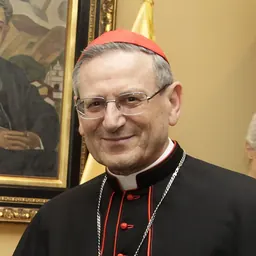
Mela was proclaimed to be Venerable on 12 June 2014 after Pope Francis approved her life of heroic virtue. Mela was beatified in La Spezia on 10 June 2017 and Cardinal Angelo Amato presided over the celebration on the pope's behalf; the miracle in question concerned the revival of an Italian newborn, whose body was in state of clinical brain death.
Life Itala Mela was born on 28 August 1904 in La Spezia to Pasquino Mela and Luigia Bianchini; both were atheist teachers.
The death of her brother Enrico at the age of nine (27 February 1920) challenged Mela's perception of her Christian faith, and she wrote of her feelings to the loss: "After his death, nothing". As a result, she eschewed her Christian faith and slipped into atheism.
Mela became a member of FUCI in 1923, where she met future pope Giovanni Battista Montini and Alfredo Ildefonso Schuster at the meetings there; she also met the priests Divo Barsotti and Agostino Gemelli. At such meetings, Montini and both the politicians Aldo Moro and Giulio Andreotti served as major influences upon her. She was the main friend of Angela Gotelli, a teacher of classic letters and a Roman Catholic partisan who was close to the political ideas of Aldo Moro.
Mela received her high school diploma at the liceo classico Lorenzo Costa of La Spezia (where she later became a teacher) with recognition of being a brilliant student and in 1922 was enrolled at the University of Genoa, where she later received a degree in letters in 1928 as well as in classical studies.
Since 1937 Mela received spiritual stigmata every Friday. She also received the gift of the transverberation of the heart (August 1938). Her adoration for the "Inabitazione" ("Inhabitation," a form of worship of the Trinity), led her to establish a religious family in 1946 consisting of priests and laymen engaged in the spread of devotion.
Santa Maria del Mare monastery in La Spezia houses a small museum about Mela, with the bedroom and other mementos. Beatification The beatification process started in La Spezia in its diocese on 29 April 1968, which granted Mela the title Servant of God; the process spanned until 21 November 1976 and was validated in Rome on 2 October 1992. In 1983, at the canonical reconnaissance that are regularly carried out in the case of beatification processes, his body was found intact. Following the local process, all of Mela's writings were approved in 1979 and permitted for evaluation in the cause.
The Positio then was compiled and submitted in 2003 to the Congregation for the Causes of Saints for further evaluation. On the occasion of the 2006 Convention of Italian Churches in Verona, the churches of Liguria chose Mela as an exemplary witness to their heritage of faith and spirituality.
It was on 12 June 2014 that Pope Francis approved that Mela had lived a life of heroic virtue thus declared her to be Venerable.
On 14 December 2015, the pope also approved a miracle attributed to the intercession of Mela which would allow for her beatification to take place; it was celebrated at Piazza Europa in La Spezia on 10 June 2017 with Cardinal Angelo Amato presiding over the celebration on the pope's behalf. The following afternoon after his Angelus address – given on the Solemnity of the Most Holy Trinity – Pope Francis referred to her beatification in which he mentioned the real presence of "God the Father, Son and Holy Spirit who abides in the chamber of our heart".
The current postulator assigned to this cause is Dr. Andrea Ambrosi. Her writings altogether occupy more than 42 volumes. Her original writings are kept in the Diocesan Archive at the Episcopal Seminary in Sarzana. Mela's findings were typewritten by the nuns of the Benedictine Monastery of Santa Maria del Mare, Castellazzo, La Spezia.
Later, a commission of experts verified the fidelity of the typewritten copies to the originals. The archive preserves both Mela's autograph writings and typewritten copies (which are the only ones that can be consulted by the public).
In honor to Mela, the Municipality of La Spezia named a stairway between Via XXVII Marzo and Via dei Colli.
The Trinitarian indwelling The Trinitarian indwelling is a spiritual experience proposed by Mela to help the faithful live their lives in the light of the Trinity. It consists of trying to do everything in union with the Father, the Son and the Holy Spirit, relying on their guidance and always trying to do God's will.
Trinitarian indwelling is an experience that can be lived in any situation of life, not just in a convent or in a place of prayer. For Mela, in fact, daily life is the place where it is possible to meet God and bear witness to one's faith, through concrete gestures of love and charity towards others.
The Trinitarian indwelling finds foundation in the Gospel according to John, chapter 10, verses from 22 to 39 and in particular in the words "The Father is in me and I in Him". Thus, the three divine Persons inhabit each other. According to Mela, man, created in the image and likeness of God, is made to live the same life as God through the Trinitarian indwelling of the soul and body. It is not a mere intellectual fact, but an experience that concerns the person in his entirety of soul and body. Anyone who coherently lives as a Son of God can also experience this communion of love with God and with his neighbour.
Mela lived her first experiences of trinitarian indwelling after having prayed the Office of the Hours, received the Eucharist during holy mass or having practiced an intense Eucharistic adoration.
Mela immolated herself, offering her joyful suffering and infirmity to God so that other people could experience the Trinitarian indwelling, for the forgiveness of their sins and their eternal salvation.
The Trinitarian indwelling theology was also described by Elizabeth of the Trinity. It was anticipated by the Diuturnum illud of Pope Leo XIII and then confirmated by the encyclical Mystici corporis of Pius XII.
As it results from her name of "Mary of the Trinity", Mela was a devoted to the Blessed Virgin Mary. Mela conceived the sainthood of Mary and of the Saints as "nothing but a reflection, a communication of the sanctity of the triune God." According to her, "every mystery, every aspect of faith flows from the very life of the august Trinity."
Thomas Aquinas' Compendium theologiae affirms:
In arts In memory of Mela, Clemente Terniit composed a cantata for contralto, tenor and bass with instruments and percussion, very freely inspired by the texts collected in the volume In un mare di luce and by the lauda Alta Trinità beata contained in the ancient Laudario of Cortona, dated back to the 13th century. The first performance took place in San Miniato al Monte, at the Monastery of San Leonardo, not far from the temple of San Salvatore al Monteit, a microcosm of the heavenly temple frescoed by Leonardo da Vinci.
In honour to Mela, the Master friar Claudio Grana, OCD, composed the hymn Se mi ami davvero (If you truly love me) (n°. 1978). Its stanzas are taken from the Elevation to the Trinity by St Elizabeth of the Trinity.
Works Itala Mela, Benedictine Monastery of Santa Maria a Mare (editor for stenography), Marinasco, Nel dialogo delle tre persone, Sarzana 1976 Retrieved on 26 January 2025. (4 notebooks; no ISBN available) Itala Mela, Quo tu non-vis (Dove tu non-vuoi). Itinerario spirituale, Libreria Editrice Vaticana 2002, Itala Mela, In un mare di luce. Scritti mistici, Piemme 1999, Itala Mela, Amare l'amore, Mondadori, Itala Mela, Luigi Crippa (editor) (1 October 2014), Pensieri sull'obbedienza benedettina, Editrice Domenicana Italiana,. Itala Mela, L'ascesi alla luce dell'Inabitazione, in Ritiri mensili 1958, 1959, 1960, 1961, Apostolato per la Comunione frequente agli ammalati, Genoa,
Some of Mela's writings were translated into Spanish by Manuel Garrido Bonaño (1923–2013), OSB, who collaborated in the cause for beatification of Josemaría Escrivá de Balaguer at the Diocesan Tribunal of Madrid and as promoter of justice in that of Sister Eusebia Palomino Yenes.
In 2017, Annamaria Valli published a bibliography of the studies and anthologies related to Mela's writings.
Letters In the substantial collection of Mela's letters, gathered in her typewritten volumes, there were only seven of the approximately one hundred letters sent from 1931, on the eve of her taking the veil, until 1956, a few months before her death in her house in Via del Torretto, La Spezia.
The letters were addressed to the abbots of San Paolo fuori le Mura, Ildebrando Vannucciit and his successor Cesario D'Amatoit, and to the director of the Oblates, Fr, Giuseppe Turbessi, who was succeeded by Fr. Ippolito Boccoliniit. as well as the construction of the monastery of Saint Scholastica near Civitella San Paolo, north of Rome, a proposal put forward by Schuster
Don’t just read it —
keep it.
Full-length biographies made to live with: read them, listen on the way to work, watch them tonight.
- E-book
- Audio
- Video
Instant download · yours to keep · every purchase keeps this site free
Important facts
People in Itala Mela's life
Named in this biography and alive at the same time





Related people
Same field, nearest in time

Contemporaries
People whose lives overlapped Itala Mela's




Frequently asked questions
Who was Itala Mela?
Italian Benedictine oblate, mystic, and theologian (1904–1957)
When was Itala Mela born?
Itala Mela was born on 24 August 1904 in La Spezia.
When did Itala Mela die?
Itala Mela died on 29 April 1957 in La Spezia.
What was Itala Mela's occupation?
Itala Mela was a theologian.
What nationality was Itala Mela?
Itala Mela was Italian.
Sources & further reading
Cite this page
APA: Biography.guide. (2026). Itala Mela. https://biography.guide/itala-mela/
MLA: "Itala Mela." Biography.guide, https://biography.guide/itala-mela/.
Chicago: "Itala Mela." Biography.guide. https://biography.guide/itala-mela/.
Data last updated: 2026-09-20 · Spot an error? Report a correction.
Page generated 2026-09-27 05:26 UTC