
About István Sárközy
Lived 1920 – 2002 (aged 81). István Sárközy was a Hungarian composer and musicologist.
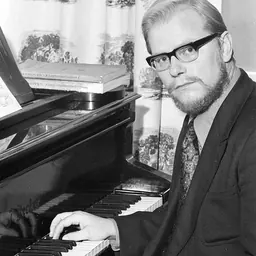
István Sárközy (26 November 1920 – 6 July 2002) was a Hungarian classical composer, music critic, editor and academic teacher. His compositions date from the 1940s to 1979, and include works for musical theatre, choral works and songs, orchestral and chamber works, and works for piano. Notable examples include the stage works Liliomfi and Szelistyei asszonyok (The Women of Szelistye; 1951), the chamber cantata Júlia énekek (Julia Songs; 1956), the overture Az ifjúsághoz (To Youth; 1957), and the Sinfonia concertante for clarinet and strings (1963). He taught at the Franz Liszt Academy of Music from 1959.
Biography Sárközy was born in the Pesterzsébet suburb of Budapest in 1920. As a youth, he studied the piano with Lula Földessy-Hermann. He trained in composition with the composers Zoltán Kodály, Ferenc Farkas and János Viski at Budapest's Higher Music School (1938–39) and the Franz Liszt Academy of Music, Budapest (from 1939). Sárközy was a confidant of the composer Endre Szervánszky, a leading composer of the post-1956 era, In a 1969 review, the British music critic Stephen Walsh describes his music as differing from that of other Hungarian composers of the time due to "its determination to be agreeable both to ear and to mind", concluding that in Sárközy's best works, at least, "his ideal of euphonious beauty by no means precludes profundity or originality of thought." Walsh describes it as "beautiful",
Important later works include the Sinfonia concertante for clarinet and strings (1963), A review in Music & Letters finds influences from Bartók and praises the piece's "idiomatic" composition for the flute and piano, but criticises its "rhythmic monotony", describing it as "virtuously dissonant and unutterably boring". During the 1970s Sárközy composed a comedic oratorio, Ypszilon-háború (1971), a song cycle, Sok gondom közt (Amid my Many Worries; 1972), the Concerto semplice (Ricordanze II) for violin and orchestra (1973), and several chamber pieces, including Ricordanze III for string quartet (1977). Sonata da Camera (Qualiton) ((S)LPX-1246) Concerto grosso (Orchestra of Hungarian Radio and Television; György Lehel, conductor); Shepherd's Ballad, Three songs on poems by András Metzei (Erika Sziklay, soprano; Loránt Szűcs, piano); Sinfonia concertante (Béla Kovács, clarinet; Hungarian Chamber Orchestra) (Hungaroton; 1974) (SLPX-11667) Confessioni, Concerto semplice (Hungaroton; 1984) (SLPX 12515)
Don’t just read it —
keep it.
Full-length biographies made to live with: read them, listen on the way to work, watch them tonight.
- E-book
- Audio
- Video
Instant download · yours to keep · every purchase keeps this site free
Important facts
People in István Sárközy's life
Named in this biography and alive at the same time




Related people
Same field, nearest in time


Contemporaries
People whose lives overlapped István Sárközy's



Frequently asked questions
Who was István Sárközy?
Hungarian classical composer and music critic (1920–2002)
When was István Sárközy born?
István Sárközy was born on 26 November 1920 in Budapest District XX.
When did István Sárközy die?
István Sárközy died on 6 July 2002 in Budapest.
What was István Sárközy's occupation?
István Sárközy was a composer and musicologist.
What nationality was István Sárközy?
István Sárközy was Hungarian.
Sources & further reading
Cite this page
APA: Biography.guide. (2026). István Sárközy. https://biography.guide/istvan-sarkozy/
MLA: "István Sárközy." Biography.guide, https://biography.guide/istvan-sarkozy/.
Chicago: "István Sárközy." Biography.guide. https://biography.guide/istvan-sarkozy/.
Data last updated: 2026-09-20 · Spot an error? Report a correction.
Page generated 2026-09-27 05:26 UTC