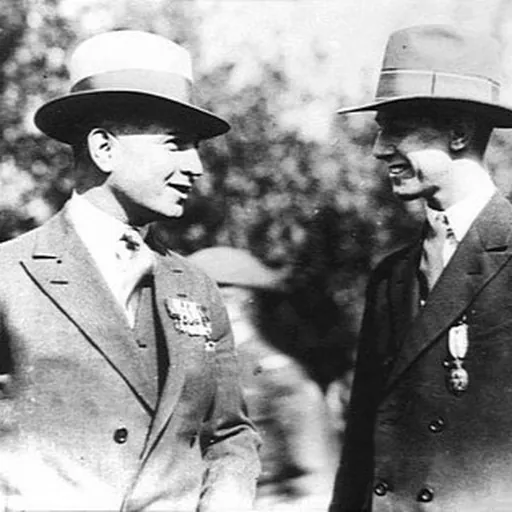
About Issy Smith
Lived 1890 – 1940 (aged 49). Issy Smith was a British military personnel and politician.
Early life Smith was born in Constantinople, the son of Moses and Eva Shmeilowitz, who were of Russian Empire Jewish origin. They met in Berdychiv and later relocated to Odessa. They left Rostov-on-Don in 1888 for Turkey. They relocated to Egypt at the start of the 1900s. Although it was alleged his father was employed by the French Consulate-General as a clerk in Egypt, 'this has to be completely false. Moses would have been nearly 80 years of age by the time he took the job –and he spoke no French' Eva worked as a seamstress, and Moses worked a sewing machine. It is not clear what other work he obtained.
Aged 11, Smith embarked as a stowaway aboard a vessel proceeding to London, where his elder brothers had migrated to. Undaunted by this unfamiliar environment, Smith attended Berner Street School, Commercial Street, London, and worked as a deliverer in the East End, then an impoverished ghetto where Yiddish was the predominant spoken language. Persecution and extreme deprivation had compelled millions of Eastern European Jews to migrate to Western Europe, the Americas, and elsewhere. By the time of Issy Smith's arrival, Jewish immigration to Britain had peaked but was curtailed by the enactment of the Aliens Act in 1905.
It was theorised that the pseudonym Issy Smith was adopted, in the process of enlisting, at the behest of a recruiting sergeant. This legend has been dismissed as apocryphal, as this surname was already used by his brothers Jacob and Joseph and Morris who lived in London. He joined the militia on 21 April 1904, giving a declared age of 17 years, 8 months. He was working as a plumber, living in Manchester. He enlisted under regular terms of service in the British Army on 2 September 1904, giving a declared age of 18 years, joining as a private in the Manchester Regiment. Smith completed his training, later he was posted to South Africa on 15 March 1906. From here, he was then sent on 28 October 1906 to India to join the 1st Battalion, and disembarked at Bombay on 6 November 1906. At the time of the 1911 census, he was stationed at Kamptee Cantonment in the Nagpur division within India. He boxed competitively. He was the middleweight champion of his battalion. disembarked at Southampton on 11 October 1912, then headed to the discharge depot at Fort Brockhurst. He was transferred to the army reserve on 15 October 1912, after eight years of service with the colours. A newspaper article states that upon returning to London from India, he was greeted at the railway station by his brother, accompanied by Elsie, who would later become his wife. ) He changed from Army Reserve Section A, with its higher pay but the soldier was not permitted 'to reside out of the United Kingdom', to Army Reserve Section B on 20 May 1914.
World War I Given that he was retained as a reservist until 1 September 1916, for the remainder of his 12-year engagement, Smith was mobilised by the British Army after the commencement of hostilities in August 1914,, as were his reservist comrades back in the UK. He was one of more than 200 Imperial reservists that were mobilised in Victoria. Some contemporary newspaper articles sources state that Smith was present at the capture of German New Guinea by the Australian Naval and Military Expeditionary Force. In June, he was being treated at No. 6 Stationary Hospital at Le Havre. Smith's service record suggests that he was medically evacuated from France in August 1915. ('Dublin Jews yesterday morning besieged the Dublin University V.A.D.) Auxiliary Hospital in Mountjoy square, for one of the inmates; Corporal Issy Smith, one of their co-religionists, had just been awarded the V.C. Corporal Smith had been in the hospital since August 8th.... it was not long before they went, in ones and twos and dozens, to the hospital at Mountjoy square, where he has been slowly recovering from the effects of gas poisoning since August 8th.' He was feted by publications such as The Jewish Chronicle, and his status as a recipient of the VC was utilised by the British government for the purposes of stimulating further recruitment. His visits to Jewish communities in the United Kingdom generated much interest, attracting dignitaries and large crowds in the process. On one such occasion, in September 1915, he was invited back to his old school in the East End to receive a gold watch and chain in honour of his Victoria Cross. Also that month, Smith was received at Mansion House, Dublin, by the Under-Secretary for Ireland, Matthew Nathan, who took advantage of the occasion to reaffirm loyalty to both Britain and Ireland. Contemporaries, however, continued to report instances of discrimination against Jewish servicemen, including an incident involving Issy Smith in Leeds. While documenting his recruitment drive, The Jewish Chronicle reported that the proprietor of the Grand Restaurant had refused to serve Smith during his tour of Yorkshire because he was Jewish, while indicating the staff were prepared to accept his non-Jewish acquaintance. Smith's tour continued otherwise without disruption, taking him to Edinburgh, Scotland. His appointed rank changed from Acting Corporal to unpaid Acting Lance Sergeant on 5 October 1915, then he was promoted to Sergeant on 7 March 1916.
Meanwhile, on the Western Front, the demoralised and depleted Indian Corps fought its final European battle at Loos. With the exception of two cavalry divisions, the Indian Corps in Europe redeployed to the Middle East theatre, sailing from Marseille on 10 December 1915 and arriving in Basra on 8 January 1916 to be integrated into the Mesopotamian Expeditionary Force.
Smith returned to active duty as a sergeant. He was posted to the 1st Battalion on 4 September 1916, serving in Mesopotamia. Within a fortnight of arriving at Basra, he was hospitalised with malaria. After the capture of Baghdad on 11 March 1917, Smith's nose was broken by a shell during the subsequent fighting. He transferred to the Royal Engineers on 1 April 1917. and his tailor's copy of a Durbar commemorative medal. In postwar photos, he is also wearing a trio of WW1 campaign medals, along with the French , with bronze palm. He was chosen as a guard of honour, accompanying 73 other holders of the Victoria Cross, at the Burial of the Unknown Warrior, Westminster Abbey, 11 November 1920, in the presence of the King. (It was mis-reported in an obituary in a Tasmanian newspaper that 'After the war [Issy] was chosen as a member of the late King's personal bodyguard when he visited India'. In 1922, he attended "The Pilgrimage to Ypres", in Belgium, laying a wreath at the Cloth Hall there.
Legacy alt=Black and white photograph of three boys. The two boys in the centre and right-hand side of the photo are wearing formal suits with medals pinned on the left-hand side of their chest. Only part of the head of the third boy is visible on the left-hand side of the photo. Despite his fame and popularity, like many former servicemen contending with post-war economic hardship, Smith struggled financially – a predicament compounded by illness. As a consequence he pawned his medals for £20, only for them to be recovered by the Jewish Historical Society on the urging of the wife of Chief Rabbi Joseph Hertz and ultimately reunited with Smith. Smith's varied occupations in post-war Britain included work as an actor with a theatre troupe. He had married his wife Elsie (née McKechnie) at Camberwell Register Office, followed by a formal ceremony held at Central Synagogue, Hallam Street, as an observance of Jewish religious tradition. Whether there was disapproval by the family, this is not known. The family relocated from Camberwell to Hackney later that year. The marriage to Elsie produced two children (Olive and Maurice, born 1919 and 1932 (died 2000 and 2020) respectively). He emigrated to Australia in 1927.
The family settled in Moonee Ponds, Melbourne, where Smith's standing in the Jewish community became high. There he joined the Essendon sub branch of the Returned and Services League of Australia (RSL). He was the President of the 1914 Imperial Reservists Association, Australia. In 1928, he was appointed manager of British International Pictures in Melbourne, and then worked for Dunlop Rubber Company. His final job was with the Civil Aviation Board at Essendon Airport. Appointed a Justice of the Peace in 1930, Smith tried politics as a candidate in the 1931 federal election for the United Australia Party, contesting the seat of Melbourne in the House of Representatives, and "seriously challenged the hitherto unassailable Dr Maloney".
On 20 February 1940, he sent a letter, to apply to join the Second Australian Imperial Force. A Major Barrett replied, to advise there were presently no suitable vacancies, but if he could provide the particulars of his army service and age, for future guidance, it would be appreciated. He sent a response to the Major, dated 4 March 1940, a copy of which is with the family. He stated that his date of birth was 18th September 1890.
Smith died of coronary thrombosis on 10 September 1940. He was buried in the Jewish section of Fawkner Cemetery with full military honours. In September 2010, the 70th Anniversary of his death was commemorated at a graveside ceremony in Melbourne, Major-General Jeffrey Rosenfeld laid a wreath. Over 100 people were in attendance, including Ben Hirsh as President, VAJEX Australia, and Captain Rabbi Dovid Gutnick (son of Mordechai Gutnick).
His medals were sold by his family in 1990, and auctioned 5 years later as part of a special collection of Medals to the Manchester Regiment, selling for £35,288 (US$75,000). Communities Secretary Eric Pickles announced in September 2013 that the plan, to memorialise the 482 British-born First World War Victoria Cross medal holders by laying commemorative paving stones in their home towns, would be extended to the 145 born overseas include Smith. At the time of the announcement, it was believed he was born in Egypt. He is commemorated in Rope Walk Gardens, a few minutes walk away from the location of Berners Street School in Whitechapel.
On 23 June 2026, a historical interpretive marker was mounted on the building in Hackney, London where he lived after the war. The marker was donated by the Jewish American Society for Historic Preservation, IDS Housing and AJEX U.K.
Don’t just read it —
keep it.
Full-length biographies made to live with: read them, listen on the way to work, watch them tonight.
- E-book
- Audio
- Video
Instant download · yours to keep · every purchase keeps this site free
Important facts
People in Issy Smith's life
Named in this biography and alive at the same time

Related people
Same field, nearest in time





Contemporaries
People whose lives overlapped Issy Smith's





Frequently asked questions
Who was Issy Smith?
British-Australian soldier (1890–1940)
When was Issy Smith born?
Issy Smith was born on 18 September 1890 in Constantinople.
When did Issy Smith die?
Issy Smith died on 10 September 1940 in Melbourne.
What was Issy Smith's occupation?
Issy Smith was a military personnel and politician.
What nationality was Issy Smith?
Issy Smith was British.
Sources & further reading
Cite this page
APA: Biography.guide. (2026). Issy Smith. https://biography.guide/issy-smith/
MLA: "Issy Smith." Biography.guide, https://biography.guide/issy-smith/.
Chicago: "Issy Smith." Biography.guide. https://biography.guide/issy-smith/.
Data last updated: 2026-09-23 · Spot an error? Report a correction.
Portrait: Wikimedia Commons · author & licence
Page generated 2026-09-27 05:05 UTC