About Ismail I
Lived 1487 – 1524 (aged 36). Ismail I was a governor, monarch, military leader, head of state, politician and poet.
Ismail I (; 17 July 1487 – 23 May 1524) was the founder and first shah of Safavid Iran, ruling from 1501 until his death in 1524. His reign is one of the most vital in the history of Iran, and the Safavid era is often considered the beginning of modern Iranian history. Under Ismail, Iran was unified under native rule for the first time since the Islamic conquest of the country eight-and-a-half centuries earlier.
Ismail inherited leadership of the Safavid Sufi order from his brother as a child. His predecessors had transformed the religious order into a military movement supported by the Qizilbash (mainly Turkoman Shiite groups). The Safavids took control of northwestern Iran, with Tabriz as the capital. In 1501, Ismail was crowned as shah (king). In the following years, Ismail conquered the rest of Iran and other neighbouring territories. His expansion into Eastern Anatolia brought him into conflict with the Ottoman Empire. In 1514, the Ottomans decisively defeated the Safavids at the Battle of Chaldiran, which brought an end to Ismail's conquests. Ismail fell into depression and heavy drinking after this defeat and died in 1524. He was succeeded by his eldest son Tahmasp I.
One of Ismail's first actions was the proclamation of the Twelver denomination of Shia Islam as the official religion of the Safavid state, marking one of the most important turning points in the history of Islam, which had major consequences for the ensuing history of Iran. He caused sectarian tensions in the Middle East when he destroyed the tombs of the Abbasid caliphs, the Sunni Imam Abu Hanifa, and the Sufi Muslim ascetic Abdul Qadir Gilani in 1508. It also reasserted Iranian identity in large parts of Greater Iran. The legacy of the Safavid Empire was also the revival of Iran as an economic stronghold between the East and the West, the establishment of a bureaucratic state, its architectural innovations, and patronage for fine arts. and seen as a precursor to the Azerbaijani language. He also contributed to Persian literature, though few of his Persian writings survive.
Origins
After the Battle of Chaldiran, Ismail lost his supernatural air and the aura of invincibility, gradually falling into heavy drinking. He retired to his palace and never again participated in a military campaign, and left the affairs of the state to his vizier Mirza Shah Husayn, who became his close friend and Nadeem (i.e. drinking companion). This allowed Mirza Shah Husayn to gain influence and expand his authority. Mirza Shah Husayn was assassinated in 1523 by a group of Qizilbash officers, after which Ismail appointed Zakariya's son Jalal al-Din Mohammad Tabrizi as his new vizier. Ismail died on 23 May 1524 aged 36 and was buried in Ardabil. He was succeeded by his son Tahmasp I.
The consequences of the defeat at Chaldiran were also psychological for Ismail; his relationships with the Qizilbash followers were fundamentally altered. The tribal rivalries between the Qizilbash which had ceased temporarily before the defeat at Chaldiran resurfaced intensely immediately after his death and led to ten years of civil war (930–40/1524–33) until Shah Tahmasp regained control of the affairs of the state. The Safavids later briefly lost Balkh and Kandahar to the Mughals, and nearly lost Herat to the Uzbeks.
Shah Ismail's death ensued after a few years of a very saddening and depressing period of his life. He was buried in Ardabil, next to the tomb of his illustrious ancestor Shayk Safi. The Tomb of Shah Ismail was built by his wife Tajlu Khanum in 1524, in the Sheikh Safi al-Din Khānegāh and Shrine Ensemble.
Another early commission was the contribution of additional miniatures in 1505 to an Aq Qoyunlu manuscript, the Khamsa of Nizami (Tabriz, 1481). Shah Isma'il entrusted the creation of eleven miniatures to the young painter Sultan Mohammed, who later became a key artist of the Safavid school. Some of the paintings created by Sultan Mohammed for this manuscript are considered as highly original, such as The Mir'aj of Prophet Muhammad (now in the Keir Collection in London), in which the Prophet can be seen rising over the Great Mosque in Mecca, the Ka'ba and his tomb, riding into a billowing mass of heavenly clouds with a multitude of angels. The sky is pieced with an oculus, an artistic device of probable European origin. A small inscription in gold letters on the portal of a small building on a terrace gives the date of creation as 1505.
One of the main criteria used to differentiate the Safavid miniatures from the Aq Qoyunlu ones is for a great part iconographic, as the protagonists in Shah Isma'il's paintings generally wear his signature turban, the Taj-i Haydari, which he introduced when he occupied Tabriz in 1501-1502.
Towards the end of his reign, circa 1520-21, Shāh Ismaʿīl also commissioned panegyric histories of his accomplishments, where he can be seen in various court and battle scenes. These works, such as the Shāhnāmah Shāh Ismaʿīl (Tabriz, 1541), were generally completed only after he died.
Probably about 1522, Shah Isma'il started a sumptuous illuminated manuscript of the Shahnameh for his son Shah Tahmasp I. But Shah Ismail I died in 1524, shortly after the work had begun. Work continued into the 1530s, ultimately including 258 original miniatures. It is now dispersed, and known under the name of Shahnameh of Shah Tahmasp.
Ismail's poetry Dīvān of Khatā'ī (Collected Poems by Shah Isma’il), "Five youths in the garden". Tabriz. 1515-20s. Text in Turkish in black nasta’liq script: "I have never seen anyone so beautiful as you on the earth, never in this world anyone as gorgeous as you. Truly within the garden of the soul there can be no gesture so elegant as your tall erect cypress. Although there are many beauties among humanity, there is none, O Beauty, so radiant as you". Dīvān of Khatā'ī (Collected Poems by Shah Isma’il), "The Castle". Tabriz. 1515-20s. Text on the castle walls: "Founder of the Sultanate, the greatest sultan and most just, most noble emperor, liege lord of the kings of the Arabs and Persians, layer of the foundations of justice and munificence, spreader of the carpet of safety and security, Abu'l-Muzaffar Shah Isma'il Bahadur Khan". Ismail is also known for his poetry using the pen name Khaṭāʾī (, 'sinner', or 'the mistaken one'). Khatai was a popular pen name among Iranian poets, but none are as famous as Ismail. He wrote in Turkish and Persian, although his extant verses in the former vastly outnumber those in the latter. The Turkish spoken in Iran, which was commonly known as Turki, was not the Turkish of Istanbul, but a precursor of modern-day Azerbaijani or Azeri Turkic (see also: Ajem-Turkic). His devotional poetry was meant for the mainly Turkish-speaking Qizilbash who followed him, hence his decision to write in that language.
Most of the poems are concerned with love—particularly the mystical Sufi kind—though there are also poems propagating Shi'i doctrine and Safavi politics. His other serious works include the Nasihatnāme, a book of advice sometimes included in his divan, and the unfinished Dahnāme, a book which extols the virtues of love—both written in proto-Azeri Turkic.
Along with the poet Imadaddin Nasimi, Khata'i is considered to be among the first proponents of using a simpler Azerbaijani language in verse that would appeal to a broader audience. His work is most popular in Azerbaijan, as well as among the Bektashis of Turkey. There is a large body of Alevi and Bektashi poetry that has been attributed to him. The major impact of his religious writings, in the long run, was the conversion of Persia from Sunni to Shia Islam.
Mughal portraiture A few Mughal depictions of Shah Ismail are also known, such as "Shah Ismail Safavi and Six of His Descendants", now in the Museum of Islamic Art, Doha, Qatar (MIA.2013.109). Shah Ismail Safavi appears seating under a symbolic canopy, together with several of his illustrious descendants from the line of his youger son Bahram Mirza Safavi, who formed a cadet branch of the Safavid dynasty in the service of the Mughal Empire that survived there for two centuries and became one of the most prominent families in the Mughal court.
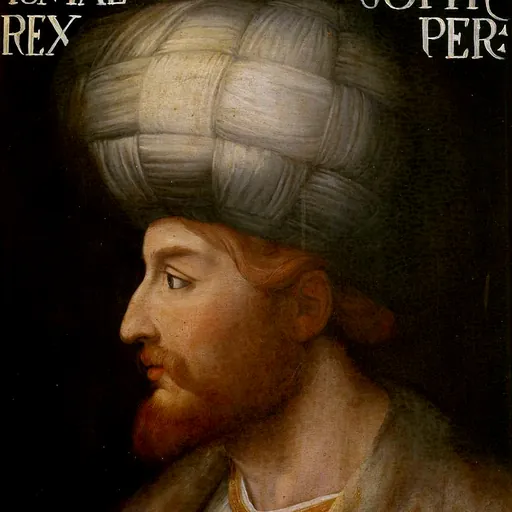
Europeans made several attempts at a portraiture of Sultan Ismail. Paolo Giovio, in his Elogia virorum bellica virtute illustrium (1554),
This portrait engraving was then used as a reference by the Italian painter Cristofano dell'Altissimo between 1552 and 1568 for his famous portrait of Shah Ismail in the Florencian style. It is thought that this portrait was affected by idealized notions of Shah Ismail as a savior of Christians and Europeans against the Ottomans, complete with rumors of a conversion of Christianity. According to Azerbaijani literary critic Hamid Arasly, this story is related to Ismail I. But it is also possible that it is dedicated to Ismail II.
Places and structures A district (Xətai raion), facility, monument (erected in 1993), and metro station in Baku, Azerbaijan A street in Ganja, Azerbaijan
Statues A statue in Ardabil, Iran (in the Azerbaijan region of Iran) A statue in Baku, Azerbaijan A sculpture in Khachmaz, Azerbaijan A bust in Ganja, Azerbaijan
Music Shah Ismayil is the name of an Azerbaijani mugham opera in 6 acts and 7 scenes composed by Muslim Magomayev, in 1915–19.
Other Shah Ismail Order (the highest Azerbaijani military award presented by the Commander-in-chief and President of Azerbaijan)
Issue
Sons Contemporary portrait of Shah Tahmasp, son of Shah Ismail. Cartier Hafiz, painted circa 1531. Likely depiction of Mahinbanu Soltanum, daughter of Shah Ismail. Qazvin, circa 1544. Tahmasp I – with Tajlu Khanum. Alqas Mirza (15 March 1515 – 9 April 1550) Governor of Astrabad 1532/33–1538, Shirvan 1538–1547 and Derbent 1546–1547. He rebelled against his brother Tahmasp with Ottoman help. Captured and imprisoned at the Fortress of Qahqahan. He had a consort, Khadija Sultan Khanum, and two sons, Ahmad Mirza (died 1568) Farukh Mirza (died 1568) Rostam Mirza (born 13 September 1517) Sam Mirza (28 August 1518 – December 1567) Governor-General of Khorasan 1521–1529 and 1532–1534, and of Ardabil 1549–1571. He rebelled against his brother Tahmasp, was captured and imprisoned at the Fortress of Qahqahan. He had two sons and one daughter. His daughter married Prince Jesse of Kakheti (died 1583) Governor of Shaki, the third son of Georgian king Levan of Kakheti. Bahram Mirza (7 September 1518 – 16 September 1550) – with Tajlu Khanum. Governor of Khorasan 1529–1532, Gilan 1536–1537 and Hamadan 1546–1549. He married Zainab Sultan Khanum and had three sons: Soltan Hosayn Mirza (died 1577) Ibrahim Mirza (1541–1577), Badi uz-Zaman Mirza (k.1577) Hossein Mirza (born 11 December 1520)
Daughters Pari Khan Khanum – with Tajlu Khanum, married in 1520–21 to Shirvanshah Khalilullah II; Mahinbanu Khanum – with Tajlu Khanum Khanesh Khanum (1507–563, buried in Imam Husayn Shrine, Karbala), married to Shah Nur-al Din Nimatullah Baqi, and had a son named Mirmiran and a daughter named Pari peykar Begum (Wife of Ismail II); Khair al-Nisa Khanum (died at Masuleh, 13 March 1532, and buried in Sheikh Safi al-Din tomb, Ardabil), married on 5 September 1517 to Amira Dubbaj, ruler of Gilan and Fuman; Shah Zainab Khanum; Nakira Khanum; Farangis Khanum;
Ancestry
Don’t just read it —
keep it.
Full-length biographies made to live with: read them, listen on the way to work, watch them tonight.
- E-book
- Audio
- Video
Instant download · yours to keep · every purchase keeps this site free
Important facts
Family & relationships
People in Ismail I's life
Named in this biography and alive at the same time

Related people
Same field, nearest in time



Contemporaries
People whose lives overlapped Ismail I's

Frequently asked questions
Who was Ismail I?
founder and first shah of Safavid Iran
When was Ismail I born?
Ismail I was born on 17 July 1487 in Ardabil.
When did Ismail I die?
Ismail I died on 23 May 1524 in Tabriz.
What was Ismail I's occupation?
Ismail I was a governor, monarch, military leader, head of state, politician and poet.
What nationality was Ismail I?
Ismail I's recorded nationality: Safavid Iran.
Sources & further reading
Cite this page
APA: Biography.guide. (2026). Ismail I. https://biography.guide/ismail-i/
MLA: "Ismail I." Biography.guide, https://biography.guide/ismail-i/.
Chicago: "Ismail I." Biography.guide. https://biography.guide/ismail-i/.
Data last updated: 2026-09-20 · Spot an error? Report a correction.
Page generated 2026-09-27 05:10 UTC