
Isidore of Seville
Hispano-Roman scholar, theologian and bishop
About Isidore of Seville
Lived 560 – 636 (aged 75–76). Isidore of Seville was a writer, musicologist, philosopher, music theorist, catholic priest and historian.
Isidore of Seville (; 4 April 636) was a Hispano-Roman scholar, theologian and archbishop of Seville. He is widely regarded, in the words of the 19th-century historian Charles Forbes René de Montalembert, as "the last scholar of the ancient world".
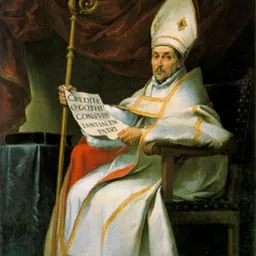
At a time of disintegration of classical culture, aristocratic violence, and widespread illiteracy, Isidore was involved in the conversion of the Arian Visigothic kings to Catholicism, both assisting his brother Leander of Seville and continuing after Leander's death. He was influential in the inner circle of Sisebut, Visigothic king of Hispania. Like Leander, he played a prominent role in the Councils of Toledo and Seville.
His fame after his death was based on his Etymologiae, an etymological encyclopedia that assembled extracts of many books from classical antiquity that would otherwise have been lost. This work also helped to standardise the use of the full stop, comma and colon.
Since the Early Middle Ages, Isidore has sometimes been called Isidore the Younger or Isidore Junior , because of the earlier history purportedly written by Isidore of Córdoba.
Childhood and education Isidore was born in Cartago Spartaria (now Cartagena, Spain), a former Carthaginian colony, to a notable family in Roman Hispania, of high social rank, His father was named Severianus and his mother Theodora.
Isidore received his elementary education in the Cathedral school of Seville. and acquired some Greek and Hebrew.
Two centuries of Gothic control of Iberia incrementally suppressed the ancient institutions, classical learning, and manners of the Roman Empire. The associated culture entered a period of long-term decline. The ruling Visigoths nevertheless showed some respect for the outward trappings of Roman culture. Arianism meanwhile took deep root among the Visigoths as the form of Christianity that they received.
Fourth National Council of Toledo
All bishops of Hispania attended the Fourth National Council of Toledo, begun on 5 December 633. The aged Archbishop Isidore presided over its deliberations and originated most enactments of the council.
In it, Isidore entered his own terse digest of Roman handbooks, miscellanies and compendia. He continued the trend towards abridgements and summaries that had characterised Roman learning in late antiquity. In the process, many fragments of classical learning are preserved that otherwise would have been hopelessly lost; "in fact, in the majority of his works, including the Origines, he contributes little more than the mortar which connects excerpts from other authors, as if he was aware of his deficiencies and had more confidence in the stilus maiorum than his own", his translator Katherine Nell MacFarlane remarks. —that it superseded the use of many individual works of the classics themselves, which were not recopied and have therefore been lost: "all secular knowledge that was of use to the Christian scholar had been winnowed out and contained in one handy volume; the scholar need search no further".
Book VIII of the Etymologiae covers religion, including the Christian Church, Judaism, heretical sects, pagan philosophers, sibyls, and magi. In this section, Isidore documents pre-Christian religious and magical beliefs, preserving knowledge about ancient magical practices, even while condemning them as superstition. His writings serve as one of the few surviving records of magical thought in early medieval Europe, helping to transmit classical esoteric ideas into the Middle Ages.
The fame of this work imparted a new impetus to encyclopedic writing, which bore abundant fruit in the subsequent centuries of the Middle Ages. It was the most popular compendium in medieval libraries. It was printed in at least ten editions between 1470 and 1530, showing Isidore's continued popularity in the Renaissance. The Etymologiae was much copied, particularly into medieval bestiaries.
On the Catholic Faith against the Jews
Isidore's De fide catholica contra Iudaeos furthers Augustine of Hippo's ideas on the Jewish presence in the Christian society of the ancient world. Like Augustine, Isidore held an acceptance of the Jewish presence as necessary to society because of their expected role in the anticipated Second Coming of Christ.
But Isidore had access to Augustine's works, out of which one finds more than forced acceptance of but rather broader reasons than just an endtime role for Jews in society:
iversities in the manners, laws, and institutions whereby earthly peace is secured and maintained [are not scrupled in the heavenly city for which we strive, while its citizens sojourn on earth], but recognizing that, however various they are, they all tend to one and the same end of earthly peace.
[The heavenly city] is therefore so far from rescinding and abolishing these diversities, that it even preserves and adopts them, so long only as no hindrance to the worship of the one supreme and true God is thus introduced...and makes this earthly peace bear upon the peace of heaven; for this alone can be truly called and esteemed the peace of the reasonable creatures, consisting as it does in the perfectly ordered and harmonious enjoyment of God and of one another in God. (City of God, Book 19, Chapter 17)
According to Jeremy Cohen, Isidore exceeds the anti-rabbinic polemics of earlier theologians by criticising Jewish practice as deliberately disingenuous in De fide catholica contra Iudaeos.
But once again Isidore's same predecessor, Augustine, seems to have written of at least the possibility of Jewish rabbinical practice along that subject's content's purportedly deceptive lines in the same work cited above:
They say that it is not credible that the seventy translators [of the Septuagint] who simultaneously and unanimously produced one rendering, could have erred, or, in a case in which no interest of theirs was involved, could have falsified their translation, but that the Jews, envying us our translation of their Law and Prophets, have made alterations in their texts to undermine the authority of ours. (City of God, Book 15, Chapter 11)
He also contributed Canon 65, thought to forbid Jews and Christians of Jewish origin from holding public office.
Other works
Isidore's authored more than a dozen major works on various topics including mathematics, holy scripture, and monastic life, all in Latin: Historia de regibus Gothorum, Vandalorum et Suevorum, a history of the Gothic, Vandal and Suebi kings. The longer edition, issued in 624, includes the Laus Spaniae and the Laus Gothorum. Chronica Majora, a universal history De differentiis verborum, a brief theological treatise on the doctrine of the Trinity, the nature of Christ, of Paradise, angels, and men De natura rerum (On the Nature of Things), a book of astronomy and natural history dedicated to the Visigothic king Sisebut Questions on the Old Testament Liber numerorum qui in sanctis Scripturis occurrunt, a mystical treatise on the allegorical meanings of numbers a number of brief letters De viris illustribus De ecclesiasticis officiis De summo bono or Sententiae libri tres De ortu et obitu patrum Regula Monachorum
Veneration
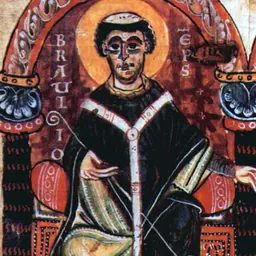
Isidore was one of the last of the ancient Christian philosophers and was contemporary with Maximus the Confessor. He has been called the most learned man of his age by some scholars, and he exercised a far-reaching and immeasurable influence on the educational life of the Middle Ages. His contemporary and friend Braulio of Zaragoza said of him: "After so much destruction and so many disasters, God has raised him in recent times to restore the monuments of the ancients, so that we would not fall completely into barbarism".
The Eighth Council of Toledo (653) recorded its admiration of his character in these glowing terms: "The extraordinary doctor, the latest ornament of the Catholic Church, the most learned man of the latter ages, always to be named with reverence, Isidore". This tribute was endorsed by the Fifteenth Council of Toledo, held in 688. Isidore was proclaimed a Doctor of the Church in 1722 by Pope Innocent XIII.
Isidore was interred in Seville. His tomb represented an important place of veneration for the Mozarabs during the centuries after the Arab conquest of Visigothic Hispania. In the middle of the 11th century, with the division of Al Andalus into taifas and the strengthening of the Christian holdings in the Iberian Peninsula, Ferdinand I of León and Castile found himself in a position to extract tribute from the fractured Arab states. In addition to money, Abbad II al-Mu'tadid, the Abbadid ruler of Seville (1042–1069), agreed to turn over St. Isidore's remains to Ferdinand I. A Catholic poet described al-Mutatid placing a brocaded cover over Isidore's sarcophagus, and remarked, "Now you are leaving here, revered Isidore. You know well how much your fame was mine!" Ferdinand had Isidore's remains reinterred in the then-recently constructed Basilica of San Isidoro in León. Today, many of his bones are buried in the cathedral of Murcia, Spain.
Criticisms and contemporary appraisal
Contemporary researchers have criticised Isidore—specifically, his work in the Etymologies. The historian Sandro D'Onofrio has argued that "job consisted here and there of restating, recapitulating, and sometimes simply transliterating both data and theories that lacked research and originality".
In this view, Isidore—considering the large popularity his works enjoyed during the Middle Ages and the founding role he had in Scholasticism—would be less a brilliant thinker than a Christian gatekeeper making etymologies fit into the Christian worldview. "e prescribed what they should mean," asserts D'Onofrio.
The researcher Victor Bruno has countered this argument. According to him, it was not the meaning of the Etymologies, or of Isidore's work as a whole, to give a scientific or philological account of the words, as a modern researcher would do. "It is obvious that, from a material point of view," argues Bruno, "Isidore's practical knowledge on etymology, geography, and history are considered outdated; his methods, from the current academic and scientific standpoint, are questionable, and some of his conclusions are indeed incorrect. But Isidore is less concerned about being etymologically or philologically right than being ontologically right." In Bruno's view, Isidore, despite living in the 6th and 7th centuries, is an archaic or "traditional" thinker. Being religiously inclined, Isidore would be concerned with the redeeming meaning of words and history, the ultimate quest of religions. The same researcher also found parallels between Isidore's interpretation of the word "year" (annus) and the meaning of the same words in the Jāiminīya-Upaniṣad-Brāmaṇa.
Honours St. Isidore Island in Antarctica is named for him.
Don’t just read it —
keep it.
Full-length biographies made to live with: read them, listen on the way to work, watch them tonight.
- E-book
- Audio
- Video
Instant download · yours to keep · every purchase keeps this site free
Important facts
People in Isidore of Seville's life
Named in this biography and alive at the same time
Related people
Same field, nearest in time



Contemporaries
People whose lives overlapped Isidore of Seville's




Frequently asked questions
Who was Isidore of Seville?
Hispano-Roman scholar, theologian and bishop (c. 560–636)
When was Isidore of Seville born?
Isidore of Seville was born in 560 in Cartagena.
When did Isidore of Seville die?
Isidore of Seville died on 4 April 636 in Spalis.
What was Isidore of Seville's occupation?
Isidore of Seville was a writer, musicologist, philosopher, music theorist, catholic priest and historian.
What nationality was Isidore of Seville?
Isidore of Seville's recorded nationality: Kingdom of Toledo.
Sources & further reading
· Wikipedia: Isidore of Seville
Cite this page
APA: Biography.guide. (2026). Isidore of Seville. https://biography.guide/isidore-of-seville/
MLA: "Isidore of Seville." Biography.guide, https://biography.guide/isidore-of-seville/.
Chicago: "Isidore of Seville." Biography.guide. https://biography.guide/isidore-of-seville/.
Data last updated: 2026-09-20 · Spot an error? Report a correction.
Page generated 2026-09-27 05:25 UTC