
About Isidor Sârbu
Lived 1886 – 1980 (aged 93–94). Isidor Sârbu was a Romanian and Russian politician.
Isidor Sârbu, also known as Sîrbu (1887–1980), was a victim of dekulakization in the Moldavian Autonomous Soviet Socialist Republic (MASSR). Of Romanian heritage, Sârbu was born a citizen of the Russian Empire in Corjova, where he spent some fifty years of his life. Before the October Revolution, he had amassed a relatively large agricultural estate and was employing farmhands, leading him to be designated as a kulak. Politically and socially marginalized by the MASSR, he sold most of his properties before the land collectivization of 1930. Sârbu was allowed to join the collective farm, and became one of its managers, but in 1933 lost his position and found himself arrested by the OGPU. He received a suspended sentence for theft (due to having purposefully destroyed some of his crops), was stripped of his remaining property, and then reduced to supporting his wife and eight children as a day laborer.
In 1935, the NKVD engineered Sârbu's forced resettlement to Pervomaisk, separating him from his children. He was arrested after his clandestine return to Corjova, in 1936, and sentenced to a prison term in Tiraspol; in 1937, he broke the terms of his parole and was rearrested, along with his wife Tatiana. They returned to Corjova in 1940, shortly before Romania occupied the region. Narrowly escaping execution by the NKVD, Sârbu welcomed the Romanian-established Transnistria Governorate, which appointed him mayor of Corjova. He fled to Romania in early 1944, leaving most of his family behind. Sârbu was briefly active in the anti-communist resistance movement in Romania; upon the consolidation of a communist regime, which he reportedly continued to resent, he withdrew back into peasant life, spending the rest of his life at Brezoaele. His descendants in modern-day Moldova include Vladimir Voronin, who became chairman of the Party of Communists and served terms as President of Moldova. Voronin's connections to Sârbu, first exposed publicly in the early 2000s, have remained a topic of controversy.
Biography Early life and wealth Isidor Sârbu, described in some sources as a "full-blooded Romanian" or "great Romanian", was born in the village of Corjova, then part of the Russian Kherson Governorate—and on the Dniester-marked border with Bessarabia Governorate. His officially recorded year of birth is 1887, though he himself believed that he was already aged fifty-seven in early 1942. According to records of his interrogation, he was from a peasant family that, at one point, comprised eleven individuals; he had five sisters and four brothers. By 1917, his farm stretched over 40 hectares, in addition to which he leased 10–15 hectares; he owned two houses, some ten cows, and 25 sheep, and employed three or four seasonal farmhands. He and his wife Tatiana Negrea had eight living children by 1933; the oldest was a daughter, Olga, born in 1915 or 1916. Shortly after the war, Bessarabia united with Romania, leaving Corjova and the Sârbus in lands disputed between the Ukrainian People's Republic and the communist Odessa Soviet Republic. Isidor once described his first experiences with Bolshevism, in 1917, as a time when "all things came tumbling down." This period was followed by the collectivization of 1930. During the latter event Sârbu was recorded by MASSR officials as almost a kulak, but opted to enter Corjova's collective farm, possibly for fear of deportation to Siberia. He managed to earn the respect of his peers, being selected as one of the farm's administrators.
Soviet repression Despite his efforts at integration, Sârbu was targeted by the dekulakization campaign of 1932. Initially prosecuted for theft of collective property in August 1932 (he and one of his sons, Marcu, allegedly burned down some of the crops), A tribunal found the evidence against Isidor inconclusive, and he received a suspended sentence.
Sârbu himself reported that the OGPU had confiscated and sold his house in March 1933, leaving the family to bunk into a room in Corjova, rented to them by Dumitru Halippa. This situation lasted to 1934, when the Sârbus moved to the neighboring city, Dubăsari, where Isidor worked two jobs—as a vintager and as a brickmaker. The NKVD's Ivan Sterpul intervened in April 1935, be resettled away from the Romanian border. Isidor and Tatiana moved inland to Pervomaisk, leaving their children in the care of relatives from the Dubăsari area; upon arrival, Sârbu was rewarded with his first Soviet passport. Unable to provide for his family, he ignored NKVD orders and returned to Corjova that June, bunking with his brother-in-law Serghei Șpac. The Militsiya withdrew his passport, warning him that he should return to Pervomaisk. Sârbu continued to defy the authorities, and was again arrested in January 1936.
On January 14, 1936, the NKVD commandants of the MASSR sentenced Sârbu to three years in a penal facility at Tiraspol; a model prisoner who took up manual labor on the surrounding farmland, Their teen-aged daughter, Olga, was shocked by these news, which, as Sârbu himself noted, contributed to her death in May 1938. One of his sons had instead been drafted into the Red Army, and as such processed by Romania as a prisoner-of-war. The latter event again took him to Bucharest. Sârbu's newfound status lasted only until the Soviet reoccupation of 1944. Ahead of this defeat, he and his daughter Domnica took refuge in Romania; Tatiana and the couple's other children opted to stay in Corjova. As noted by historian Ion Varta, he petitioned the Romanian authorities not to extradite him, "allow[ing] him to live in Romania". Except for an enrollment with the anti-communist resistance in the Oaș Mountains, That side of the family had since achieved fame through Isidor's grandson Vladimir Voronin (born to Pelaghia). He began his political career with the Communist Party of Moldavia in the 1960s, when he reportedly abjured the Sârbus; His ascent continued in post-Soviet Moldova, when he became leader of the Party of Communists, serving as national president in 2001–2009. The story first broke in March 2002, when Gheorghe Budeanu published in Timpul an article asking that Voronin either confirm or deny his connection with Brezoaele.
The aged Domnica participated in the resulting debates. In 2002, she came out as a supporter of Moldovan–Romanian unionism and believer in a fused ethnic identity; she also argued that her father's native region, which had become a Soviet-style secessionist entity, was unsalvagable by Moldova, and should be "left to sink or swim". she shares her father's grave.
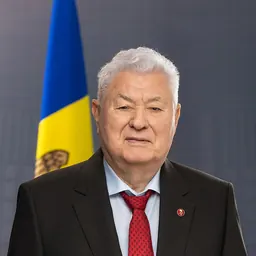
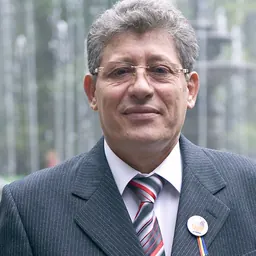
Voronin's successor as president, Mihai Ghimpu, ordered the dossiers of Soviet political prisoners to be declassified in 2010, which allowed public access to Sârbu's biographical records. In 2012, Voronin himself discussed his family history with journalist Lorena Bogza of ProTV Chișinău. He "admitted to being Isidor Sârbu's grandson, but denied that the latter had been an anti-communist, or that he had taken refuge to Romania of his own will. [Voronin] claimed that his grandfather wished to make his return to Corjova in 1945, but that he had been labeled a traitor by the Soviets, and only in that context did he prefer to stay in Romania." More in detail, Voronin argued that Sârbu had been sent to Romania with crates of ordnance, and denied that the family had ever been wealthy, other than owning a cart and horses. He also recounted having once met Domnica. Voronin left open the issue of his ethnic background, prompting journalists to argue that his ancestry may be entirely Romanian.
Don’t just read it —
keep it.
Full-length biographies made to live with: read them, listen on the way to work, watch them tonight.
- E-book
- Audio
- Video
Instant download · yours to keep · every purchase keeps this site free
Important facts
People in Isidor Sârbu's life
Named in this biography and alive at the same time


Related people
Same field, nearest in time





Contemporaries
People whose lives overlapped Isidor Sârbu's






Frequently asked questions
Who was Isidor Sârbu?
Moldovan politician
When was Isidor Sârbu born?
Isidor Sârbu was born in 1886 in Corjova.
When did Isidor Sârbu die?
Isidor Sârbu died in 1980 in Brezoaele.
What was Isidor Sârbu's occupation?
Isidor Sârbu was a politician.
What nationality was Isidor Sârbu?
Isidor Sârbu was Romanian and Russian.
Sources & further reading
Cite this page
APA: Biography.guide. (2026). Isidor Sârbu. https://biography.guide/isidor-sarbu/
MLA: "Isidor Sârbu." Biography.guide, https://biography.guide/isidor-sarbu/.
Chicago: "Isidor Sârbu." Biography.guide. https://biography.guide/isidor-sarbu/.
Data last updated: 2026-09-20 · Spot an error? Report a correction.
Page generated 2026-09-27 05:23 UTC