
About Isaac Taylor
Lived 1787 – 1865 (aged 77). Isaac Taylor was a British theologian and writer.
Isaac Taylor (17 August 1787 – 28 June 1865) was an English philosophical and historical writer, artist, and inventor.
Life He was the eldest surviving son of Isaac Taylor of Ongar. He was born at Lavenham, Suffolk, on 17 August 1787, and moved with his family to Colchester and, at the end of 1810, to Ongar. In the family tradition, he was trained as draughtsman and engraver. After a few years' occupation as a designer of book illustrations, he turned to literature as vocation.
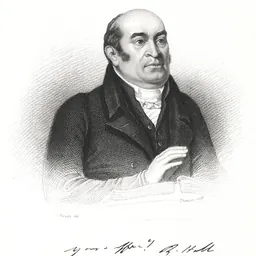
From 1812 to 1816 he wintered in the west of England, and he spent most of this time at Ilfracombe and Marazion in the company of his sister, Jane. About 1815 through the works of Sulpicius Severus he started to collect patristic literature. Shortly afterwards Francis Bacon's De Augmentis excited his interest in inductive philosophy. In 1818 a friend of the family, Josiah Conder, then editor of the Eclectic Review, persuaded Taylor to join its regular staff, which already included Robert Hall, John Foster, and Olinthus Gilbert Gregory.
Works As a young man he executed designs for his father and for the books issued by his sister Jane Taylor. He executed anatomical drawings for a surgeon, and painted miniatures, one a portrait of his sister, another of himself in 1817. Some of his designs for John Boydell's 'Illustrations of Holy Writ' (1820), were admired by Dante Gabriel Rossetti, and compared by Alexander Gilchrist with some of the plates of William Blake (Life of Blake, 1863). it appeared in two sumptuous illustrated volumes (1847 and 1851), but lost money.
In his publication during 1839–40 of Ancient Christianity and the Doctrines of the Oxford Tracts (in 8 parts, London; 4th edit. 1844, 2 vols.), Taylor argued as controversialist against the Tracts for the Times, his contention being that the Christian Church of the fourth century had already matured into superstition and error. This view was contested. Loyola and Jesuitism in its Rudiments (London, 1849; several editions) and Wesley and Methodism (London, 1851; 1863, 1865, and New York, 1852) were followed by a popular work on the Christian argument, The Restoration of Belief (London, 1855; several American editions), an anonymous publication. Logic in Theology and Ultimate Civilisation were volumes of essays reprinted in part from the Eclectic Review during 1859 and 1860, and were followed in turn by The Spirit of Hebrew Poetry (London, 1861; numerous editions), a volume of lectures, originally delivered at Edinburgh. After Considerations on the Pentateuch (London, 1863; two editions), in which he opposed the conclusions of John William Colenso, and a number of short memoirs for the Imperial Dictionary of Biography, his last work was Personal Recollections (London, 1864), a series of papers, in part autobiographical, which had appeared in Good Words.
Inventor Taylor was interested in mechanical devices and inventions, and he had a workshop that he fitted up at Stanford Rivers. Early in life he invented a beer-tap (patented 20 November 1824) which came into wide use, and he designed a machine for engraving on copper (pat. 12248, 21 August 1848). Though it did not profit him, the idea was eventually applied on a large scale by a syndicate to engraving patterns on copper cylinders for calico printing in Manchester.
Family
Two of his sisters had a reputation as poets. Ann Taylor, later Mrs. Gilbert (1782–1866), and Jane (1783–1824), responsible for the well-known rhyme Twinkle Twinkle Little Star. Josiah Gilbert, son of Ann Taylor, was an artist and author.
Taylor's children were:
Jane, who married, first, Dr. Harrison, and secondly, the Rev. S. D. Stubbs; Isaac Taylor (1829–1901), churchman and author; Phœbe; James Medland Taylor, architect, born 1834; Rosa; Henry Taylor, architect and author, born in 1837; Catherine; Jessie, who married Thomas Wilson; and Euphemia.
Don’t just read it —
keep it.
Full-length biographies made to live with: read them, listen on the way to work, watch them tonight.
- E-book
- Audio
- Video
Instant download · yours to keep · every purchase keeps this site free
Important facts
People in Isaac Taylor's life
Named in this biography and alive at the same time



Related people
Same field, nearest in time



Contemporaries
People whose lives overlapped Isaac Taylor's


Frequently asked questions
Who was Isaac Taylor?
British writer (1787-1865)
When was Isaac Taylor born?
Isaac Taylor was born on 17 August 1787 in Lavenham.
When did Isaac Taylor die?
Isaac Taylor died on 28 June 1865.
What was Isaac Taylor's occupation?
Isaac Taylor was a theologian and writer.
What nationality was Isaac Taylor?
Isaac Taylor was British.
Sources & further reading
Cite this page
APA: Biography.guide. (2026). Isaac Taylor. https://biography.guide/isaac-taylor-theologian/
MLA: "Isaac Taylor." Biography.guide, https://biography.guide/isaac-taylor-theologian/.
Chicago: "Isaac Taylor." Biography.guide. https://biography.guide/isaac-taylor-theologian/.
Data last updated: 2026-09-20 · Spot an error? Report a correction.
Page generated 2026-09-27 05:32 UTC