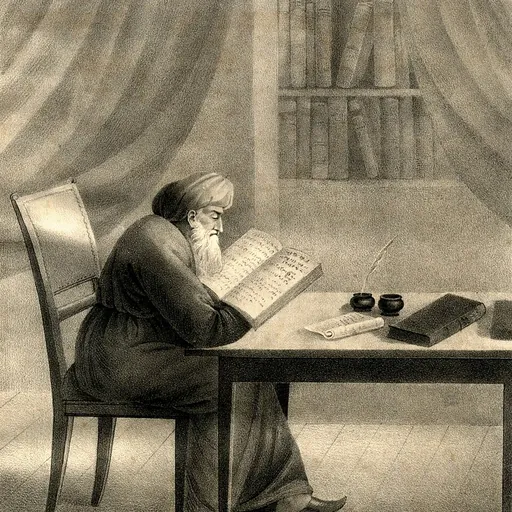
About Isaac Alfasi
Lived 1013 – 1103 (aged 89–90). Isaac Alfasi was a rabbi, writer, posek, religious studies scholar, scholar and talmudist.
Isaac ben Jacob Alfasi (1013–1103) (, ), also known as the Alfasi or by his Hebrew acronym, the Rif ( Rabbi Isaac al-Fasi), was a Maghrebi Talmudist and posek (decider in matters of Halakha). He is best known for his halakhic legal work Sefer Ha-halachot, considered the first fundamental work in halakhic literature.
Biography He was born in Qal'at Bani Hammad in modern-day Algeria, the capital city of the Sanhaja Hammadid dynasty of the central Maghreb, and is sometimes called "ha-Kala'i" because of it. hence the name "al fasi". Fez's Jewish community undertook to support him and his family so that he could work on his Sefer Ha-halachot undisturbed. They also founded a yeshiva in his honor, and many students throughout Morocco came to study under his guidance. The most famous of his many students is Judah Halevi, author of the Kuzari; he also taught Joseph ibn Migash (the Ri Migash), who was in turn a teacher of Rabbi Maimon, father and teacher of Maimonides (Rambam).
Alfasi remained in Fez for 40 years, during which time he completed his Sefer Ha-halachot. In 1088, aged seventy-five, two informers denounced him to the government upon some unknown charge. He left Fes for Al-Andalus, eventually becoming head of the yeshiva in Lucena, Córdoba in 1089.
His "magnanimous character" is illustrated by two incidents. When his opponent Isaac Albalia died, Alfasi adopted Albalia's son. When Alfasi was himself on the point of death, he recommended as his successor in the Lucena rabbinate, not his own son, but his pupil Joseph ibn Migash.
Sefer haHalachot Sefer ha-Halachot (ספר ההלכות), also known as Hilchot haRif or Hilchot Rav Alfas (Hebrew: הלכות רב אלפס), was Alfasi's main work, written in Fez. It extracts all the pertinent legal decisions from the three Talmudic orders Moed, Nashim and Nezikin as well as the tractates of Berachot and Chulin - 24 tractates in all. Alfasi transcribed the Talmud's halakhic conclusions verbatim, without the surrounding deliberations; he also excludes all Aggadic (non-legal, homiletic) matter as well as discussion of the halakha practicable only in Land of Israel.
Generally the work follows the ordering of the Talmud, but sometimes Talmudic excerpts are moved from place to place, and very rarely non-Talmudic texts are incorporated into the work.
Impact Maimonides wrote that Alfasi's work "has superseded all the geonic codes…for it contains all the decisions and laws which we need in our day…".
Sefer ha-Halachot plays a fundamental role in the development of Halakha. Firstly, "the Rif" succeeded in producing a Digest, which became the object of close study, and led in its turn to the great Codes of Maimonides and of Rabbi Joseph Karo. Secondly, it served as one of the "Three Pillars of Halakha", as an authority underpinning both the Arba'ah Turim and the Shulkhan Arukh. Nissim of Gerona (the RaN) compiled a detailed and explicit commentary on this work; in yeshivot, "the Rif and the RaN" are regularly studied as part of the daily Talmudic schedule.
This work was published before the times of Rashi and other commentaries, and resulted in a profound change in the study practices of the scholarly Jewish public in that it opened the world of the gemara to the public at large. It soon became known as the Talmud Katan ("Little Talmud"). At the close of the Middle Ages, when the Talmud was banned in Italy, Alfasi's code was exempted so that from the 16th to the 19th centuries his work was the primary subject of study of the Italian Jewish community. Alfasi also occupies an important place in the development of the Sephardic method of studying the Talmud. In contradistinction to the Ashkenazi approach, the Sephardim sought to simplify the Talmud and free it from casuistical detail; see for example Hananel ben Hushiel.
Other works Alfasi also left many responsa. These were originally written in Judeo-Arabic and soon translated into Hebrew as She'elot u-Teshuvot ha-Rif.
Don’t just read it —
keep it.
Full-length biographies made to live with: read them, listen on the way to work, watch them tonight.
- E-book
- Audio
- Video
Instant download · yours to keep · every purchase keeps this site free
Important facts
more
Yiṣḥāq Ben-Yaʿaqov, Ishaq ibn Ya'aqob al-FasiPeople in Isaac Alfasi's life
Named in this biography and alive at the same time


Related people
Same field, nearest in time





Contemporaries
People whose lives overlapped Isaac Alfasi's




Frequently asked questions
Who was Isaac Alfasi?
Maghrebi Talmudist and posek (1013–1103)
When was Isaac Alfasi born?
Isaac Alfasi was born in 1013 in Qal'at Bani Hammad.
When did Isaac Alfasi die?
Isaac Alfasi died in 1103 in Lucena.
What was Isaac Alfasi's occupation?
Isaac Alfasi was a rabbi, writer, posek, religious studies scholar, scholar and talmudist.
What nationality was Isaac Alfasi?
Isaac Alfasi's recorded nationality: Almoravid dynasty.
Sources & further reading
Cite this page
APA: Biography.guide. (2026). Isaac Alfasi. https://biography.guide/isaac-alfasi/
MLA: "Isaac Alfasi." Biography.guide, https://biography.guide/isaac-alfasi/.
Chicago: "Isaac Alfasi." Biography.guide. https://biography.guide/isaac-alfasi/.
Data last updated: 2026-09-21 · Spot an error? Report a correction.
Portrait: Wikimedia Commons · author & licence
Page generated 2026-09-27 05:01 UTC