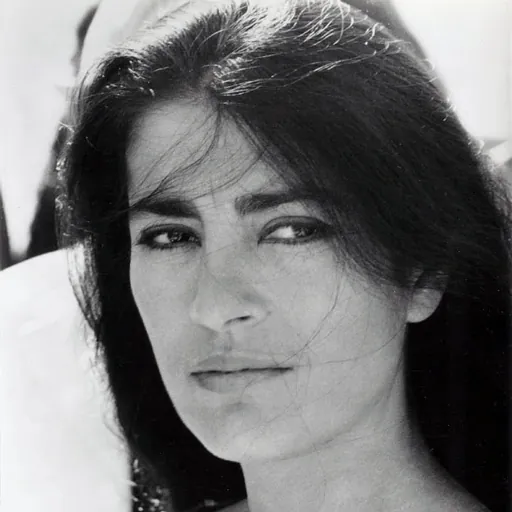
About Irene Papas
Lived 1929 – 2022 (aged 93). Irene Papas was a Greek actor, singer, film director and dancer.
Early life Papas was born as Eirini Lelekou (Ειρήνη Λελέκου) on 3 September 1929, (There has been confusion over the date of birth, with the Enciclopedia Italiana stating in 1994 that Papas was born on 3 September 1926 rather than 3 September 1929.) ). Papas addressed the confusion directly, noting that she had often been described as three years older than she actually was. At the start of an interview on Greek state television in 2004 she said "I was born on Sept. 3, 1929. All the papers are there in Chiliomodi [her home village]". in the village of Chiliomodi, outside Corinth, Greece. Her mother, Eleni Prevezanou (Ελένη Πρεβεζάνου), was a schoolteacher, and her father, Stavros Lelekos (Σταύρος Λελέκος), taught classical drama at the Sofikós school in Corinth. The family moved to Athens when she was seven years old. She found the acting style advocated by the school old-fashioned, formal, and stylised, and rebelled against it, causing her to have to repeat a year; she eventually graduated in 1948. She played in Iphigenia in Aulis in Broadway's Circle in the Square Theatre in 1968.
She starred in Medea in 1973 on Broadway. Reviewing the production in the New York Times, drama critic Clive Barnes described her as a "very fine, controlled Medea", smouldering with a "carefully dampened passion", constantly fierce. Theatre critic Walter Kerr also praised the performance. Both saw in her portrayal what Barnes called an "unrelenting determination and unwavering desire for justice". She appeared in The Bacchae in 1980 at Circle in the Square, She began to attract attention with her role in Frixos Iliadis's 1952 film Dead City (Greek, "Nekri Politeia"). The film was shown at the Cannes Film Festival, where Papas was welcomed by the international press, and photographed spending time with the wealthy Aga Khan. Greek filmmakers thought her a noncommercial actress, and she tried her hand abroad, signing with Lux Film in Italy, where the publicity for Dead City was enough to launch her as a film star. She played in Lux's 1954 films Attila and Theodora, Slave Empress, which attracted Hollywood's attention. in his Iphigenia (1977).
Papas made her name playing powerful women in films of Greek tragedy, such as Clytemnestra in Euripides's play Iphigenia in Aulis.
Hollywood Papas debuted in American film with a bit part in the B-movie The Man from Cairo (1953); her next American film was a much larger role as Jocasta Constantine, with James Cagney, in the Western Tribute to a Bad Man (1956).
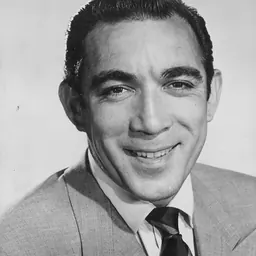
In The Guns of Navarone, she stars as a resistance fighter involved in the action, an addition to Alistair Maclean's novel , providing a love interest and a strong female character. Gerasimus Katsan comments that she plays a "hard as nails" partisan in The Guns of Navarone, "capable, unafraid, stoic, patriotic and heroic"; when the men hesitate, she kills the treacherous Anna; but although she interacts romantically with Andreas (Anthony Quinn), she remains "cool and rational", revealing little of her sensual persona; she is as tough as the men, like the stereotype of a Greek village woman, but she is contrasted with them in the film. Katsan said that she was most often remembered as the "sensual widow" in Zorba. The scholar of film Jefferson Hunter wrote that Papas helped lift Zorba from being merely an "exuberant" film with the stark passion of her subplot role.
This success did not earn her an easy life; she stated that she did not work for 2 years after Electra, despite the prizes and acclamation; and again, she was out of work for 18 months after Zorba. It turned out to be her most popular film, but she said she earned only $10,000 from it. She played an admired Catherine of Aragon in Anne of the Thousand Days, opposite Richard Burton and Geneviève Bujold in 1969. In 1976, she starred in The Message about the origin of Islam, a film which Mark Cousins stated was "perhaps seen by as many people as...any film in cinema history." In 1982, she appeared in Lion of the Desert. One of her last film appearances was in Captain Corelli's Mandolin in 2001, where in Katsan's view she was underused reprising her strong peasant woman from The Guns of Navarone and the widow from Zorba. In the view of the film critic Philip Kemp, She stood out in Costa-Gavras's 1968 political film Z, based on a real-life assassination, and in Ruy Guerra's 1983 Eréndira, with a screenplay by the novelist Gabriel García Márquez. Ordinary actors, he suggested, had trouble sharing the screen with Papas. All the same, her presence in many well-known movies, wrote Ebert, inspired "something of a cult". That made her Helen in The Trojan Women, pacing up and down like a caged panther "with just the searching eyes darting through the bars", a "marvelous surprise", as Hollywood saw that in fact she was also an accomplished actor.
The scholar of Greek, Gerasimus Katsan, called her the most recognizable and best-known Greek film star, with "range, power, and subtlety", stating that her work made her a kind of national hero. She acted strong women with "beauty and sensuality, but also fierce independence and spirit".
Kourelou wrote that although Papas had appeared in the films of both European and American "auteurs", she was best known as a tragedienne, citing the film-maker Manoel de Oliveira's remark that "this great tragedienne is the grand and beautiful image that embodies the deepest essence of the female soul. She is the image of Greece of all time ..., the mother of western civilisation". In Kourelou's view, Papas's tragic persona "offers an image of sublimated beauty with a transcendental quality";
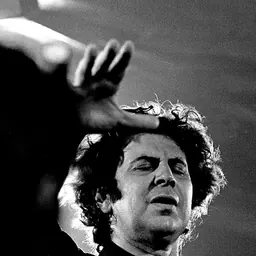
Asked about her acting for film and stage, and in classical and modern films, Papas stated that the acting techniques and method of expressing oneself are the same. One might, she said, need to use a louder voice on a classical stage, but "you always use the same soul". Papas knew Mikis Theodorakis from working with him on Zorba the Greek
In 1972, she appeared on the album 666 by the Greek rock group Aphrodite's Child on the track "∞" (infinity). She chants "I was, I am, I am to come" repeatedly and wildly over a percussive backing, worrying the label, Mercury, who hesitated over releasing the album, causing controversy with her "graphic orgasm".
In 1979, Polydor released her album of eight Greek folk songs entitled Odes, with electronic music performed (and partly composed) by Vangelis. The lyrics were co-written by Arianna Stassinopoulos. They collaborated again in 1986 for Rapsodies, an electronic rendition of seven Byzantine liturgy hymns, also on Polydor; Jonny Trunk wrote that there was "no doubting the power, fire and earthy delights of Papas' voice".
Politics
In 1967, Papas, a lifelong liberal, called for a "cultural boycott" against the "Fourth Reich", meaning the military government of Greece at that time. Her opposition to the regime sent her, and other artists such as Mikis Theodorakis, whose songs she sang, into exile when the military junta came to power in Greece in 1967; she moved into temporary exile in Italy and New York. Her second marriage was to the film producer José Kohn in 1957; that marriage was later annulled. She was the aunt of the film director Manousos Manousakis and the actor Aias Manthopoulos .
In 2003 she served on the board of directors of the Anna-Marie Foundation, a fund which provided assistance to people in rural areas of Greece. In 2013 she began to suffer from Alzheimer's disease. Papas spent her final years in home care at her niece's house in Kifissia. She died there on 14 September 2022, at the age of 93, 1962: Thessaloniki International Film Festival (Best Actress, for the film Elektra) 1971: National Board of Review (Best Actress, for the film The Trojan Women) 1987 Venice Film Festival jury president 1993: Golden Arrow Award for lifetime achievement at Hamptons International Film Festival 1993: Flaiano Prize for Theatre (Career Award) 2009: Cairo International Film Festival (Lifetime Achievement Award)
2009: Leone d'oro alla carriera (Golden Lion career award), Venice Biennale
She received the honours of Commander of the Order of the Phoenix in Greece, Commandeur des Arts et des Lettres in France, and Commander of the Civil Order of Alfonso X, the Wise in Spain.
In 2017, it was announced that the National Theatre of Greece's drama school would move to a new "Irene Papas – Athens School" on Agiou Konstantinou Street in Athens from 2018.
Discography
1968 : Songs of Theodorakis, in concert in New York, music conducted by Harry Lemonopoulos 1972 : 666 by Aphrodite's Child – Chanted vocals on "∞" 1986 : Ραψωδίες – Rapsodies – with Vangelis The Man from Cairo (Italian, "Dramma del Casbah", 1953) as Yvonne Lebeau The Guns of Navarone (1961) as Maria Z (French, 1969) as Helene Rome Good (Italian, "Roma Bene", 1971) as Elena Teopoulos Don't Torture a Duckling (Italian, "Non si servizia un paperino", 1972) as Dona Aurelia Avallone I'll Take Her Like a Father (Italian, "Le farò da padre", 1974) Iphigenia (Greek, 1977) as Clytemnestra Lion of the Desert (Arabic, "Asadu alsahra", 1981) as Mabrouka as Mother Giuseppina Sweet Country (1987) as Mrs. Araya Chronicle of a Death Foretold (1987) as Angela's mother High Season (1987) as Penelope (Italian, "Un bambino di nome Gesù", 1987) (TV film) as Marquise (French, "Les Cavaliers aux yeux verts", 1990) as Anasthasie Rouch (Italian, "L'ispettore anticrimine", 1993)
Don’t just read it —
keep it.
Full-length biographies made to live with: read them, listen on the way to work, watch them tonight.
- E-book
- Audio
- Video
Instant download · yours to keep · every purchase keeps this site free
Important facts
People in Irene Papas's life
Named in this biography and alive at the same time




Related people
Same field, nearest in time




Contemporaries
People whose lives overlapped Irene Papas's

Frequently asked questions
Who was Irene Papas?
Greek actress and singer (1929–2022)
When was Irene Papas born?
Irene Papas was born on 3 September 1929 in Chiliomodi, Corinthia, Second Hellenic Republic.
When did Irene Papas die?
Irene Papas died on 14 September 2022 in Kifisia.
What was Irene Papas's occupation?
Irene Papas was an actor, singer, film director and dancer.
What nationality was Irene Papas?
Irene Papas was Greek.
Sources & further reading
Cite this page
APA: Biography.guide. (2026). Irene Papas. https://biography.guide/irene-papas/
MLA: "Irene Papas." Biography.guide, https://biography.guide/irene-papas/.
Chicago: "Irene Papas." Biography.guide. https://biography.guide/irene-papas/.
Data last updated: 2026-09-22 · Spot an error? Report a correction.
Portrait: Wikimedia Commons · author & licence
Page generated 2026-09-27 05:04 UTC