About Intef II
Lived 2150 BC – 2073 BC (aged 76–77). Intef II was an Egyptian statesperson.
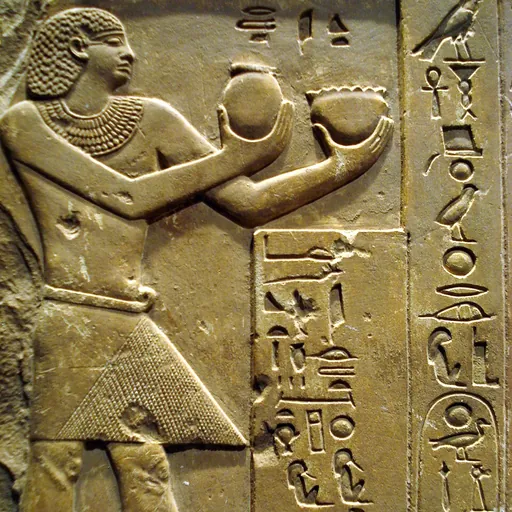
Stela of Intef I and Intef II, in the Temple of Montu at Tod, dated to the reign of Mentuhotep II. Now in the Egyptian Museum. Wahankh Intef II (also Inyotef II and Antef II) was an Ancient Egyptian ruler from 2112 BC to 2063 BC, during the era now known as the First Intermediate Period. In the First Intermediate Period (c. 2181–c. 2055 BC), rule of Egypt was decentralized and split between several dynasties based in different cities; Intef II's capital was Thebes. This impression would appear to be confirmed by an expedition led by Djemi from Gebelein to the land of Wawat (i.e.: Nubia) during his reign.
Titulary Intef II apparently never held the full royal fivefold titulary of the Old Kingdom pharaohs. He did, however, claim the dual kingship nswt bity and the title s3-Re son of Ra, which emphasizes the divine nature of kingship. His finely carved tomb stele, now at the British Museum, shows that Intef II claimed the dual throne of Egypt but also recognizes the limited extent of his rule: "The horus Wahankh, king of Upper and Lower Egypt, son of Re, Intef, born of Nefru, he who lives eternally like Re, [...] this land was under his rule southwards as far as Yebu and reaching as far north as Abydos". Tjetjy then describes his career in the typical self-laudatory manner of the Egyptian elite. Most importantly, the text demonstrates the undisputed power of the king in the Theban kingdom of the 11th Dynasty "I was a trustworthy favorite of my lord, an official great of heart and quiet of temper in the palace of his lord [...]. I am one who loved good and hated evil, one who was loved in the palace of his lord, one who performed every duty in obedience to the will of his lord. Indeed, as for every task which he commanded me to undertake [...], I performed it rightly and justly. Never did I disobey the orders he gave me; never did I substitute one thing for another [...]. Moreover, as for every responsibility of the royal palace which the majesty of my lord committed to me, and for which he caused me to perform some task, I did it for him in accordance with everything which his Ka desired." Hetepy was an official from Elkab who administered the three southernmost nomes of Intef II's realm. This means that there were no monarchs in Theban-controlled territories. Just as in the case of Tjetjy, the constant reference to the king in Hetepy's stele demonstrates the centralized organization of the government of the Theban kingdom and the power of the king, to whom everything was due: "I was one beloved of my Lord and praised by the lord of this land and his majesty truly made this servant happy. His majesty said: 'There is no one who [. . .] of (my) good command, but Hetepy!', and this servant did it exceedingly well, and his majesty praised this servant on account of it".
Monuments The dogs of Intef II on his funerary stele, Egyptian Museum, Cairo.
On his funerary stele Intef emphasizes his monument building activities. It is significant that the earliest surviving fragment of royal construction at Karnak is an octagonal column bearing Intef II's name. Intef II is also the first ruler to build chapels for Satet and Khnum on the island of Elephantine. In fact, Intef II started a tradition of royal building activities in the provincial temples of Upper Egypt which was to last throughout the Middle Kingdom.
Tomb Intef's tomb in El-Tarif at Thebes is a saff tomb. Saff stands for "row" in Arabic and refers to the double row of columns and entry ways fronting a large trapezoidal courtyard at the eastern end of which was a mortuary chapel. This chapel may have been intended to serve the same purpose as a valley temple.
Intef II's tomb was investigated by a royal commission during the reign of Ramses IX, toward the end of the 20th Dynasty, as many royal tombs were being plundered at the time. As reported on the Abbott Papyrus, The commission noted that: "The pyramid-tomb of king Si-Rêˁ In-ˁo (i.e. Intef II) which is north of the House of Amenḥotpe of the Forecourt and whose pyramid is crushed down upon it [. . .]. Examined this day; it was found intact." No remains of this pyramid have been found yet. A stela mentioning the king's dogs was also said to be set up before the tomb. Another stela mentioning a dog named Beha was discovered, but it was found near the offering chapel.
Don’t just read it —
keep it.
Full-length biographies made to live with: read them, listen on the way to work, watch them tonight.
- E-book
- Audio
- Video
Instant download · yours to keep · every purchase keeps this site free
Important facts
Related people
Same field, nearest in time


Frequently asked questions
Who was Intef II?
Egyptian Pharaoh
When was Intef II born?
Intef II was born in 2150 BC.
When did Intef II die?
Intef II died in 2073 BC.
What was Intef II's occupation?
Intef II was a statesperson.
What nationality was Intef II?
Intef II was Egyptian.
Sources & further reading
Cite this page
APA: Biography.guide. (2026). Intef II. https://biography.guide/intef-ii/
MLA: "Intef II." Biography.guide, https://biography.guide/intef-ii/.
Chicago: "Intef II." Biography.guide. https://biography.guide/intef-ii/.
Data last updated: 2026-09-20 · Spot an error? Report a correction.
Page generated 2026-09-27 05:10 UTC