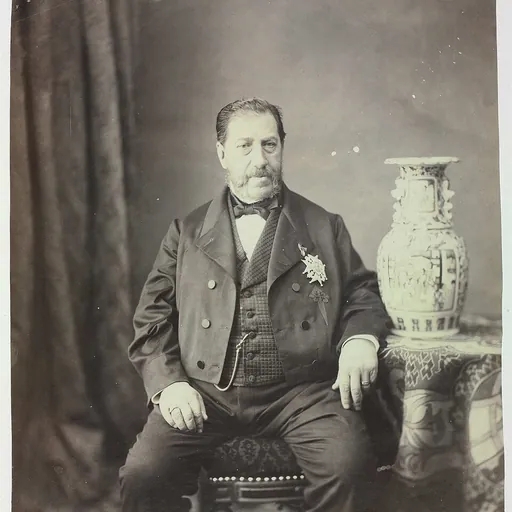
About Infante Francisco de Paula of Spain
Lived 1794 – 1865 (aged 71). Infante Francisco de Paula of Spain was a Spanish aristocrat and politician.
Infante Francisco de Paula of Spain (10 March 1794 – 13 August 1865) was an infante of Spain and the youngest son of Charles IV of Spain and Maria Luisa of Parma. He was the brother of Ferdinand VII and the uncle and father-in-law of Isabella II.
His education at the Spanish court was derailed by the Napoleonic intervention in Spain. The departure of the 14-year-old Infante to exile in May 1808 provoked a popular uprising that was violently suppressed by French troops. For the next ten years, Infante Francisco de Paula lived in exile with his parents, first in Marseille and later in Rome.
Infante Francisco de Paula returned to Spain in 1818, being called by his eldest brother, King Ferdinand VII, who showered him with honors and privileges. Interested in artistic pursuits, Francisco was an amateur singer and painter. In 1819, he married his niece, Princess Luisa Carlotta of the Two Sicilies, the eldest daughter of his older sister María Isabel. The couple had eleven children and were very active in political affairs. Luisa Carlotta was instrumental in securing the succession for Ferdinand VII's daughter, Queen Isabella II.
During the regency of Isabella II, Francisco was excluded from the government by his sister-in-law, Queen Maria Christina. Siding with the liberals, Francisco de Paula and his wife became active in the opposition and were forced to move to France in 1838. They returned to Spain under the government of Maria Christina's successor as regent, General Baldomero Espartero. As they also conspired against Espartero, they were sent back into exile.
The proclamation of Queen Isabella II's majority allowed them to return. The Infante and his wife centered their hopes on marrying their eldest son, Infante Francisco de Asis, to Queen Isabella II. Luisa Carlotta died in 1844, but, under pressure from French diplomacy, Queen Isabella II married Francisco de Asis in October 1846. As the father-in-law of his niece the Queen, Infante Francisco de Paula occupied a prominent position at court during Isabella II's reign. However, as he tried to intervene in politics, he was briefly exiled once again in 1849. In 1852, with the Queen's approval, he contracted a morganatic marriage. He died almost 12 years later in 1865.
Early life
Born on 10 March 1794 at the Royal Palace of Aranjuez, Infante Francisco de Paula was the fourteenth child of King Charles IV of Spain (1748–1819) and his wife Maria Luisa of Parma (1751–1819), a granddaughter of King Louis XV of France. He received the names Francisco de Paula Antonio Maria. His father, King Carlos IV, had a passion for hunting and collecting clocks, but little interest in political affairs. He took a passive role in the direction of his own kingdom, leaving the government to his wife and to his prime minister, Manuel Godoy. Queen Maria Luisa thoroughly dominated the King. Lacking the political acumen necessary to hold power on her own, Maria Luisa deposited her trust and the rule of government on Godoy, whom she raised to prominence.
As a child, Francisco de Paula had blond hair, brown eyes and a tender expression. In the spring 1800, at the age of six, he was painted with his family by Francisco Goya in the portrait Charles IV of Spain and His Family. The plan of studies assigned to him was inspired by the pedagogical theories of Johann Heinrich Pestalozzi. After achieving his objective, Napoleon gave Spain to his brother Joseph Bonaparte and ordered the remaining members of the Spanish royal family out of the country.
While his parents and eldest brothers were at the conference in Bayonne with Napoleon, Francisco de Paula, then fourteen years old, was left behind at the Royal Palace of Madrid with his sister, the deposed Queen of Etruria, and her children. On 2 May 1808, at the departure of the Infante, the last remaining male member of royal family on Spanish soil, a crowd gathered in front of the Royal Palace in an attempt to prevent his removal. The appearance of Francisco de Paula, pale and overcome by emotion, touched the crowd. Poorly armed, the population confronted the French troops. The spontaneous popular uprising against the French invaders spread throughout Madrid, but the French General Joachim Murat brutally crushed the rebellion.
Exile
For the next six years all the members of the Spanish royal family lived in exile. Ferdinand VII, his brother Infante Don Carlos and their uncle, old Infante Don Antonio, were confined under close surveillance at the Château de Valençay. Francisco de Paula, still a teenager, was the only child allowed to accompany his parents in exile in France.
King Charles IV, the Queen and Infante Francisco de Paula, always followed by Godoy, were installed at the Château de Compiègne to the north-east of Paris. Looking for a warmer climate, they moved to Marseille in October 1808. They spent the next four years there, under increasingly strained circumstances. The Infante's sister, the former Queen of Etruria, was imprisoned in a convent in Rome by Napoleon. In order to be closer to her – and with fond memories of their early years in Naples and Parma – Francisco de Paula's parents moved with him to Rome in July 1812. They settled at Palazzo Borghese. During the Hundred Days, following Napoleon's escape from Elba, Murat, who had been King of Naples since 1808, marched on Rome in the Emperor's name. The family fled to Verona. After Napoleon's final defeat, the Spanish royal party returned to Rome, moving to Palazzo Barberini.
While in exile, Francisco de Paula's education was neglected. Godoy, who shared the same household with the deposed royal family, gave him some classes. In Rome, Francisco de Paula's parents tried to lead him to a career in the Church. He received minor orders, wore religious garments daily and the Pope offered to make him cardinal. However Francisco de Paula had no real inclination for clerical life. Ferdinand VII, restored to the Spanish throne after Napoleon's fall, called his brother back to Spain in order to frustrate the prospect of a wedding with Godoy's daughter.
The Infante left Rome on 22 November 1816. While in Lyon on his way to Spain, he became entangled in a scandal that derailed the trip. For the next seventeen months the Infante visited Paris, Brussels, Amsterdam, Frankfurt, Berlin, Weimar, Leipzig, Dresden, Prague, and Vienna. Neither of these two projects came to fruition. The Infante wanted to marry his niece, Princess Maria Luisa Carlota of Parma, then fourteen years old. However, the princess's mother, Maria Luisa (the former Queen of Etruria), opposed the union, considering her twenty-two-year-old brother too reckless for her young daughter. In March 1818, Ferdinand VII, pressed by his wife Maria Isabel of Braganza, finally ordered his brother to return to Spain. This was with the consent of Ferdinand VII. This was a union between uncle and niece. The couple married by proxy on 15 April 1819. Between 1820 and 1834 the couple had eleven children. The family lived in a wing of the royal palace of Madrid and also spent periods of time at the palaces of la Granja, Aranjuez and Sevilla.
The position of Francisco de Paula and his wife at court was, however, a modest one. The Infante was only fifth in the line of succession—after his brother Don Carlos and Don Carlos's three sons. Hoping to have descendants, Ferdinand VII, who had no children from his first two wives, married for a third time four months after Francisco's wedding. During the 1820s Spain was a country in constant political turmoil, facing economic hardships. The economy had been devastated in the war of independence from France and by the loss of the Spanish colonies in the continental Americas. A revolution in 1820 imposed on Ferdinand VII the liberal constitution of 1812, which he had previously repudiated. This period lasted for three years. In 1823, with the approval of Britain, France, Russia, Prussia, and Austria, a French army invaded Spain and reinstated the King's absolute power. Constant political tensions between liberals and conservatives, who had the upper hand, continued. In this political struggle, Francisco de Paula, grateful, loyal and subservient to his brother the King, supported Ferdinand VII's conservative policies. However, as the Infante's political views were moderate, the ultra-royalist party at court viewed him as a liberal.
With a placid personality, Infante Francisco de Paula was more interested in art than in politics. The Infante, who in his childhood had received drawing lessons from the court painter and miniaturist Antonio Carnicero, was himself an amateur painter. Some of his works, including an oil painting of Saint Jerome, have survived. The Infante's main passion was music. Until he was forced to leave Spain for exile in 1808, he received music lessons from Pedro Anselmo Marchal and violin lessons from Francesco Vaccari. The Infante was a skillful singer with a good bass singing voice. His rooms at the Royal Palace were a gathering place for musicians and singers and he used to sing with them. The Infante also sang during musical evenings at the royal palace in the company of professional singers. This collection, acquired by the Biblioteca Nacional de España, has been preserved to this day. When Ferdinand VII created the Madrid Royal Conservatory in 1830, the Infante was made an honorary member. As she had a grudge against Maria Francisca and Maria Francisca's sister, Maria Teresa, Princess of Beira (widow of Francisco de Paula's cousin, Infante Pedro Carlos), Luisa Carlotta was determined to avoid Don Carlos becoming King after Ferdinand VII's death. The opportunity came with the death of Queen Maria Josepha in May 1829. On good terms with her brother in law Ferdinand VII, Luisa Carlotta convinced the King to marry her sister Maria Christina of the Two Sicilies. Their wedding took place in December that same year. The eldest of Ferdinand VII and Maria Christina's two daughters, Isabella, became heir to the crown thanks in great part to Luisa Carlotta's intervention. Don Carlos and his family opposed the change of the succession and they had to leave the country. Within months, Don Francsico and his wife began to conspire against the regent with the support of the liberals. Spain plunged into turmoil as Don Carlos and his ultra-royalist followers attempted to seize power by force, unleashing a civil war (1833 -1839). Maria Christina held on to power with the help of the moderates. She mistrusted her ambitious sister and when in 1837 Don Francisco claimed a place in the senate, Maria Christina refused to approve his appointment. This not only thwarted the Infante's appointment, but cemented the enmity between Luisa Carlotta and her sister, the Queen regent. Their relationship never recovered. For the next five years Francisco de Paula and his wife intrigued against Maria Christina, undermining her power. These political intrigues were such as that Maria Christina ordered Infante Francisco and his family to move abroad.
Once back in Spain, Francisco de Paula and Luisa Carlotta initially settled in Burgos as Espartero banned them from approaching the capital.
Arriving in Zaragoza in October 1842, the Infante and his wife were at the center of the opposition of Espartero's government. In November, the Infante's supporters tried to provoke a coup d'état overthrowing the regency in favor of Don Francisco de Paula. When the plan was discovered, Espartero expelled the Infante and his wife from Spain once again. However his new exile was short lived. In July 1843, a military upraising combined with a conspiracy of the moderates overthrew the regency. The rebels declared Queen Isabella of age, and Espartero went into exile in England. On 29 January 1844, Luisa Carlotta died suddenly of measles, aged 39. Widowed, Francisco de Paula continued living at the palace of San Juan. He wished to remarry and made a proposal to his sister-in-law and niece Princess Maria Carolina of the Two Sicilies, but the project did not come to fruition. He renewed his efforts in his plan to marry his nieces to his two sons, but was not successful. However, under pressure of French diplomacy, Maria Cristina, who personally disliked his nephew Francisco de Asis, agreed to sanction the marriage of her daughter Queen Isabella to her cousin. Antoine, Duke of Montpensier, the youngest son of King Louis Philippe of France, was chosen as Infanta Luisa Fernanda's husband. The rejected Infante Don Enrique was involved in a conspiracy and had to go into exile.
Back in Spain, Infante Francisco de Paula was involved in a scandal. He was found playing sexual games with two women while blindfolded. The women were sent away by the police. Little is known about his second wife, Teresa de Arredondo y Ramirez de Arellano, except that she was from Murcia and a good dancer. The child was not permitted to carry the Bourbon last name, instead he was given the title of Duke of San Ricardo by Isabella II in 1864. Their eleven-year-old son, Ricardo María, was put under the care of his maternal grandmother. title=Ancestors of Francisco de Paula of Spain boxstyle_1=background-color: #fcc; boxstyle_2=background-color: #fb9; boxstyle_3=background-color: #ffc; boxstyle_4=background-color: #bfc; boxstyle_5=background-color: #9fe; 1= 1. Francisco de Paula of Spain 2= 2. Charles IV of Spain 3= 3. Maria Luisa of Parma 4= 4. Charles III of Spain 5= 5. Maria Amalia of Saxony 6= 6. Philip, Duke of Parma 7= 7. Louise-Élisabeth of France 8= 8. Philip V of Spain 9= 9. Elisabeth Farnese 10= 10. Augustus III of Poland 11= 11. Maria Josepha of Austria 12= 12. Philip V of Spain (= 8) 13= 13. Elisabeth Farnese (= 9) 14= 14. Louis XV of France 15= 15. Marie Leszczyńska
Don’t just read it —
keep it.
Full-length biographies made to live with: read them, listen on the way to work, watch them tonight.
- E-book
- Audio
- Video
Instant download · yours to keep · every purchase keeps this site free
Important facts
Family & relationships
People in Infante Francisco de Paula of Spain's life
Named in this biography and alive at the same time

Related people
Same field, nearest in time

Contemporaries
People whose lives overlapped Infante Francisco de Paula of Spain's




Frequently asked questions
Who was Infante Francisco de Paula of Spain?
Spanish infante (1794-1865)
When was Infante Francisco de Paula of Spain born?
Infante Francisco de Paula of Spain was born on 10 March 1794 in Aranjuez.
When did Infante Francisco de Paula of Spain die?
Infante Francisco de Paula of Spain died on 13 August 1865 in Palace of San Juan.
What was Infante Francisco de Paula of Spain's occupation?
Infante Francisco de Paula of Spain was an aristocrat and politician.
What nationality was Infante Francisco de Paula of Spain?
Infante Francisco de Paula of Spain was Spanish.
Sources & further reading
· Wikipedia: Infante Francisco de Paula of Spain
· DBpedia: Infante Francisco de Paula of Spain
Cite this page
APA: Biography.guide. (2026). Infante Francisco de Paula of Spain. https://biography.guide/infante-francisco-de-paula-of-spain/
MLA: "Infante Francisco de Paula of Spain." Biography.guide, https://biography.guide/infante-francisco-de-paula-of-spain/.
Chicago: "Infante Francisco de Paula of Spain." Biography.guide. https://biography.guide/infante-francisco-de-paula-of-spain/.
Data last updated: 2026-09-29 · Spot an error? Report a correction.
Portrait: Wikimedia Commons · author & licence
Page generated 2026-10-05 04:14 UTC