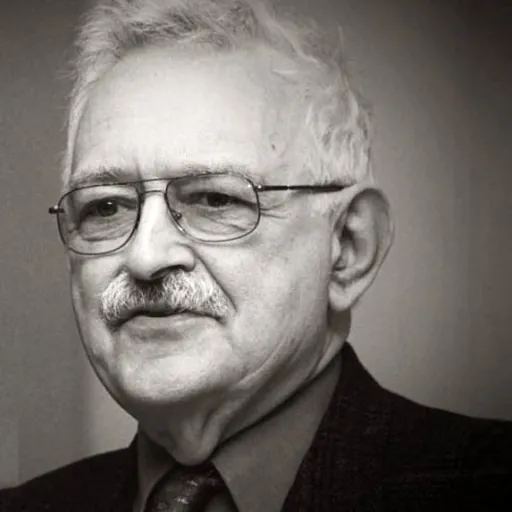
Immanuel Wallerstein
American sociologist and economic historian
About Immanuel Wallerstein
Lived 1930 – 2019 (aged 88). Immanuel Wallerstein was an American economist, geopolitical analyst, economic historian, historian, political scientist and writer.
Personal life and education His parents, Sara Günsberg (born in 1895) and Menachem Lazar Wallerstein (born in 1890), were Polish Jews from Galicia who moved to Berlin, because of World War I, where they married in 1919. Two years later, Sara gave birth to their first son, Solomon. In 1923, the Wallerstein family emigrated to New York, where Immanuel was born. On the "list of alien passengers for the United States" at the time of his family's emigration, the nationality of his mother and brother was described as Polish. He received all three of his degrees from Columbia University: a BA in 1951, an MA in 1954, and a PhD in 1959, where he completed his dissertation under the supervision of Hans L. Zetterberg and Robert Staughton Lynd. Université libre de Bruxelles, Universite Paris 7 Denis Diderot, and Universidad Nacional Autónoma de México.
From 1951 to 1953 Wallerstein served in the U.S. Army. He and Beatrice had five grandchildren.
Academic career During his time at Columbia University he was a supporter of students who were active during Columbia University protests of 1968 opposing the university's involvement in the Vietnam War.
Originally, Wallerstein's principal sub-area of study was not American affairs, but the politics of the non-European world, specifically India and Africa.
Professional career Wallerstein's academic career began at Columbia University where he was an instructor and then associate professor of sociology from 1958 to 1971.
In 1976 Wallerstein was offered the unique opportunity to pursue a new avenue of research, and so became head of the Fernand Braudel Center for the Study of Economies, Historical Systems and Civilization at Binghamton University in New York, whose mission was "to engage in the analysis of large-scale social change over long periods of historical time". The Center opened with the publishing support of a new journal, Review, He was awarded multiple honorary titles, intermittently served as Directeur d'études associé at the École des Hautes Études en Sciences Sociales in Paris, and served as president of the International Sociological Association between 1994 and 1998. At this time he also held a titled professorship at New York University and lectured at Columbia University. Similarly, during the 1990s he chaired the Gulbenkian Commission on the Restructuring of the Social Sciences, whose object was to indicate a direction for social scientific inquiry for the next 50 years.
Between 2000 and his death in 2019, Wallerstein worked as a senior research scholar at Yale University. He was also a member of the Advisory Editors Council of the Social Evolution & History journal. In 2003, he received the "Career of Distinguished Scholarship Award" from the American Sociological Association, Wallerstein died on August 31, 2019, from an infection, at the age of 88.
Wallerstein was remembered for his willingness to engage personally with younger scholars and to encourage their intellectual work. During his time as a lecturer some of the students in attendance recalled him as "a calm, reserved, elegant man". When taking criticism for his thesis, he would usually be calm and collected. As well as hinting at the fact that he was almost disappointed for the people or audience for not fully comprehending what he wished to establish. His publications focused almost exclusively on this topic until the early 1970s, when he began to distinguish himself as a historian and theorist of the global capitalist economy on a macroscopic level. His early criticism of global capitalism and championship of "anti-systemic movements" made him an éminence grise with the anti-globalization movement within and outside of the academic community, along with Noam Chomsky (1928– ) and Pierre Bourdieu (1930–2002).
Wallerstein's most important work, The Modern World-System, appeared in four volumes between 1974 and 2011. In it, Wallerstein drew on several intellectual influences. From Karl Marx, Wallerstein took the underlying emphasis on economic factors and their dominance over ideological factors in global politics, and such ideas as the dichotomy between capital and labor, while criticizing deterministic or teleological Marxian views of world economic development through stages such as feudalism and capitalism. From dependency theory, he took the key concepts of "core" and "periphery".
However, Wallerstein named Frantz Fanon (1925–1961), Fernand Braudel (1902–1985), and Ilya Prigogine (1917–2003) as the three individuals who exerted the greatest influence "in modifying my line of argument (as opposed to deepening a parallel line of argument)." Wallerstein anticipated the growing importance of the North–South divide at a time when the main world conflict was the Cold War.
Wallerstein was often mocked for arguing since 1980 that the United States is a "hegemon in decline", but since the Iraq War this argument has become more widespread. During this time, Wallerstein also argued that the development of the capitalist world economy was detrimental to a large proportion of the world's population. Like Marx, Wallerstein predicted that capitalism will be replaced by a socialist economy, a view held in the 1970s, but reassessed in the 1980s. He concluded that the successor system(s) is unknowable.
Wallerstein both participated in and wrote about the World Social Forum.
The Modern World-System
Wallerstein's first volume on world-systems theory (The Modern World System, 1974) was predominantly written during a year at the Center for Advanced Study in the Behavioral Sciences (now affiliated with Stanford University).
Wallerstein rejected the notion of a "Third World", claiming that there is only one world connected by a complex network of economic exchange relationships — i.e., a "world-economy" or "world-system" in which the "dichotomy of capital and labor" and the endless "accumulation of capital" by competing agents (historically including, but not limited, to nation-states) account for frictions. This approach is known as the world-system theory.
Wallerstein located the origin of the modern world-system in 16th-century Western Europe and the Americas. An initially slight advance in capital accumulation in Britain, the Dutch Republic, and France, due to specific political circumstances at the end of the period of feudalism, set in motion a process of gradual expansion. As a result, only one global network or system of economic exchange exists in modern society. By the 19th century, virtually every area on earth was incorporated into the capitalist world-economy.
The capitalist world-system is far from homogeneous in cultural, political, and economic terms; instead, it is characterized by fundamental differences in social development, accumulation of political power, and capital. Contrary to affirmative theories of modernization and capitalism, Wallerstein did not conceive of these differences as mere residues or irregularities that can and will be overcome as the system evolves.
A lasting division of the world into core, semi-periphery, and periphery is an inherent feature of world-system theory. Other theories, partially drawn on by Wallerstein, leave out the semi-periphery and do not allow for a grayscale of development.
Semi-periphery Defines states that are located between core and periphery, and who benefit from the periphery through unequal exchange relations. At the same time, the core benefits from the semi-periphery through unequal exchange relations.
Quasi-monopolies Defines a kind of monopoly where there is more than one service provider for a particular good/service. Wallerstein claims that quasi-monopolies are self-liquidating because new sellers go into the market by exerting political pressure to open markets to competition.
Kondratiev waves A Kondratiev wave is defined as a cyclical tendency in the world's economy. It is also known as a supercycle. Wallerstein argues that global wars are tied to Kondratiev waves. According to him, global conflicts occur as the summer phase of a wave begins, which is when production of goods and services around the world are on an upswing.
Honors and fellowships Phi Beta Kappa, 1951 Foreign Area Fellowship, Africa, 1955–57 Fellow, Center for Advanced Study in the Behavioral Sciences, Stanford, 1970–71 Ford Fellow in Economics, Political Science and Sociology, 1970–71 Sorokin Prize (for Distinguished Scholarship), American Sociological Association, 1975 Officier, Ordre des Arts et des Lettres, France, 1984 George A. Miller Visiting professor, University of Illinois-Urbana, 1989 Wei Lun Visiting professor, Chinese University of Hong Kong, 1991 University Award for Excellence in Scholarship, Binghamton University, 1991 Medal of the university, University of Helsinki, 1992 Gulbenkian Professor of Science and Technology, 1994 Fellow, The American Academy of Arts and Sciences, 1998 IPE Distinguished Scholar, International Studies Association, 1998 Leerstoel (chair) Immanuel Wallerstein, University of Ghent, 2002– [Inaugural Lecture by IW on Mar. 11, 2002] Career of Distinguished Scholarship Award, American Sociological Association, 2003 Career of Distinguished Scholarship Award, Political Economy of the World-System Section of American Sociological Association, 2003 Premio Carlos Marx 2003, Fondo Cultural Tercer Mundo, Mexico Distinguished Fellow, St. John's College, University of British Columbia, 2004–present Centro de Estudios, Información y Documentación Immanuel Wallerstein, Univ. de la Tierra-Chiapas y el CIDECI Las Casas, 2004–present N.D. Kondratieff Gold Medal, Russian Academy of Natural Sciences, 2005 International Sociological Association Award for Excellence in Research and Practice, 2014
Works Year Title Author(s) Publisher 1961 Africa, The Politics of Independence Immanuel Wallerstein New York: Vintage Books 1964 The Road to Independence: Ghana and the Ivory Coast Immanuel Wallerstein Paris & The Hague: Mouton 1967 Africa: The Politics of Unity Immanuel Wallerstein New York: Random House 1969 University in Turmoil: The Politics of Change Immanuel Wallerstein New York: Atheneum 1972 Africa: Tradition & Change Immanuel Wallerstein with Evelyn Jones Rich New York: Random House 1974 The Modern World-System, vol. I: Capitalist Agriculture and the Origins of the European World-Economy in the Sixteenth Century Immanuel Wallerstein New York/London: Academic Press 1979 The Capitalist World-Economy Immanuel Wallerstein Cambridge University Press 1980 The Modern World-System, vol. II: Mercantilism and the Consolidation of the European World-Economy, 1600–1750 Immanuel Wallerstein New York: Academic Press 1982 World-Systems Analysis: Theory and Methodology Immanuel Wallerstein with Terence K. Hopkins et al. Beverly Hills: Sage 1982 Dynamics of Global Crisis Immanuel Wallerstein with Samir Amin, Giovanni Arrighi and Andre Gunder Frank London: Macmillan 1983 Historical Capitalism Immanuel Wallerstein London: Verso 1984 The Politics of the World-Economy. The States, the Movements and the Civilizations Immanuel Wallerstein Cambridge: Cambridge University Press 1986 Africa and the Modern World Immanuel Wallerstein Trenton, NJ: Africa World Press 1989 The Modern World-System, vol. III: The Second Great Expansion of the Capitalist World-Economy, 1730-1840s Immanuel Wallerstein San Diego: Academic Press 1989 Antisystemic Movements Immanuel Wallerstein with Giovanni Arrighi and Terence K. Hopkins London: Verso 1990 Transforming the Revolution: Social Movements and the World-System Immanuel Wallerstein with Samir Amin, Giovanni Arrighi and Andre Gunder Frank New York: Monthly Review Press 1991 Race, Nation, Class: Ambiguous Identities Immanuel Wallerstein with Étienne Balibar London: Verso. 1991 Geopolitics and Geoculture: Essays on the Changing World-System Immanuel Wallerstein Cambridge: Cambridge University Press 1991 Unthinking Social Science: The Limits of Nineteenth Century Paradigms Immanuel Wallerstein Cambridge: Polity 1995 After Liberalism Immanuel Wallerstein New York: New Press 1995 Historical Capitalism, with Capitalist Civilization Immanuel Wallerstein London: Verso 1998 Utopistics: Or, Historical Choices of the Twenty-first Century Immanuel Wallerstein New York: New Press 1999 The End of the World As We Know It: Social Science for the Twenty-first Century Immanuel Wallerstein Minneapolis: University of Minnesota Press 2001 Democracy, Capitalism, and Transformation Immanuel Wallerstein Documenta 11, Vienna, March 16, 2001 2003 Decline of American Power: The U.S. in a Chaotic World Immanuel Wallerstein New York: New Press 2004 The Uncertainties of Knowledge Immanuel Wallerstein Philadelphia: Temple University Press 2004 World-Systems Analysis: An Introduction Immanuel Wallerstein Durham, North Carolina: Duke University Press 2004 Alternatives: The U.S. Confronts the World Immanuel Wallerstein Boulder, Colorado: Paradigm Press 2006 European Universalism: The Rhetoric of Power Immanuel Wallerstein New York: New Press 2011 The Modern World-System, vol. IV: Centrist Liberalism Triumphant, 1789–1914 Immanuel Wallerstein Berkeley: University of California Press 2013 Uncertain Worlds: World-Systems Analysis in Changing Times Immanuel Wallerstein with Charles Lemert and Carlos Antonio Aguirre Rojas Boulder, CO: Paradigm Publishers 2013 Does Capitalism Have a Future? Immanuel Wallerstein with Randall Collins, Michael Mann, Georgi Derluguian and Craig Calhoun New York: Oxford University Press 2015 The World is Out of Joint: World-Historical Interpretations of Continuing Polarizations Immanuel Wallerstein (editor) Boulder, CO: Paradigm Publishers 2022 The Global Left: Yesterday, Today, Tomorrow Immanuel Wallerstein (editor) Routledge
Don’t just read it —
keep it.
Full-length biographies made to live with: read them, listen on the way to work, watch them tonight.
- E-book
- Audio
- Video
Instant download · yours to keep · every purchase keeps this site free
Important facts
People in Immanuel Wallerstein's life
Named in this biography and alive at the same time






Related people
Same field, nearest in time


Contemporaries
People whose lives overlapped Immanuel Wallerstein's



Frequently asked questions
Who was Immanuel Wallerstein?
American sociologist and economic historian (1930–2019)
When was Immanuel Wallerstein born?
Immanuel Wallerstein was born on 28 September 1930 in New York City.
When did Immanuel Wallerstein die?
Immanuel Wallerstein died on 31 August 2019 in Branford.
What was Immanuel Wallerstein's occupation?
Immanuel Wallerstein was an economist, geopolitical analyst, economic historian, historian, political scientist and writer.
What nationality was Immanuel Wallerstein?
Immanuel Wallerstein was American.
Sources & further reading
· Wikipedia: Immanuel Wallerstein
· DBpedia: Immanuel Wallerstein
Cite this page
APA: Biography.guide. (2026). Immanuel Wallerstein. https://biography.guide/immanuel-wallerstein/
MLA: "Immanuel Wallerstein." Biography.guide, https://biography.guide/immanuel-wallerstein/.
Chicago: "Immanuel Wallerstein." Biography.guide. https://biography.guide/immanuel-wallerstein/.
Data last updated: 2026-09-21 · Spot an error? Report a correction.
Portrait: Wikimedia Commons · author & licence
Page generated 2026-09-27 05:00 UTC