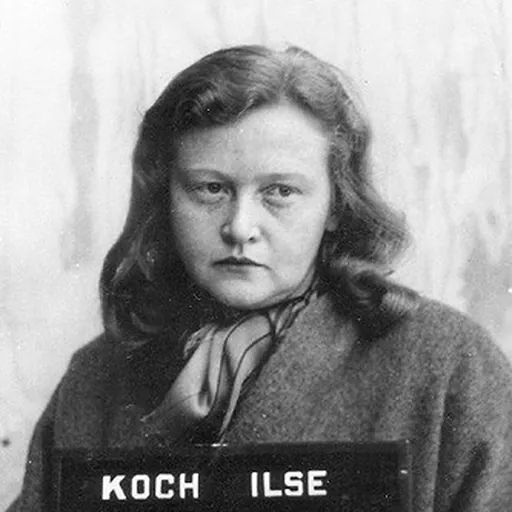
Ilse Koch
German war criminal, wife of camp commandant Karl-Otto Koch
About Ilse Koch
Lived 1906 – 1967 (aged 60). Ilse Koch was a German torturer, concentration camp guard, librarian and war criminal.
Margarete Ilse Koch (; 22 September 1906 – 1 September 1967) was a German war criminal who committed atrocities while her husband Karl-Otto Koch was the commandant at Buchenwald. Though Ilse Koch had no official position in Nazi Germany,
Because of the egregiousness of her alleged actions, including that she had selected Jewish prisoners for death in order to fashion lampshades from human skin and other items from it, her 1947 U.S. military commission court trial at Dachau received worldwide media attention, as did the testimony of survivors who ascribed sadistic and perverse acts of violence to Koch—giving rise to the image of her as "the concentration camp murderess".
However, the most serious of these allegations was found to be without proof in two different legal processes, one conducted by an American military commission court at Dachau in 1947, and another by the West German Judiciary at Augsburg in 1950–1951. the "Queen of Buchenwald", the "Red Witch of Buchenwald", "Butcher Widow", and "The Bitch of Buchenwald".
She committed suicide by hanging at Aichach women's prison Karl and Ilse had two daughters and one son, This crime, however, has been said to be apocryphal. While various objects fashioned from human skins were discovered in Buchenwald's pathology department at liberation, their connection to Koch was tenuous, given that she had not been at the camp since the summer of 1943. The more likely culprit was SS doctor Erich Wagner, who wrote a dissertation while serving at Buchenwald on the purported link he saw between habitual criminality and the practice of tattooing one's skin.
However, Clay also suggested that Koch could be tried under West German law: "I hold no sympathy for Ilse Koch. She was a woman of depraved character and ill repute. She had done many things reprehensible and punishable, undoubtedly, under German law. We were not trying her for those things. We were trying her as a war criminal on specific charges."
The reduction of Koch's sentence to four years resulted in an uproar when it was made public on 16 September 1948, but Clay stood firm by his decision. Years later, Clay stated:
There was absolutely no evidence in the trial transcript, other than she was a rather loathsome creature, that would support the death sentence. I suppose I received more abuse for that than for anything else I did in Germany. Some reporter had called her the "Bitch of Buchenwald", had written that she had lamp shades made of human skin in her house. And that was introduced in court, where it was absolutely proven that the lampshades were made out of goat skin. In addition to that, her crimes were primarily against the German people; they were not war crimes against American or Allied prisoners ... Later she was tried by a German court for her crimes and sentenced to life imprisonment. But they had clear jurisdiction. We did not.
Koch was immediately re-arrested following her release from Landsberg prison in 1949. Bavarian chief prosecutor Johann Ilkow indicted Koch for twenty-five misdemeanor counts of grievous bodily harm, incitement to grievous bodily harm in a number of cases "no longer determinable", sixty-five counts of incitement to attempted murder, and twenty-five counts of incitement to murder. Her mental health began to suffer considerably during the trial, leading to her collapse in court in late December 1950, At least four witnesses for the prosecution testified that they had seen Koch choose tattooed prisoners, who were then killed, or had seen or been involved in the process of making human-skin lampshades from tattooed skin.
On 15 January 1951, the court pronounced its verdict, in a 111-page-long decision, for which Koch was not present in court. In its written judgment, the Augsburg court labeled Koch's crimes at Buchenwald particularly egregious because she "consciously suppressed any feeling of compassion and pity she had as a woman", and instead gave "free rein to her pursuit of power and prestige, her arrogance and her selfishness."
Family
Ilse and Karl-Otto Koch had a son named Artwin (b. 1938 - d. 1964), and two daughters, Gisela (b. 1939 - d. 2018) and Gudrun (b. 1940 - d. 1941). Gudrun died of pneumonia at four months of age in February 1941; Artwin died by suicide in 1964; Gisela died in 2018. at Aichach women's prison on 1 September 1967 at age 60. Her suicide note was written to her son Uwe: "There is no other way. Death for me is a release."
Don’t just read it —
keep it.
Full-length biographies made to live with: read them, listen on the way to work, watch them tonight.
- E-book
- Audio
- Video
Instant download · yours to keep · every purchase keeps this site free
Important facts
more
The Bitch of Buchenwald, Ilse KöhlerPeople in Ilse Koch's life
Named in this biography and alive at the same time

Related people
Same field, nearest in time





Contemporaries
People whose lives overlapped Ilse Koch's
Frequently asked questions
Who was Ilse Koch?
German war criminal, wife of camp commandant Karl-Otto Koch (1906–1967)
When was Ilse Koch born?
Ilse Koch was born on 22 September 1906 in Dresden.
When did Ilse Koch die?
Ilse Koch died on 1 September 1967 in Aichach.
What was Ilse Koch's occupation?
Ilse Koch was a torturer, concentration camp guard, librarian and war criminal.
What nationality was Ilse Koch?
Ilse Koch was German.
Sources & further reading
Cite this page
APA: Biography.guide. (2026). Ilse Koch. https://biography.guide/ilse-koch/
MLA: "Ilse Koch." Biography.guide, https://biography.guide/ilse-koch/.
Chicago: "Ilse Koch." Biography.guide. https://biography.guide/ilse-koch/.
Data last updated: 2026-09-23 · Spot an error? Report a correction.
Portrait: Wikimedia Commons · author & licence
Page generated 2026-09-27 05:06 UTC