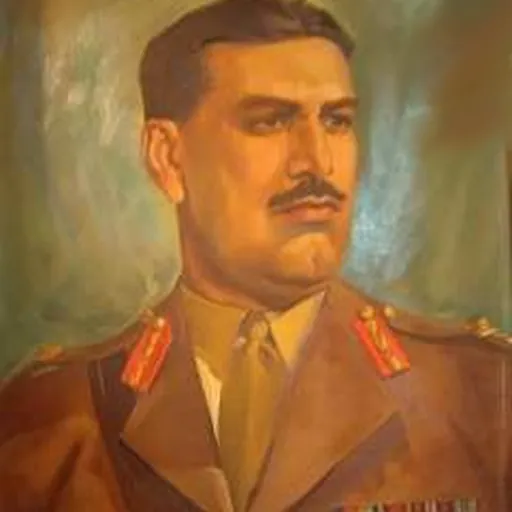
About Iftikhar Khan
Lived 1907 – 1949 (aged 41–42). Iftikhar Khan was a Pakistani military personnel.
Major General Mohammad Iftikhar Khan (10 January 1909 — 13 December 1949) known as Iftikhar Khan and Ifti among his colleagues, was a Pakistani two-star rank general, who last served as the General Officer Commanding 10th Division in Lahore from 1948 to 1949, before proceeding to attend a course at the Imperial Defence College. He was the most senior officer in line to succeed General Gracey as the Commander-in-Chief, but was killed in a Dakota C-53 crash with 22 others, including his wife and infant daughter, leading to General Ayub Khan being appointed instead.
Born in Chakwal, Khan was awarded a scholarship to the Royal Military College, Sandhurst in 1927. He was commissioned into the British Indian Army in 1929.
Early life Mohammad Iftikhar Khan was born on 10 January 1909
On 12 November 1927, Iftikhar and Azam Khan were the two Muslim cadets selected to attend the Royal Military College, Sandhurst which began on 2 February 1928. Days later on 17 November, both were awarded the Pratap Singh Memorial Scholarship, worth each.
Personal life Iftikhar Khan was married to Begum Meher Iftikhar, a Parsi woman who was the number one woman rider in India. According to Express News, she converted to Islam.
Iftikhar had 13 siblings, nine brothers and four sisters. Six brothers including him were in the army, namely Major Generals Mohammad Akbar Khan and Muhammad Anwar Khan, Brigadiers Muhammad Afzal, Mohammad Zafar Khan, and Muhammad Yusuf Khan. The three other brothers Baqir Khan, Tahir Khan, and Masud Khan chose civilian careers.
Military career British Indian Army and World War II After graduating from the Royal Military College, Sandhurst, Khan was commissioned as a Second Lieutenant into the British Indian Army on 29 August 1929. He then spent a year on attachment to the 2nd Battalion of the Manchester Regiment. He was posted to the 7th Light Cavalry on 16 October 1930 and was promoted to lieutenant on 29 November 1931. In April 1934, he came in 1st and won The Netheravon Cup.
He served as Regimental Quartermaster from 1 August 1937 to 18 April 1938, after which he became Regimental Adjutant of the 3rd Cavalry Regiment, holding that position from 19 April 1938 to 5 August 1940. He attended the Staff College, Quetta in 1941 and later became the first Muslim to be the directing staff.
He served at No. 2 Indian Army Armoured Corps Training Center from 17 December 1941 to January 1943, before taking on the role of General Staff Officer Grade II at Ceylon Army Command Headquarters until July 1943. He then served as General Staff Officer Grade II at the Staff College, Quetta until April 1944. He subsequently served as Second-in-command of the 45th Cavalry from 1945 until 31 August 1946.
On 1 September 1946, Khan became the first Indian commandant of the 7th Light Cavalry. In December 1946, Lieutenant Colonel Iftikhar Khan, Haji Iftikhar Ahmad, and Colonel Mian Hayaud Din were among several officers selected to attend the first course at the Joint Services Staff College (UK) which commenced in January 1947. The course ended on 19 July 1947.
Pakistan Army After the Partition of British India on 14 August 1947, Khan opted to join the newly formed Pakistan Army. He was commander of the 103 Infantry Brigade.
Death The Ministry of Defence announced that a Pak-Air Dakota, flying between Lahore and Karachi, had crashed against a hill forty-five miles north-east of Karachi. Rescue parties who made their way to the scene among hills on difficult terrain found the aircraft totally wrecked and no survivors. The aircraft carried 22 passengers and four crew members. The ministry said a court of inquiry is investigating the accident. They added that "the deaths of Major-General Iftikhar Khan and Brigadier Sher Khan constitute a most regrettable loss to the Pakistan Army and to the country. Both of these officers were soldiers of wide experience and proven ability."
The funeral procession began on 15 December 1949 at the Frere Hall in Karachi, making its way one and a half miles through Saddar Bazaar with thousands of people witnessing the procession before it reached its final destination at the Armed Forces Cemetery (Fauji Qabristan). The remains of Generals Iftikhar and Sher Khan were transported onto Gun carriages by military personnel, namely Commodore Choudri, Brigadier Rodham, Brigadier Sher Ali Khan Pataudi, and Group Captain Bapu Murad.
Legacy and commemorations (Retd) Major General Sher Ali Khan Pataudi, who referred to Iftikhar Khan as his best friend and said he had known him since they met at the Royal Indian Military College in 1925, recalled that he was professionally sound, well read and highly intelligent. He added that Iftikhar was a shy person and people wrongfully assumed he was conceited. He also said that Iftikhar was concerned about the politicisation of officers and distrusted politicians.
According to him, Iftikhar once said: "it would be better for both of us if we both got out [of the army] before our hands were stained and garments polluted." Pataudi also believed that if Iftikhar had lived to assume the role of Commander-in-Chief instead of General Ayub Khan, "he would not have allowed the Army to be used for political purposes" and "would have never used his position as C-in-C, to come into power through the Army-he disliked being actively involved with politics or with the politician in any form."
(Retd) Lieutenant General Mohammad Yusuf, who was concurrently adjutant of 7th Light Cavalry remembered Iftikhar, as "a fine horseman and a strict adjutant."
Dates of rank
Don’t just read it —
keep it.
Full-length biographies made to live with: read them, listen on the way to work, watch them tonight.
- E-book
- Audio
- Video
Instant download · yours to keep · every purchase keeps this site free
Important facts
People in Iftikhar Khan's life
Named in this biography and alive at the same time




Related people
Same field, nearest in time



Contemporaries
People whose lives overlapped Iftikhar Khan's


Frequently asked questions
Who was Iftikhar Khan?
Pakistani general
When was Iftikhar Khan born?
Iftikhar Khan was born in 1907 in Chakwal.
When did Iftikhar Khan die?
Iftikhar Khan died on 13 December 1949.
What was Iftikhar Khan's occupation?
Iftikhar Khan was a military personnel.
What nationality was Iftikhar Khan?
Iftikhar Khan was Pakistani.
Sources & further reading
Cite this page
APA: Biography.guide. (2026). Iftikhar Khan. https://biography.guide/iftikhar-khan/
MLA: "Iftikhar Khan." Biography.guide, https://biography.guide/iftikhar-khan/.
Chicago: "Iftikhar Khan." Biography.guide. https://biography.guide/iftikhar-khan/.
Data last updated: 2026-09-23 · Spot an error? Report a correction.
Portrait: Wikimedia Commons · author & licence
Page generated 2026-09-27 05:07 UTC