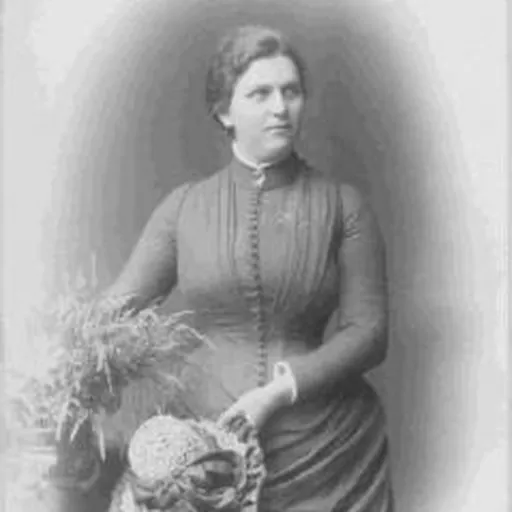
About Ida Freund
Lived 1863 – 1914 (aged 51). Ida Freund was a British and Austrian chemist and writer, known for Science education.
Ida Freund (5 April 1863 – 15 May 1914) She is known for her influence on science teaching, particularly the teaching of women and girls. She wrote two key chemistry textbooks and invented the idea of baking periodic table cupcakes, as well as inventing a gas measuring tube, which was named after her.
Biography Ida Freund was born in the Austrian Empire. Following the death of her mother, she moved to live with her grandparents in Vienna. In 1881 her grandparents died, and she moved to England to live with her uncle and guardian, the violinist Ludwig Straus well known as a member of the Joachim Quartet and leader of the Hallé Orchestra (1875–88). She enrolled in Girton College, achieving a first class honours in the Natural Sciences Tripos course Amongst her students, she was thought to be an inspirational teacher and a singular character. She had lost a leg in a cycling accident when she was a girl and used variously walking sticks, a prosthetic leg and a three-wheeled tricycle wheelchair worked with her arms. Her disability and unconventional style of dress made her a distinctive figure, which was much remarked upon at the time by colleagues and contemporaries.
Freund was an active feminist and supporter of women's suffrage. She was amongst the women who fought for admission to the Chemical Society in the early 1900s. Women were eventually admitted to the Society in 1920, six years after her death. She remained at Newnham until her retirement due to ill-health in 1913. The Study of Chemical Composition: An Account of its Method and Historical Development with Illustrative Quotations (1904) (reprinted in 2014. ) and The Experimental Basis of Chemistry: Suggestions for a Series of Experiments Illustrative of the Fundamental Principles of Chemistry published posthumously in 1920. She had planned that the book should be 20 chapters but had only completed ten chapters at her death. The book was later edited for publication by colleagues and friends, including Mary Beatrice Thomas, Director of Science Studies at Girton College.
In the preface for the book, editors A. Hutchinson and Mary Beatrice Thomas suggest that in writing it: "Miss Freund was attempting to bring to the notice of other teachers her views as to the manner in which students may be helped to realise that chemistry is a science-based on experiment, and that logical interpretation of experiments leads directly to the generalisation known as the laws of chemistry."
Both of Freund's books are considered to be key texts in the teaching of chemistry and are much cited.
Teaching Freund is known for her interest in science education, and in particular for improving science teaching in girls' schools. At the time, in Cambridge, women could not work in the same laboratories as men so Freund taught special classes in the Chemistry labs at Newnham College. She also wrote textbooks and organised holiday workshops for women teachers. Freund experimented with different teaching techniques, favouring Wilhelm Ostwald's approach, in which "he main facts of chemistry are dealt with in the form of a dialogue between a teacher and a pupil". She insisted that her students read original research and test the validity of published work – a revolutionary approach for the time, for which she was criticised. However, she had a significant influence on the teaching techniques of the time and was much loved by her students but made use of her own baking and culinary skills to create engaging teaching resources.
Periodic table cupcakes
Freund was the first person to bake a set of periodic table cupcakes. She used them as teaching aids in her classroom. She created boxes of chocolates with pictures of scientists and a large periodic table with each element represented by a cupcake decorated with its name and atomic number in icing.
One of her students described her approach:
In my year we were requested to go and make a further study of the 'Periodic Table of the Elements.' We found a very large board with the Table set out. The divisions across and down were made with Edinburgh Rock, numbers were made of chocolate, and the elements were iced cakes each showing its name and atomic weight in icing. The nonvalent atoms were round, univalent had a protruding corner, bivalent two, trivalent triangular and so on. We divided it up between us! Periodic Videos aim to bring chemistry to a new generation of students.
Recipe instructions for modern versions of Freund's periodic table of cupcakes are available from a variety of sources online.
Inventions As well as inventing periodic table cupcakes, Freund also had a piece of laboratory apparatus (a gas measuring tube) named after her as her invention. The apparatus is no longer in common use. Furthermore, Girton College awards the Ida Freund Prize to its students of physical sciences for first-class academic achievements.
Don’t just read it —
keep it.
Full-length biographies made to live with: read them, listen on the way to work, watch them tonight.
- E-book
- Audio
- Video
Instant download · yours to keep · every purchase keeps this site free
Important facts
People in Ida Freund's life
Named in this biography and alive at the same time


Related people
Same field, nearest in time



Contemporaries
People whose lives overlapped Ida Freund's



Frequently asked questions
Who was Ida Freund?
Austrian-British chemist
When was Ida Freund born?
Ida Freund was born on 15 April 1863 in Vienna.
When did Ida Freund die?
Ida Freund died on 15 May 1914 in Cambridge.
What was Ida Freund's occupation?
Ida Freund was a chemist and writer.
What was Ida Freund known for?
Ida Freund was known for Science education.
What nationality was Ida Freund?
Ida Freund was British and Austrian.
Sources & further reading
Cite this page
APA: Biography.guide. (2026). Ida Freund. https://biography.guide/ida-freund/
MLA: "Ida Freund." Biography.guide, https://biography.guide/ida-freund/.
Chicago: "Ida Freund." Biography.guide. https://biography.guide/ida-freund/.
Data last updated: 2026-09-22 · Spot an error? Report a correction.
Portrait: Wikimedia Commons · author & licence
Page generated 2026-09-27 05:00 UTC