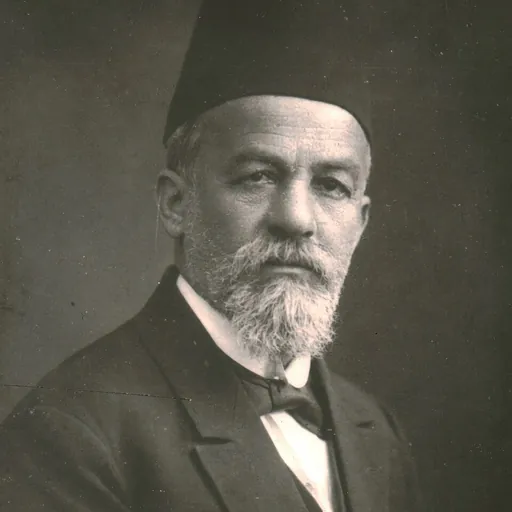
About Ibrahim Starova
Lived 1865 – 1945 (aged 80). Ibrahim Starova was a Romanian, Turkish and Albanian politician, revolutionary and physician, known for Committee of Union and Progress and Society for the Publication of Albanian Writings.
Ibrahim Starova, then founded as an Ottomanist organization, following which he contributed to the Albanian National Awakening through his activities in the Bashkimi Society.
Early life İbrâhim Edhem was born in Struga 1865 to a family with origins from Starovë (now Buçimas), Albania, with ancestors that served as soldiers for the Ottoman Empire and later migrated to his birthplace.
He was married to a sister of the Frashëri brothers (Abdyl, Naim and Sami).
Albanian activism During his student years, he came into contact with Albanian nationalist groups operating secretly in Istanbul. In addition to Albanian leaders such as Şemseddin Sâmi and Naim Frasheri, he also established contact with Apostol Margarit, one of the leaders of the Aromanian movement, which carried out anti-Greek propaganda together with Albanians in Macedonia. In 1879 during the League of Prizren period, Temo was a founder of the Society for the Publication of Albanian Letters . Temo became acquainted with Ahmet Rıza, the leader of the Paris cell and both established a working relationship.
Temo was also active in the Albanian national movement present in Romania. In Romania Temo maintained close ties with the leadership of an Aromanian (Kutzo-Vlach) organisation and Romanian authorities supported those connections. Due to his activities his reputation was enhanced within the Balkans.
To secure support from the leading Young Turk organisations and to talk about the potential for activities within the Balkans, Temo toward late 1902 travelled to Europe to meet the leadership of the two dominant CUP factions. The Ottoman Empire asked the Romanian government to take necessary measures against him and the Ottomans tried and sentenced Temo in contumaciam. In Paris, Temo participated in the Congress of Ottoman Opposition (1902) organised by Prince Sabahaddin calling for reforms, minority rights, revolution and European intervention in the empire. Later from Romania he sided with Ahmet Rıza who was against foreign intervention in the Ottoman state.
Post 1902 Congress After a reorganisation of the CUP, Temo along with friends still involved in the group continued with Young Turk activities yet they were of little significance from an organisational perspective.
In May 1907, Shakir met with Temo, and other CUP members at Constanța where new instructions were given from the CUP centre. Later Temo sent an agent to İzmir as requested by the CUP centre yet after meeting with Armenians in the city the Young Turk operative was arrested by Ottoman authorities. The local CUP branch attempted to get support from Muslims in Constanța and Temo organised lectures in towns like Babadag to inform the public with some talks given by him being about medical topics.
Return from exile The Young Turk Revolution occurred in 1908, the CUP forced Abdul Hamid II to restore constitutional monarchy in the Ottoman Empire starting the Second Constitutional Era. He soon published anonymous articles attacking the Unionists in their publications. He noticed the history of the revolution was already being written, and took care to promote important rebels who were being sidelined in favour of more famous ones. Temo had a soft spot for Atıf Bey, an key participant in the revolt, and paid a publisher based in Vienna to produce 10,000 postcards of his image.
In 1909 Temo founded the Ottoman Democratic Party and was elected its president. It advocated for democratic government, minority rights and upholding constitutional liberties that was in opposition to the CUP.
In Istanbul, he was first appointed as a sanitary inspector of Beyoğlu. After the dethronement of Abdulhamid II, he was appointed director of the Darülaceze, but was soon forced to resign. In 1911, he was sent away from Istanbul to combat cholera outbreaks in Edirne and Tekirdağ. After completing his duties in Edirne, he left Istanbul in January 1911 for Constanta.
Temo came to Istanbul during the Balkan Wars as head of a seven-person Romanian Red Cross delegation. He attempted to publish a Turkish newspaper called Şık in Medgidia (Mecidiye) in early 1914. He continued his research on writing Turkish in the Latin alphabet, preparing an alphabet resembling the modern Turkish alphabet and distributing it to teachers. He requested that Abdullah Cevdet publish the İçtihad magazine in Istanbul using this alphabet, but this idea was not implemented.
Romanian politician When Romania entered World War I, Temo served in its army as a major. After the Armistice, he joined the Albanian delegation to the Paris Peace Conference and served on the border demarcation sub-committee.
After returning to Romania, Ibrahim Temo joined the People's Party and served in the Romanian Parliament from 1920 to 1922 as a senator for Caliacra. He served as leader of the party's Medgidia chapter and as the city's interim mayor (1926). During his tenure in Parliament, he brought a dispute concerning the Adakale district, a Turkish-speaking island located on the Danube between Romania and Serbia, to Parliament's attention, contributing to the island's incorporation into Romania. He continued to publish medical and political articles in Turkish magazines. In 1937, he published a 16-page pamphlet titled "Why I Love Atatürk." Temo then embarked on writing his memoirs, sorting through his and İshak Sükûti's private documents and chronicling the founding and development of the CUP. He died in Medgidia on August 5, 1945.
Legacy A Macedonian high school in Struga in North Macedonia is named after Temo.
Don’t just read it —
keep it.
Full-length biographies made to live with: read them, listen on the way to work, watch them tonight.
- E-book
- Audio
- Video
Instant download · yours to keep · every purchase keeps this site free
Important facts
People in Ibrahim Starova's life
Named in this biography and alive at the same time

Related people
Same field, nearest in time





Contemporaries
People whose lives overlapped Ibrahim Starova's



Frequently asked questions
Who was Ibrahim Starova?
Albanian politician (1865-1939)
When was Ibrahim Starova born?
Ibrahim Starova was born on 1 March 1865 in Struga.
When did Ibrahim Starova die?
Ibrahim Starova died on 15 August 1945 in Constanța.
What was Ibrahim Starova's occupation?
Ibrahim Starova was a politician, revolutionary and physician.
What was Ibrahim Starova known for?
Ibrahim Starova was known for Committee of Union and Progress and Society for the Publication of Albanian Writings.
What nationality was Ibrahim Starova?
Ibrahim Starova was Romanian, Turkish and Albanian.
Sources & further reading
Cite this page
APA: Biography.guide. (2026). Ibrahim Starova. https://biography.guide/ibrahim-starova/
MLA: "Ibrahim Starova." Biography.guide, https://biography.guide/ibrahim-starova/.
Chicago: "Ibrahim Starova." Biography.guide. https://biography.guide/ibrahim-starova/.
Data last updated: 2026-09-22 · Spot an error? Report a correction.
Portrait: Wikimedia Commons · author & licence
Page generated 2026-09-27 05:04 UTC