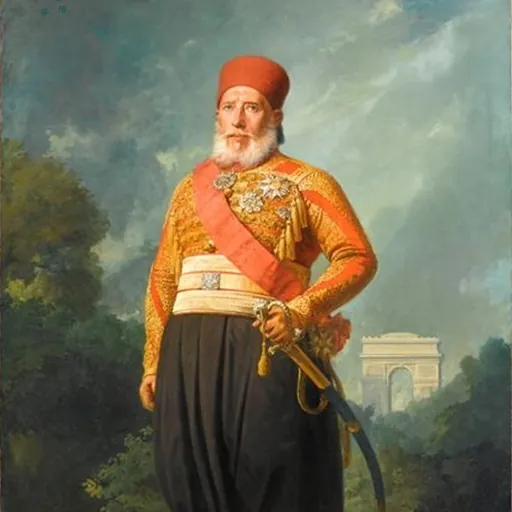
About Ibrahim Pasha of Egypt
Lived 1789 – 1848 (aged 58–59). Ibrahim Pasha of Egypt was an Egyptian politician and military personnel.
Ibrahim Pasha ( Ibrāhīm Bāshā; 1789 – 10 November 1848) was an Egyptian general and politician; he was the commander of both the Egyptian and Ottoman armies and the eldest son of Muhammad Ali, the Ottoman Wāli and unrecognized Khedive of Egypt and Sudan. He was the second ruler of Egypt from the Muhammad Ali dynasty and ruled from 20 July 1848 to 10 November 1848.
Ibrahim served as a general in the Egyptian army that his father established during his reign, taking his first command of Egyptian forces when he was merely a teenager. In the final year of his life, he was appointed Regent for his still-living father and became the effective ruler of Egypt and Sudan, owing to the latter's ill health. His rule also extended over the other dominions that his father had brought under Egyptian rule, namely Syria, Hejaz, Morea, Thasos, and Crete. Ibrahim pre-deceased his father, dying 10 November 1848, only four months after rising to power. He was succeeded as Regent by his nephew (son of Muhammad Ali's second oldest son), Abbas, who upon Muhammad Ali's death the following year inherited the Egyptian throne.
Ibrahim remains one of the most celebrated members of the Muhammad Ali dynasty, particularly for his impressive military victories, including several crushing defeats of the Ottoman Empire, which placed him among the most outstanding commanders in military history. Among Egyptian historians, Ibrahim, his father Muhammad Ali, and his son Isma'il the Magnificent are held in far higher esteem than other rulers from the dynasty, who were largely viewed as indolent and corrupt; this is largely the result of efforts by his grandson Fuad I of Egypt to ensure the positive portrayal of his paternal ancestors in the Royal Archives that he created, which were the primary source for Egyptian history from the 1920s until the 1970s. Today, a statue of Ibrahim occupies a prominent position in Egypt's capital, Cairo.
Background His mother was Amina Hanim (1770–1824). She was the widow of Ottoman official Serezli Ali Bey, and a daughter of the Ottoman Major Ali Aga of Nusratli. Ibrahim was her first-born son with Muhammad Ali of Egypt (her first born was Princess Tawhida). It is further known that he was born in the village of Nusratli (today Nikiforos), near the town of Drama, the Ottoman province of Rumelia, in what is now the eastern parts of Macedonian region in Greece. Ibrahim was of Albanian origin through his father Muhammad.
In 1805, during his father's struggle to establish himself as ruler of Egypt, the adolescent Ibrahim, at 16, was sent as a hostage to the Ottoman Kapudan Pasha. However, Ibrahim was allowed to return to Egypt once his father was recognised as Wāli of Egypt by the Ottoman Sultan, and had defeated the British military expedition of Major General Alexander Mackenzie Fraser.
When Muhammad Ali went to Arabia to prosecute the war against the Al Saud in 1813, Ibrahim was left in command of Upper Egypt. He continued the war against the broken power of the Mameluks, whom he suppressed. In 1816 he succeeded his brother Tusun Pasha in command of the Egyptian forces in Arabia.
Campaigns against the house of Saud
Muhammad Ali had already begun to introduce European discipline into his army, and Ibrahim had probably received some training, but his first campaign was conducted more in the old Asiatic style than his later operations. The campaign lasted two years, and ended in the destruction of the House of Saud as a political power. Muhammad Ali landed at Yanbu, the port of Medina, in 1813. The holy cities had been recovered from the Saudis, and Ibrahim's task was to follow them into the desert of Nejd and destroy their fortresses. Such training as the Egyptian troops had received, and their artillery, gave them a marked superiority in the open field. But the difficulty of crossing the desert to the Saudis stronghold of Diriyah, some 400 miles east of Medina, made the conquest a very arduous one. By the end of September 1818 he had forced the Saudi leader Abdullah bin Saud to surrender, and had taken Diriyah, which he sacked.
Operations in the Morea
Ibrahim Pasha attacks Missolonghi in the year 1826, (by Giuseppe Pietro Mazzola). Ibrahim Pasha, with father Muhammad Ali Pasha and Colonel Sève (Suleiman Pasha, right).
On 11 December 1819 he made a triumphal entry into Cairo. After his return Ibrahim gave effective support to the Frenchman, Colonel Sève (Suleiman Pasha), who was employed to drill the army on the European model. Ibrahim set an example by submitting to be drilled as a recruit. In 1824, Muhammad Ali was appointed governor of the Morea (the Peloponnese peninsula in southern Greece) by Ottoman Sultan Mahmud II. He might perhaps have administered successfully, but the exactions he was compelled to enforce by his father soon caused the popularity of his government to decline and provoked revolts.
During the 1834 peasants' revolt in Palestine, Ibrahim Pasha besieged the Transjordanian city of Al-Karak for 17 days, in pursuit of the revolt's leader Qasim al-Ahmad. After a hole was blasted into the town's walls in late August, Al-Karak was destroyed and the orchards outside the town were uprooted as punitive measures against the residents for hosting Qasim. Fearing further retaliation from Ibrahim Pasha, the rebel leaders were handed to the Egyptians.
In 1838, the Sublime Porte felt strong enough to renew the struggle, and war broke out once more. Ibrahim won his last victory for his father at Nezib on 24 June 1839. But the United Kingdom and the Austrian Empire intervened to preserve the integrity of the Ottoman Empire. Their squadrons cut his communications by sea with Egypt, a general revolt isolated him in Syria, and he was finally compelled to evacuate the country in February 1841.
Last years Ibrahim spent the rest of his life in peace, but his health was ruined. In 1846, he paid a visit to Western Europe, where he was received with some respect and a great deal of curiosity. When his father became senile, Ibrahim was appointed Regent in his place. He held his regency from July till the time of his death on 10 November 1848.
Honours Order of Glory of Turkey-1817 Knight of the Order of Saint Joseph of Tuscany-1845 Grand Cross of the Legion d'Honneur of France-1845 Grand Cross of the Order of the Tower and Sword (GCTE) of Portugal-1846
Don’t just read it —
keep it.
Full-length biographies made to live with: read them, listen on the way to work, watch them tonight.
- E-book
- Audio
- Video
Instant download · yours to keep · every purchase keeps this site free
Important facts
Family & relationships
People in Ibrahim Pasha of Egypt's life
Named in this biography and alive at the same time



Related people
Same field, nearest in time


Contemporaries
People whose lives overlapped Ibrahim Pasha of Egypt's



Frequently asked questions
Who was Ibrahim Pasha of Egypt?
Egyptian general and Wāli of Egypt (1789–1848)
When was Ibrahim Pasha of Egypt born?
Ibrahim Pasha of Egypt was born in 1789 in Drama, Kavala.
When did Ibrahim Pasha of Egypt die?
Ibrahim Pasha of Egypt died on 10 November 1848 in Cairo.
What was Ibrahim Pasha of Egypt's occupation?
Ibrahim Pasha of Egypt was a politician and military personnel.
What nationality was Ibrahim Pasha of Egypt?
Ibrahim Pasha of Egypt was Egyptian.
Sources & further reading
· Wikipedia: Ibrahim Pasha of Egypt
· DBpedia: Ibrahim Pasha of Egypt
Cite this page
APA: Biography.guide. (2026). Ibrahim Pasha of Egypt. https://biography.guide/ibrahim-pasha-of-egypt/
MLA: "Ibrahim Pasha of Egypt." Biography.guide, https://biography.guide/ibrahim-pasha-of-egypt/.
Chicago: "Ibrahim Pasha of Egypt." Biography.guide. https://biography.guide/ibrahim-pasha-of-egypt/.
Data last updated: 2026-09-23 · Spot an error? Report a correction.
Portrait: Wikimedia Commons · author & licence
Page generated 2026-09-27 05:05 UTC