
Ian Sprague
Australian potter
About Ian Sprague
Lived 1920 – 1994 (aged 73–74). Ian Sprague was a potter.
Tall stoneware vase with textured neck and cross-scored body, 1970s; 21cm x 64cm; Ian Sprague and Mungeribar marks. Ian Broun Sprague (1920–1994) was an Australian twentieth-century studio potter, ceramic sculptor and graphic artist. Delayed by the Second World War and a false start in architecture, he spent (broadly) his forties adapting Australian domestic pottery to a Japanese aesthetic of contemplative use; his fifties as a sculptor in two- and three-dimensional pottery; his sixties and seventies making landscape works on paper.
Early life Sprague was born in Geelong, Victoria, Australia, in 1920. He was the sixth and last child of Leslie Sprague, a wealthy grazier and Marion Broun, Armidale-born descendant of the Scottish Broun baronets. He was educated at Geelong Grammar. Trained as an architectural draughtsman, Sprague spent the Second World War in the AIF in New Guinea as a signals officer. After the war he went to the University of Melbourne and completed an architecture degree in 1950. But he found the next ten years in architects' offices in Melbourne and London tedious and unsatisfying. Sprague was 6 ft. 1 in. tall with fair hair and blue eyes. and as best man at fashionable weddings, but was homosexual, and never married. On a driving holiday in Scotland in 1957, he had a car accident that put him in hospital for five months. One knee was permanently damaged and a frequent source of pain. His surgeon suggested he restore the strength of his arms by taking up a craft.
Pottery Lidded storage jar, Tenmoku glazed; 14cm x 15cm; Ian Sprague mark. Sprague attended the London Central School of Arts and Crafts from 1958 to 1960. He spent two months at the David Leach pottery in Devon. He returned to Australia in February 1962, planning to make ethical pots in the Anglo–Japanese tradition founded by Bernard Leach, David's father. Sprague bought a 15-acre estate in Upper Beaconsfield, Victoria.
I had this whole setup clearly in mind. I wanted to live out of Melbourne. I wanted to have animals, some land, and to be completely free to do what I wanted.
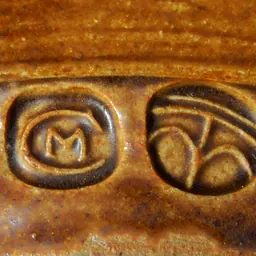
On the estate he set up a pottery, and renovated an existing five-room cottage. From England he had imported a Homer kiln capable of the high temperatures needed to make stoneware and porcelain rather than earthenware, and a Boulton's cone-driven wheel and pugmill. The equipment was on a commercial scale but devoted to studio work. The pottery was called Mungeribar: "red clay" in the local Aboriginal (Woiwurrung) language. … we finally arrived at a stoneware body mixing a local fireclay with commercial red clay, china clay and ball clay … it works well and reduces to a red-brown with lighter speckling … Most of the glazes we use are, as a result, in the darker earthy colours but speckled light greys and ochres are also possible. Drawings and paintings are signed "Ian Sprague"; work signed simply "Sprague" is generally by his nephew Leslie.
Sprague had met and liked the potter and Slade School technician Robin Welch (b. 1936) in England. He paid for Welch and his family to come to Mungeribar in 1962 so Welch could help him set up a fully professional pottery. The Welches returned to England in 1965. Sprague thus had control of every step of production from mixing the clay to passing wrapped pots over the counter. The Centre was owned and stocked entirely by him, and he travelled all over Australia in search of the best pottery, textiles, glassware, woodwork and jewellery. The opening exhibition showed the pottery of Robin Welch. Dismayed by the quality of teaching in art schools and technical colleges, he ran many workshops around the country on the textural treatment of clay. and scores of them are now in public collections.
The brown stonewares, the nicely formed functional breadcrocks, teapots, fruit platters and teacups and saucers … made his a household name among the 1970s cognoscenti. Greenaway eventually became Sprague's friend and occasional manager. He considered Sprague a gentleman potter … exceptionally skilled at his craft … For Welch, the greatest pleasure was to see shelves full of multiples of his own work but for Sprague, his objective was to place the hand-made piece of pottery in the house — making cups and saucers and beautiful objects to use and feel and generally appreciate.
In 1965 the famous Japanese potter Shōji Hamada had made a range of pots at Mungeribar; they are now in the Hamilton Gallery. The Japanese potter Tatsuzo Shimaoka worked at Mungeribar in 1972. and Michael Cardew visited.
Ovoid forms originated on the wheel but were beaten and scraped into expressive asymmetry and ornamented with clay disks and straps. A large group of these was shown at Leveson Street Gallery, North Melbourne, in December 1980.
From 1973 at the latest he specialised in fireclay panels for architectural use as wall plaques or free-standing sculptures (Littlemore's Nine Artist Potters first edition of 1973 has photos of six of them). Later examples have a spine of coloured glass in clay wells.
Sprague produced his wall panels by cutting them from fireclay blocks, heating and scraping them, and applying bold simplified motifs. These rugged clay surfaces were often finished simply by pouring a strong solution of salted water on to their surfaces … [firing] resulting in a warm toasted surface effect. The hand-modelled clay panels … combine expressive abstract forms and a rare understanding of the modulation of two dimensional relief sculpture. Generally the panels were in groups of three, but installations of 8 panels (two by four), 42 (seven by six) or 27 (three by nine) were made, notably for the Modernist Beaumaris house of sculptor and portrait painter Shirley Hannan. Hannan was one of many clients who became admiring friends.
Single panels were sometimes glazed bas-relief sculptures.
Sprague laid out a design of 20,000 ceramic tiles in the Fitzroy Gardens, Melbourne, in 1979 to form a "people's pathway". Four years later he contributed a "cave seat" to another community art-work, the Terracotta Mural Garden at Benalla, Victoria.
Sprague held open house on Sundays at Mungeribar for friends, and their friends, and his hospitality over decades played an important part in the lives of middle and upper-class gay Melbourne at a time when homosexuality still constituted a crime.
Later life Sand dune drawing, Ian Sprague 1991; unsigned and undated. Made below Shirley Hannan's beach house inside Bournda National Park, NSW. By 1981 Mungeribar was too onerous and too cold for Sprague's health. He sold the Upper Beaconsfield estate and moved to a house and studio he had bought at Mooney Mooney on the Hawkesbury River. Mungeribar was consumed by a firestorm on Ash Wednesday 1983. Sprague made pots and sculptures in a small pottery as well as works on paper. In 1992 he moved to a smaller house and studio at Sunshine Beach north of Noosa, Queensland. He died there two years later. The review in The Age, headed "Master potter hailed", wrote of his "legendary contribution to contemporary ceramics".
Gallery 1950s Ink pen and wash in a sketchbook; 380mm x 295mm; S. Pietro 8/58, signed Sprague.thumb Ink pen and wash; 380mm x 280mm; Fontana di Quattro Fiumi—Piazza Navona—Bernini, signed Sprague, undated.
1960s White glazed cylindrical vase, incised texture with a cobalt underglaze; 90mm x 80mm; Ian Sprague mark. One of a set of six cups, white-glazed with cobalt decoration, 1960s; 100mm x 70mm; Ian Sprague mark. Ash-glazed dinner and side plates from a production line set, 1960s; 280mm x 24mm, 205mm x 22mm; both Mungeribar stamped. Lidded pottery jar Tenmoku glazed; 14cm x 15cm; Ian Sprague mark.
Chün glazed dish early to mid-1970s; 38cm x 8cm; Ian Sprague mark. Lamp base (with shade), brown dry glaze with central design, 1970s; 32cm x 22cm; Ian Sprague mark.
1970s Rope-textured pottery bottle by Tatsuzo Shimaoka formerly in the collection of Ian Sprague; 27cm x 24cm. Khaki ovoid form with a dry ash glaze from the late 1970s; 15cm x 32cm; Ian Sprague mark. Fireclay wall installation for the Hannan House, Beaumaris; seven panels by six; Ian Sprague mark and signed SPRAGUE 1977. Landscape monoprint on butcher's paper; Ian Sprague 1980s; unsigned.
1980s Ian Sprague, orange and indigo pigment on damp paper, 1980s; 165mm x 205mm; unsigned. Orange and indigo monoprint; 260mm x 390mm; signed Ian Sprague ’89. One-off lithograph Hawkesbury Scene; 167mm x 210mm; signed Ian Sprague ’89. Ian Sprague pen and ink drawing, Hawkesbury River 1980s; 27cm x 35cm; unsigned and undated sketchbook page.
1990s Ian Sprague landscape with pen, ink and brown wash; unsigned and undated. Probably done near the Flinders Ranges, South Australia, 1992.thumb Ian Sprague landscape with pencil and washes on rag paper; unsigned and undated. Probably done near the Flinders Ranges, 1992. Pencil drawing of the same cottage at Marananga, 1992; 27cm x 35cm; unsigned and undated. Ink and wash drawing, Barossa Valley, 1992; 27cm x 35cm; unsigned, titled Barossa Vineyard '92. Brown ink and black crayon drawing, 1992; 27cm x 35cm; titled North Sunshine Beach.
Don’t just read it —
keep it.
Full-length biographies made to live with: read them, listen on the way to work, watch them tonight.
- E-book
- Audio
- Video
Instant download · yours to keep · every purchase keeps this site free
Important facts
People in Ian Sprague's life
Named in this biography and alive at the same time





Related people
Same field, nearest in time


Contemporaries
People whose lives overlapped Ian Sprague's






Frequently asked questions
Who was Ian Sprague?
Australian potter (1920–1994)
When was Ian Sprague born?
Ian Sprague was born in 1920 in Geelong.
When did Ian Sprague die?
Ian Sprague died on 18 April 1994.
What was Ian Sprague's occupation?
Ian Sprague was a potter.
Sources & further reading
Cite this page
APA: Biography.guide. (2026). Ian Sprague. https://biography.guide/ian-sprague/
MLA: "Ian Sprague." Biography.guide, https://biography.guide/ian-sprague/.
Chicago: "Ian Sprague." Biography.guide. https://biography.guide/ian-sprague/.
Data last updated: 2026-09-20 · Spot an error? Report a correction.
Page generated 2026-09-27 05:13 UTC