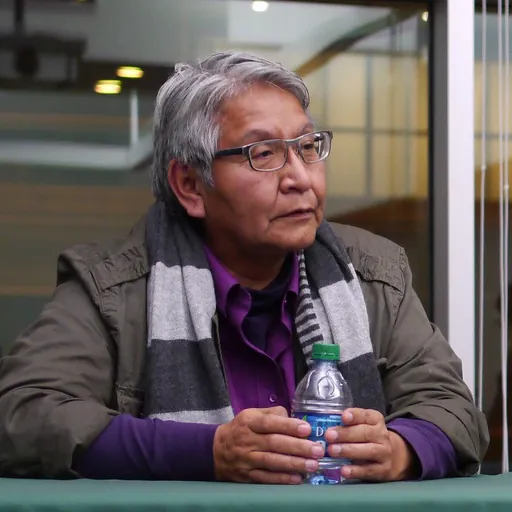
Hulleah Tsinhnahjinnie
Seminole-Muscogee-Navajo photographer, filmmaker, writer, curator and educator (born 1952)
About Hulleah Tsinhnahjinnie
Born 1952. Hulleah Tsinhnahjinnie is an American photographer and video artist, known for Photography and Videography.
Hulleah J. Tsinhnahjinnie (born 1954) is a Navajo Nation photographer, museum director, curator, and professor. She is living in Davis, California. She serves as the director of the Gorman Museum of Native American Art and teaches at University of California, Davis.
Early life and education Hulleah J. Tsinhnahjinnie, born into the Bear Clan (Taskigi) of the Seminole Nation and born for the Tsi'naajínii Clan of the Navajo Nation. Her mother, Minnie June Lee McGirt-Tsinhnahjinnie (1927–2016), was Seminole and Muskogee and her father, Andrew Van Tsinajinnie (1916–2000), was Navajo. Her father was a painter and muralist who studied at the Studio in Santa Fe, New Mexico. Tsinhnahjinnie was born in 1954 in Phoenix, Arizona. She grew up outside of Scottsdale; at age 13, she moved to the Navajo Reservation near Rough Rock. She is an enrolled citizen of the Navajo Nation.
In 1975, she began her art education at the Institute of American Indian Arts in Santa Fe. When she was age 23, Tsinhanahjinne moved to the San Francisco Bay Area for school. In 1978, Tsinhnahjinnie enrolled in the California College of Arts and Crafts (now California College of the Arts) in Oakland, where she earned a Bachelor of Fine Arts in painting with a photography minor in 1981.
She earned a Master of Fine Arts degree in Studio Arts from University of California, Irvine in 2002.
Career She served as a board member for the Intertribal Friendship House, Oakland and the American Indian Contemporary Art Gallery in Oakland. Tsinhanahjinne chooses to display her art and passion through things like newsletters, posters, t-shirts, and photos. She taught her skill of photography and media to younger students.
Currently, Tsinhanahjinne works as a professor of Native American Studies at the University of California, Davis (UC Davis). While she has been working there she holds organized conferences that hold the purpose of bringing together native American photographers like herself to discuss topics such as "Visual Sovereignty". Along with being a professor for the university, Tsinhanahjinne is the Director of Gorman Museum of Native American Art at UC Davis. Her body of work "plays upon her own autobiography and what it means to be a Native American." Her work uses photography as a means to re-appropriate the Native American as subject. Although she is a photographer, Tsinhnahjinnie often hand-tints her photographs or uses them in collage.
Using a combination of photography and digital images with a contemporary Native American photography style, she overcomes stereotypes, challenges political ideas, and creates a space for other Natives to express their ideas as well. Her goal with her art is not aimed at the non-natives but instead it is to document her life experience and share it with the world. In a statement on "America Is a Stolen Land", Tsinhnahjinnie says, ".. the photographs I take are not for White people to look at Native people. I take photographs so Native people can look at Native people. I make photographs for Native people". The Damn Series which she wrote in 1977 is Tsinhnahjinnie's most widely known piece. Throughout the piece she works in Native knowledge (including humorous jokes) to repurpose images of Natives from colonialist history by shifting them back into a rightfully Indigenous context.
20 years later, in 1994, Tsinhnahjinnie created a series called "Memoirs of an Aboriginal Savant". She uses fifteen pages of an electronic diary to reflect on life with her family, politics, and other life experiences. The diary is all written with the idea in mind that she will take the viewer on a "journey to the center of an aboriginal mind without the fear of being confronted by the aboriginal herself". The book begins on the page "1954" (her birth year) and continues to look deeply into her personal life experiences. Through the book she writes herself from a first person point of view in order to convey herself how she sees herself instead of others views.
In many of her key works from the 1990s, Tsinhnahjinnie examined the notion of beauty. Her interest in this subject should be viewed in the context of the "return to beauty" that established itself in art historical discourse in the same period At the time, critics were addressing the taboos which had developed around beauty in Western art over the 20th century and the resurfacing of beauty towards the 1990s. While debated among scholars, these taboos were often characterized as a postmodernist reaction against the past notion of beauty as represented by a passive female body. Artists at the time were navigating a "return to beauty" that took these critiques of beauty into account.
Meanwhile, Tsinhnahjinnie was working from a cultural background where beauty had never been a taboo. She defined the beauty of women in terms of their empowerment, grounded in her own perspective as an Indigenous woman. Tsinhnahjinnie's collage When Did Dreams of White Buffalo Turn to Dreams of White Women? (1990) raises questions about Native women's internalized definitions of beauty. According to Lakota lore, White Buffalo Calf Woman was an exceptionally beautiful woman who introduced the pipe ceremony to the Lakota people. The title of this work addresses the historical shift from an indigenous definition of beauty before colonization, represented by White Buffalo Calf Woman, to a neocolonial one. Accompanied by a published exhibition catalog. 2012 Native American Portraits: Points of Inquiry Museum of Indian Arts and Culture, Santa Fe, New Mexico 2010 Unfixed CBK Center for Contemporary Art, Dordrecht, Netherlands Accompanied by a published exhibition catalog. 2006 Holyland: Diaspora and the Desert Heard Museum, Phoenix, Arizona 2003 Hulleah Tsinhnahjinnie: Portraits Against Amnesia Andrew Smith Gallery, Santa Fe, New Mexico 1998 Native Nations: Journeys in American Photography Barbican Art Gallery, London Exhibition curated by Jane Alison. 1996 Image and Self in Contemporary Native American Photo Art Dartmouth College, Hanover, New Hampshire 1994 Watchful Eyes: Native American Women Artists Heard Museum, Phoenix, Arizona Theresa Harlan, guest curator. Accompanied by a published exhibition catalog. 1994 Traditions of Looking Institute of American Indian Arts Museum, Santa Fe, New Mexico 1994 Photographic Memoirs of an Indian Savant Sacred Circle Gallery of American Indian Art, Seattle, Washington 1993 Stand: Four Artists Interpret the Native American Experience Edinboro University, Edinboro, Pennsylvania 1993 Metro Bus Show CEPA Gallery, Buffalo, New York Exhibition was in conjunction with the International Cultural Festival, at the World University Games Buffalo '93. Each of the artists have created ten panels installed on the new natural gas buses and travelled the "Culture Tour" specialty bus line during the duration of the games, and July through October 1993. Participating artists included Tsinhnahjinnie, as well as, Patricia Deadman, Eric Gansworth, George Longfish, Jolene Rickard, Alan Jamieson, Jesse Cooday, and Shan Goshorn. 1991 Shared Visions: Native American Painters and Sculptors in the Twentieth Century Heard Museum, Phoenix, Arizona 1991 Composite Images Berkeley Art Center, Berkeley, California 1990 Artifacts for the Seventh Generation: Multi-Tribal, Multi-Media Visions: New Artistic Works by Eleven Native American Artists American Indian Contemporary Arts, San Francisco, California 1990 Talking Drum: Connected Vision Koncepts Cultural Gallery, Oakland, California 1990 It's All Relative: First & Second Generation Artists American Indian Contemporary Arts, San Francisco, California 1990 Language of the Lens: Contemporary Native American Photographers Heard Museum, Phoenix, Arizona 1990 Compensating Imbalances: Native American Photography Sonoma State University, Rohnert Park, California Traveling exhibition, with artists Pena Bonita, Phil Red Eagle, Larry McNeil, Camela Pappan, Carm Little Turtle, and Richard Ray Whitman. 1988 Compensating Imbalances: Native American Photography American Indian Contemporary Arts, San Francisco, California Traveling exhibition. 1985 Photographing Ourselves: Contemporary Native American Photography American Indian Contemporary Arts, San Francisco, California
Don’t just read it —
keep it.
Full-length biographies made to live with: read them, listen on the way to work, watch them tonight.
- E-book
- Audio
- Video
Instant download · yours to keep · every purchase keeps this site free
Important facts
People in Hulleah Tsinhnahjinnie's life
Named in this biography and alive at the same time




Related people
Same field, nearest in time
Contemporaries
People whose lives overlapped Hulleah Tsinhnahjinnie's



Frequently asked questions
Who is Hulleah Tsinhnahjinnie?
Seminole-Muscogee-Navajo photographer, filmmaker, writer, curator and educator (born 1952)
When was Hulleah Tsinhnahjinnie born?
Hulleah Tsinhnahjinnie was born in 1952 in Phoenix.
What is Hulleah Tsinhnahjinnie's occupation?
Hulleah Tsinhnahjinnie is a photographer and video artist.
What is Hulleah Tsinhnahjinnie known for?
Hulleah Tsinhnahjinnie is known for Photography and Videography.
What nationality is Hulleah Tsinhnahjinnie?
Hulleah Tsinhnahjinnie is American.
Sources & further reading
· Wikipedia: Hulleah Tsinhnahjinnie
· DBpedia: Hulleah Tsinhnahjinnie
Cite this page
APA: Biography.guide. (2026). Hulleah Tsinhnahjinnie. https://biography.guide/hulleah-tsinhnahjinnie/
MLA: "Hulleah Tsinhnahjinnie." Biography.guide, https://biography.guide/hulleah-tsinhnahjinnie/.
Chicago: "Hulleah Tsinhnahjinnie." Biography.guide. https://biography.guide/hulleah-tsinhnahjinnie/.
Data last updated: 2026-09-22 · Spot an error? Report a correction.
Portrait: Wikimedia Commons · author & licence
Page generated 2026-09-27 05:02 UTC