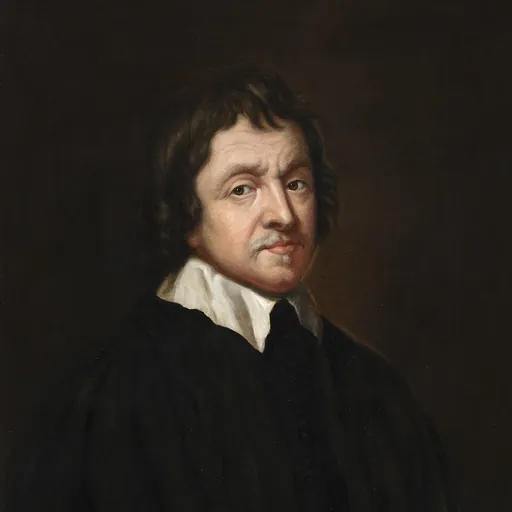
Hugh Peters
English preacher, political advisor and soldier
About Hugh Peters
Lived 1598 – 1660 (aged 62). Hugh Peters was a cleric, christian minister and priest.
Hugh Peter (or Peters) (baptized 29 June 1598 – 16 October 1660) was an English preacher, political advisor and soldier who supported the Parliamentary cause during the English Civil War and later the trial and execution of Charles I. Following the Restoration, he was executed as a regicide.
Peter became highly influential during the English Civil War. He employed a flamboyant preaching style that was considered highly effective in furthering the interests of the Puritan cause.
From a radically Protestant family of Cornwall, England, though of part Dutch origin, Peter emigrated to a Puritan colony in America, where he first rose to prominence. After spending time in Holland, he returned to England and became a close associate and propagandist for Oliver Cromwell, a contemporary of Peter at Cambridge University. Peter may have been the first to propose the trial and execution of Charles I and was believed to have assisted at the beheading.
Peter unsuccessfully proposed revolutionary changes that would have disestablished the Church of England's role in landholding and struck at the heart of the legal title to property. Disagreeing with the war against Protestant Holland and increasingly excluded after Cromwell's death, Peter's former outspokenness and role in the execution of Charles I meant he faced reprisal following the Restoration and he was hanged, drawn and quartered as a regicide.
Early life
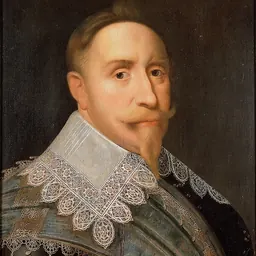
Peter was born to a father from Antwerp and was of an affluent background. Peter was baptized on 29 June 1598 in Fowey and was educated at Trinity College, Cambridge which awarded him a Bachelor of Arts degree in 1618. Having experienced conversion, he preached in Essex; returning to London, he took Anglican orders and was appointed lecturer at St Sepulchre's. He entertained, however, Puritan opinions and eventually left England for Holland. He visited Gustavus Adolphus of Sweden in Germany in about 1632 and, afterwards, became the minister of the English church at Rotterdam.
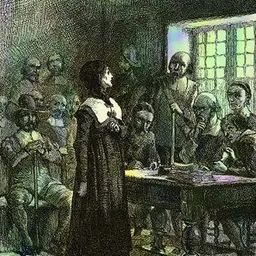
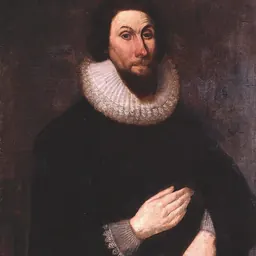
Here, his Puritan leanings again attracted attention, and Peter made a further move to New England. He was connected with John Winthrop through his wife, and he would be able to renew friendships with American colonists - also Puritans ministers - who had been his contemporaries at Cambridge University, including John Wheelwright and Samuel Whiting Snr. Peter arrived at Boston in October 1635 and was given charge of the church at Salem. He played a significant role during the 1637 trial of Anne Hutchinson during the Antinomian Controversy, being one of the ministers wanting her banished from the colony. He took a leading part in the affairs of the colony, and interested himself in the founding of the new colony in Connecticut. He was also active in the establishment of Harvard College.
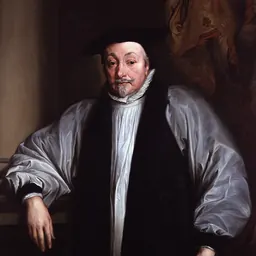
Civil War period In 1641, Peter returned to England as agent of the colony, but soon became involved in the political troubles which now began. He became chaplain to the forces of the adventurers in Ireland, and served in 1642 in Lord Forbes's expedition, of which he wrote an account. On his return he took a violent part in the campaign against William Laud, and defended the doctrines of the Independents in a preface to a tract by Richard Mather entitled "Church Government and Church Covenant discussed ..." (1643).
In September 1643 the Parliamentary Committee of Safety employed Peter on a mission to Holland, there to borrow money on behalf of Parliament, and to explain the justice of its cause to the Dutch.
He was more valuable to the Parliamentary cause as a preacher than as a diplomat, and his sermons were very effective in winning recruits to the parliamentary army. He also became famous as an exhorter at the executions of state criminals, attended Richard Challoner on the scaffold, and improved the opportunity when Sir John Hotham was beheaded. However, it was as an army chaplain that Peter exerted the widest influence. In May 1644 he accompanied the Earl of Warwick in his naval expedition for the relief of Lyme, preached a thanksgiving sermon in the church there after its accomplishment, and was commissioned by Warwick to represent the state of the west and the needs of the forces there to the attention of Parliament. This was the prelude to greater services of the same nature rendered to Sir Thomas Fairfax and the New Model Army. As chaplain, Peter took a prominent part in the campaigns of that army during 1645 and 1646. Whenever a town was to be assaulted, it was his business to preach a preparatory sermon to the storming parties, and at Bridgwater, Bristol, and Dartmouth his eloquence was credited with inspiring the soldiers. After a victory he was equally effective in persuading the populace of the justice of the parliamentary arms, and in converting neutrals into supporters. During the siege of Bristol he made converts of five thousand clubmen, and when Fairfax's army entered Cornwall, his despatches specially mentioned the usefulness of Peter in persuading his countrymen to submission.
In addition to his duties as a chaplain, Peter exercised the functions of a confidential agent of the general and of a war correspondent. Fairfax habitually employed him to represent to Parliament the condition of his army, the motives which determined his movements, and the details of his successes. His relations of battles and sieges were eagerly read, and formed a semi-official supplement to the general's own reports. Oliver Cromwell followed the example of Fairfax, and on his behalf Peter delivered to the House of Commons narratives of the capture of Winchester and the sack of Basing House. It was a fitting tribute to his position and his services that he was selected to preach, on 2 April 1646, the thanksgiving sermon for the recovery of the west before the two houses of parliament.
At the conclusion of the First English Civil War, Peter, though greatly disliked by the Presbyterians and the Scots, had attained great influence as leader of the Independents. In his pamphlet "Last Report of the English Wars" (1646), he urged religious toleration, an alliance with foreign Protestants, and an active propagation of the gospel. In the dispute between the New Model Army and the Long Parliament he naturally took the side of the former, and after the seizure of the King by the Army in June 1647 had interviews with Charles I at Newmarket and Windsor, in which he favourably impressed the latter, and gave advice upon the best course to pursue. He performed useful services in the Second Civil War, procured guns for the besiegers at the siege of Pembroke, raised troops in the Midlands, and arranged the surrender of the Duke of Hamilton at Uttoxeter. When the Army entered London in 1648 he was one of the few preachers who supported the move and spoke out in support of Pride's Purge. In August 1649 he accompanied Cromwell on his Irish Campaign, and was present at the fall of Wexford, while later he assisted the campaign by superintending from England the despatch to Cromwell of supplies and reinforcements, and was himself destined by Cromwell for a regiment of foot. In 1650 he was appointed chaplain to the Council of State. Through his office he exerted influence on various committees concerned with religious, legal and social reforms. The same year, during the Third Civil War he was in South Wales, endeavouring to bring over the people to the cause, and subsequently was present at the Battle of Worcester in 1651, where afterwards he preached to the victorious Parliamentary soldiers.
Role in trial and execution of Charles I Peter rode at the head of the force bringing Charles I to London as prisoner, and justified and supported the trial and sentence in sermons. Peter's counsel was important in the inner circle of Cromwell and influenced the highest levels of policy making. According to a witness, Peter had asserted that he was the one who first suggested to Cromwell that the king should be tried and executed. He is believed to have been the headman's assistant.
Restoration and Stuart reprisal Hugh Peters depicted in a 1660 broadside, "Don Pedro de Quixot, or in English the Right Reverend Hugh Peters" The country became unstable and factional after Cromwell's son fell from power, and General Monck came from Scotland leading the only effective and unified force left. Peter attempted to secure his position with the new power in the land and met Monck at St Albans on the latter's march to London, but met with no favour, being expelled from his lodgings at Whitehall in January 1660. Monck's restoration of the house of Stuart placed Peter in serious danger. On 11 May his arrest was ordered. On 17 May the Library of the Archbishop of Canterbury was taken from him. He was excepted from the Act of Indemnity and apprehended on September 2 in Southwark.
Peter's preaching and addresses to Parliament on Cromwell's behalf had made him too well known as a Puritan opponent of the royal house of Stuart for any disavowals to save him; thus, a recantation of his opinions and a display of repentance would probably have been his best hope. It would also prevent his property being forfeited and leave something for his heirs. However, he appeared to have panicked, sending a defence of himself to the House of Lords in which he denied any share in the death of Charles I. In addition to justifying Charles being condemned to death, Peter was alleged to be one of the two heavily disguised executioners, even the one who welded the axe, though this was a task requiring some skill. The headsman's assistant had held up the severed head to spectators, and contemptuously thrown it aside afterward, but he omitted the usual pronouncement 'This is the head of a traitor'; as a leading preacher Peter's voice would have been easily recognized. A witness testified that Peter had ordered a carpenter to drive staples into the scaffold (for tying Charles to the block if he resisted), been present at the scene on the day of the execution, disappeared for an hour during it, and was seen drinking water with the presumed headsman, Richard Brandon, afterwards. Peter produced an alibi, claiming that he had been ill and confined to bed at home on that day, which was confirmed by a house servant of his, but the court found that testimony unconvincing.
Don’t just read it —
keep it.
Full-length biographies made to live with: read them, listen on the way to work, watch them tonight.
- E-book
- Audio
- Video
Instant download · yours to keep · every purchase keeps this site free
Important facts
People in Hugh Peters's life
Named in this biography and alive at the same time


Related people
Same field, nearest in time



Contemporaries
People whose lives overlapped Hugh Peters's





Frequently asked questions
Who was Hugh Peters?
English preacher, political advisor and soldier
When was Hugh Peters born?
Hugh Peters was born on 29 June 1598 in Fowey.
When did Hugh Peters die?
Hugh Peters died on 16 October 1660 in Charing Cross.
What was Hugh Peters's occupation?
Hugh Peters was a cleric, christian minister and priest.
Sources & further reading
Cite this page
APA: Biography.guide. (2026). Hugh Peters. https://biography.guide/hugh-peters/
MLA: "Hugh Peters." Biography.guide, https://biography.guide/hugh-peters/.
Chicago: "Hugh Peters." Biography.guide. https://biography.guide/hugh-peters/.
Data last updated: 2026-09-22 · Spot an error? Report a correction.
Portrait: Wikimedia Commons · author & licence
Page generated 2026-09-27 05:00 UTC