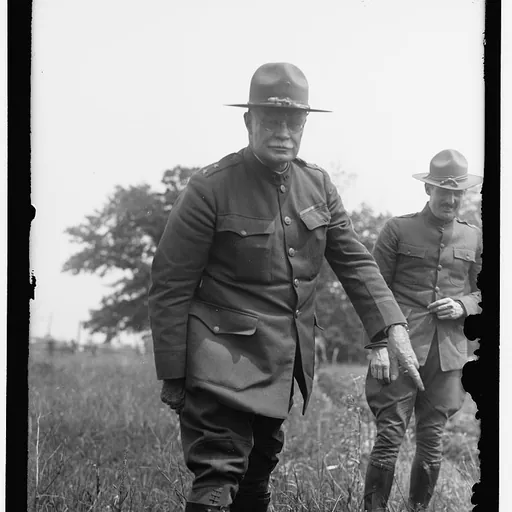
About Hugh L. Scott
Lived 1853 – 1934 (aged 80). Hugh L. Scott was an American military officer.
Hugh Lenox Scott (September 22, 1853 – April 30, 1934) was a United States Army officer. A West Point graduate of 1876, he served as superintendent of West Point from 1906 to 1910 and as chief of staff of the United States Army from 1914 to 1917, which included the first few months of American involvement in World War I. Following his military career Scott worked heavily with the Bureau of Indian Affairs and the Bureau of American Ethnology in salvage ethnography, particularly in the salvage of Plains Indian Sign Language.
Early life and family Hugh L. Scott was born in Danville, Kentucky on September 22, 1853, the son of Reverend William McKendry Scott and Mary Elizabeth (Hodge) Scott. His father was a Presbyterian minister, while his mother was from a well educated family.He was the great-great-great-grandson of Benjamin Franklin. Scott's grandfather, Charles Hodge, was the longtime president of Princeton Theological Seminary. His great-uncle was David Hunter, a United States military officer.
Scott grew up in Danville and in Princeton, New Jersey, where he was educated at The Lawrenceville School. He attended Princeton University, before being accepted into the United States Military Academy at West Point. His great-uncle Hunter helped secure him a position at the academy in 1871.
Military career Scott graduated from West Point with the Class of 1876 (his Cullum number was 2628), and was commissioned in the cavalry. He was initially assigned to the 9th United States Cavalry, but three weeks after his graduation George Armstrong Custer and many of his 7th United States Cavalry Regiment were killed at the Battle of the Little Bighorn so he was reassigned to the 7th. He was sent to Fort Lincoln in the Dakota Territory and was briefly quartered in Custer's former home. While there he learned Sioux and sign language.
Indian Wars In 1876, he was sent down the Missouri River with orders to disarm Sioux people allegedly arming Crazy Horse. In 1877, he was sent with 10 soldiers and 35 Cheyenne scouts to determine if the Sioux were forming war parties. Later that year he accompanied a supply train to Fort Custer and during his return he stopped to stay with members of the Crow tribe. After his stay, he found he preferred Crow horses. He was promoted to first lieutenant in June 1878.
In the fall of 1878, he was transferred to Fort Totten where met and married Mary Merrill, the daughter of General Lewis Merrill. They had a son, David Hunter Scott, while in the Dakota Territory. In 1886, he was transferred to Philadelphia to focus on recruitment, which he considered a career setback.
In August 1889 he was transferred to Fort Sill in the Indian Territory. He traveled by train to Henrietta, Texas, before taking a wagon to the fort. While Scott was apprehensive about future relations with the neighboring Kiowa, Comanche, and Apache, his knowledge of sign language impressed them. The Comanche would call him Molay-tay-quop, or He Talks With Hands. About this time, Scott met I-See-O of the Kiowa tribe who would become a chief intermediary between the various groups.
Scott was placed in command of Troop L of the 7th Cavalry on March 29, 1891, and of a detachment of Indian Scouts on September 18, 1891.
When Scott was given command of Troop L of the regiment in 1891, he had I-See-O serve as his first sergeant. (Infantry regiments designated Company I for their Native American scouts, and cavalry regiments did the same with Troop L.) During the ghost dance phenomenon of the early 1890s, I-See-O helped in persuading the Apache and Kiowa tribes not to go to war. This action, while serving the interest of white settlers and speculators, undoubtedly also saved the lives of many Native Americans. Scott's gratitude to I-See-O was such that, when he was chief of staff of the army, he allowed for Sergeant I-See-O to remain on active duty for life.
In 1890–91, he was given the responsibility for suppressing the "Ghost Dance" religious movement that swept the Indian reservations and received official commendation for that work. In 1892, he organized Troop L of the 7th Cavalry, composed of Kiowa, Comanche and Apache Indians, and commanded it until it was mustered out, the last Indian unit in the United States Army, in 1897. In 1894–97, he had charge of Geronimo's band of Chiricahua Apache Indian prisoners at Fort Sill, Oklahoma. He was promoted to captain in January 1895, having served as a first lieutenant for years. In November 1897, he was attached to the Bureau of American Ethnology of the Smithsonian Institution, where he began preparing a work on Indian sign languages.
Retirement Scott retired finally in May 1919 and served on the Board of Indian Commissioners from 1919 to 1929 and was chairman of the New Jersey State Highway Commission from 1923 to 1933. Scott worked heavily with the Bureau of American Ethnology to preserve Plains Indian Sign Language (PISL), also called American Indian Sign Language (AISL), a now endangered form of sign language once utilized heavily by Plains Indians as a lingua franca with other tribes and Europeans. Scott first learned PISL from a Kiowa soldier, I-See-O, during his time in the military, particularly while stationed at Fort Sill with Troop L of the 7th Cavalry.
Throughout the 1930s Scott, Richard Sanderville, and others engaged heavily with various tribes in order to compile what later became known as the The Indian Sign Language (1930). The Indian Sign Language was a silent short film which was filmed during the Indian Sign Language Grand Council which highlighted the uniqueness of PISL and its endangerment as an auxiliary form of communication. The council for the film was held in September 1930 in Montana and was hosted by the Blackfeet Nation, the council consisted of 18 participants from 12 different tribes and language groups, all of which knew PISL. Following Scott's death in 1934, Sanderville continued Scott's work by creating the Dictionary of Indian Sign Language (1930/1, 1934), a filmed dictionary of various hand signs.
There is a large bas relief memorial plaque in his honor in the Washington National Cathedral. His papers are held by the Library of Congress and Princeton University.
The various Army bases previously named for Confederate generals received those names on Scott's watch as Chief of Staff, even though it took place during his participation in the Root Mission to the Russian Provisional Government.
Namesake The US Navy lead transport ship Scott Middle School in Fort Knox, Kentucky
In popular culture General Scott appears as a character in The Friends of Pancho Villa (1996), a historical novel by James Carlos Blake.
Awards Distinguished Service Medal Indian Campaign Medal Spanish War Service Medal Philippine Campaign Medal Army of Cuban Occupation Medal Mexican Service Medal Victory Medal
Dates of rank
+ Insignia Rank Component Date Second lieutenant Regular Army 15 June 1876 First lieutenant Regular Army 28 June 1878 Captain Regular Army 24 January 1895 Major Volunteers 12 May 1898 Lieutenant colonel Volunteers 17 August 1899 Major Regular Army 25 February 1903 Colonel (temporary) Regular Army 31 August 1906 Lieutenant colonel Regular Army 3 March 1911 Colonel Regular Army 18 August 1911 Brigadier general Regular Army 23 March 1913 Major general Regular Army 30 April 1915 Major general Retired List 22 September 1917
Works Some Memories of a Soldier (1928), New York : The Century Company, xvii, 673 p., leaves of plates. Selected Kiowa Stories from the Papers of Hugh Lenox Scott (1920; Digitized page images & text)
Don’t just read it —
keep it.
Full-length biographies made to live with: read them, listen on the way to work, watch them tonight.
- E-book
- Audio
- Video
Instant download · yours to keep · every purchase keeps this site free
Important facts
People in Hugh L. Scott's life
Named in this biography and alive at the same time
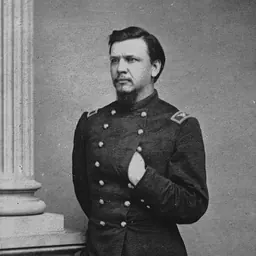
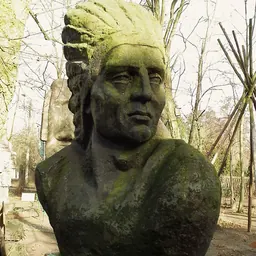



Related people
Same field, nearest in time
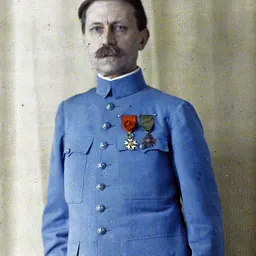




Contemporaries
People whose lives overlapped Hugh L. Scott's
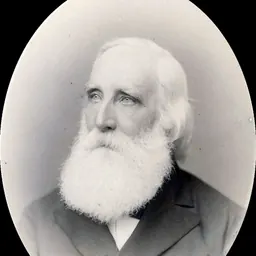


Frequently asked questions
Who was Hugh L. Scott?
7th Chief of Staff of the United States Army (1914-1917)
When was Hugh L. Scott born?
Hugh L. Scott was born on 22 September 1853 in Danville.
When did Hugh L. Scott die?
Hugh L. Scott died on 30 April 1934 in Washington, D.C..
What was Hugh L. Scott's occupation?
Hugh L. Scott was a military officer.
What nationality was Hugh L. Scott?
Hugh L. Scott was American.
Sources & further reading
Cite this page
APA: Biography.guide. (2026). Hugh L. Scott. https://biography.guide/hugh-l-scott/
MLA: "Hugh L. Scott." Biography.guide, https://biography.guide/hugh-l-scott/.
Chicago: "Hugh L. Scott." Biography.guide. https://biography.guide/hugh-l-scott/.
Data last updated: 2026-09-22 · Spot an error? Report a correction.
Portrait: Wikimedia Commons · author & licence
Page generated 2026-09-27 05:01 UTC