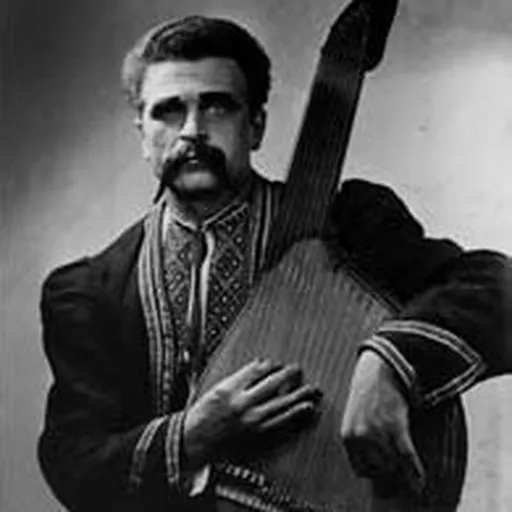
Hryhory Bazhul
Ukrainian bandurist, kobzar, and folk musician
About Hryhory Bazhul
Lived 1906 – 1989 (aged 83). Hryhory Bazhul was an Australian bandurist, musician, folk musician and kobzar.
Hryhory Ivanovych Bazhul (January 22, 1906 — October 17, 1989, sometimes spelled Georg Baschul) was a Ukrainian bandurist and publisher of articles on bandura history from Poltava, Russian Empire. After World War II he emigrated to Australia settling in Sydney.
Early life Bazhul was born in the Poltava Governorate of the Russian Empire (in present-day Ukraine), his father was a rail road engineer and his family moved to Kharkiv in 1911. After completing his studies at the Institute of Grain Culture, he was employed as an agronomist.
In the late 1920s he was arrested and spent 2 years of penal labour at the Berdyansk agricultural labour colony.
In the early 1934, Bazhul was arrested again and charged with improperly giving bread ration coupons to the Khotkevych family during the period of the Famine-Holodomor. He was sentenced to two years in exile in Siberia, northern Caucasus and Tayshet. After serving his sentence he returned to Kharkiv in 1936. Khotkevych's widow gave Bazhul a number of her husband's manuscripts for safekeeping. Some 60 manuscripts were preserved by Bazhul, including the original of the epic Bayda. He attempted to organise a bandurist capella in Kharkiv and performed numerous solo concerts locally under the non-de-plume of Keleberd. To escape repercussions from the advancing Soviet forces Bazhul moved west.
Bazhul continued travelling west through Slovakia to Austria. In Vienna, he joined the Ukrainian Bandurist Chorus and eventually became the administrator. At his insistence Volodymyr Bozhyk joined the group, alongside other professional singer non-bandurists primarily from Western Ukraine He performed solo at various community functions and ethnic festivals. He established a bandura ensemble in 1958 which toured Australia and made a recording in 1961, when it disbanded. In 1964, he re-established the bandura, which later became the Hnat Khotkevych Ukrainian Bandurist Ensemble. He remained as director until 1971 when Peter Deriashnyj replaced him.
During the ensemble's existence it undertook numerous performances by itself and with the Boyan Choir under the direction of Vasyl Matiash. In 1970, on the basis of the bandura ensemble, Bazhul organised a school for bandura playing.
Bazhul published a number of articles about Khotkevych and his life as a bandurist in various Ukrainian language journals.
Bazhul died on October 17, 1989, in Sydney, aged 83.
Don’t just read it —
keep it.
Full-length biographies made to live with: read them, listen on the way to work, watch them tonight.
- E-book
- Audio
- Video
Instant download · yours to keep · every purchase keeps this site free
Important facts
People in Hryhory Bazhul's life
Named in this biography and alive at the same time


Related people
Same field, nearest in time




Contemporaries
People whose lives overlapped Hryhory Bazhul's

Frequently asked questions
Who was Hryhory Bazhul?
Ukrainian bandurist, kobzar, and folk musician (1906–1989)
When was Hryhory Bazhul born?
Hryhory Bazhul was born on 22 January 1906.
When did Hryhory Bazhul die?
Hryhory Bazhul died on 17 October 1989 in Sydney.
What was Hryhory Bazhul's occupation?
Hryhory Bazhul was a bandurist, musician, folk musician and kobzar.
What nationality was Hryhory Bazhul?
Hryhory Bazhul was Australian.
Sources & further reading
Cite this page
APA: Biography.guide. (2026). Hryhory Bazhul. https://biography.guide/hryhory-bazhul/
MLA: "Hryhory Bazhul." Biography.guide, https://biography.guide/hryhory-bazhul/.
Chicago: "Hryhory Bazhul." Biography.guide. https://biography.guide/hryhory-bazhul/.
Data last updated: 2026-09-21 · Spot an error? Report a correction.
Portrait: Wikimedia Commons · author & licence
Page generated 2026-09-27 04:59 UTC