Howard Kendall
English footballer and manager
About Howard Kendall
Lived 1946 – 2015 (aged 69). Howard Kendall was a British association football player and association football coach.
Howard Kendall (22 May 1946 – 17 October 2015) was an English footballer and manager.
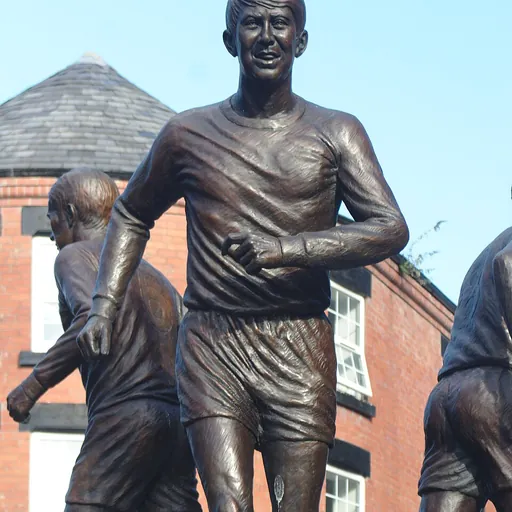
Kendall joined Preston North End as an apprentice and stayed with the club when he turned professional. He was a runner-up in the 1964 FA Cup with Preston, and at 17 years 345 days old was the youngest player to play in a Wembley final. In 1967, he joined Everton, where he played as a midfielder with Alan Ball and Colin Harvey, the trio gaining the nickname "The Holy Trinity". With Everton, Kendall won the First Division title, the Charity Shield and was again an FA Cup runner-up. He became Everton club captain for three years, before being sold to Birmingham City in 1974. Kendall joined Stoke City in 1977, where he became a player-coach and helped the club achieve promotion from the Second Division.
Kendall's managerial career began as a player-manager with Blackburn Rovers in 1979. He returned to Everton in 1981, again as a player-manager, but retired from playing after four games. With Everton, he won two Football League titles, an FA Cup, three Charity Shields, and the 1985 European Cup Winners' Cup, as well as a league runners-up place and reached two further FA Cup finals and a League Cup final. In 1987, Kendall left to manage Spanish club Athletic Bilbao. He was sacked in 1989, but quickly returned to management with Manchester City. After less than a year in Manchester, he returned to Everton but, after three mid-table seasons, he resigned and spent a short time as manager of Greek side Xanthi. After a few months spent as manager of Notts County, Kendall joined Sheffield United, saving the club from relegation and taking them to the 1997 play-off final. He returned to Everton for the third time as manager in June 1997, but left the club by mutual consent a year later, having only managed to avoid relegation on the final day of the season. His final managerial position was a four-month position in Greece, where he took charge of Ethnikos Piraeus, but was sacked with the team last in the league.
Kendall is a member of the League Managers Association's "Hall of Fame", the English Football Hall of Fame, and listed as an "Everton Giant." Kendall remains the last English manager to win a UEFA competition with an English club.
Playing career Born in Ryton, Kendall joined Preston North End as an apprentice in 1961. He began playing professionally in May 1963 and played in the 1964 FA Cup Final against West Ham United. At the time, he was the youngest player to appear in a Wembley final, due to the regular left-half Ian Davidson being suspended by the club for an unauthorised trip to Scotland. He was aged 17 years 345 days and was the youngest finalist since James Prinsep played for Clapham Rovers in the 1879 final aged 17 years 245 days. Preston North End lost the final in the last minute.
Originally a defender, Kendall was wanted by Bill Shankly at Liverpool. Liverpool failed to provide the funds, so he joined Everton for £85,000 in March 1967 where he was moved into midfield with Alan Ball and Colin Harvey. The trio gained the nickname "The Holy Trinity". They were a major component of the Everton team that reached the 1968 FA Cup Final, which they lost. They went on to win the First Division title in the 1969–70 season. In the 1970–71 season, Everton won the 1970 Charity Shield, with Kendall scoring the winning goal. During the next three seasons, Kendall captained Everton as the side struggled to build on winning the league, with a 17th-place finish in the 1972–73 season.
Kendall never played for England at senior level despite being included in several squads. However, he won caps at Schoolboy, Youth and Under-23 level, captaining the England Youth side to victory in the 1964 Little World Cup Final.
Managerial career In June 1979, Kendall was assigned as player-manager at Blackburn Rovers, helping them win promotion back up to the Second Division in the 1979–80 season and narrowly missing out on promotion to the top tier in 1981 on goal difference.
First spell at Everton In May 1981, Kendall returned to Everton as player-manager, in the hopes of restoring the club to its former glory, although he only played four games before finally retiring as a player in December 1981.
Kendall was reportedly on the verge of being sacked, In the 1984–85 season, Everton won the league title, finishing 13 points clear of runners-up Liverpool, and the European Cup-Winners' Cup, defeating Austrian side Rapid Vienna, and reached the final of the FA Cup again. Everton narrowly failed to win both the league and the FA Cup in 1985–86 – runners-up in both to Liverpool – but in the 1986–87 season, once again won the league, nine points clear of their local rivals as well as a third consecutive Charity Shield, as the Merseyside clubs continued their stranglehold on the English game.
During his first spell at Goodison Park, he built an almost entirely new team which proved itself as one of the finest of the whole decade. He brought in younger players such as Peter Reid and Trevor Steven from smaller clubs to give them the opportunity to prove that they could compete at the highest level, and was largely successful. He also brought in established star players such as Andy Gray, who was instrumental in a season and a half after joining them in November 1983, his goals transforming a struggling side into FA Cup winners and then league champions and European Cup Winners' Cup winners. He then sold Gray to Aston Villa and brought in Gary Lineker, who scored 38 goals in the 1985–86 season, albeit narrowly failing to win the major trophies. Everton had toppled Manchester United as league leaders in early February before being overhauled by Liverpool during the final stages of the season, surrendering the title to their local rivals on the final weekend of the season. They were then beaten 3–1 in an all-Merseyside FA Cup final.
Kendall left Everton in June 1987, frustrated by the ban from Europe of English clubs, to manage Athletic Bilbao in Spain. He did manage to lead Bilbao to a fourth place finish in La Liga in his first season, and qualify for the following season's UEFA Cup, where they were eliminated by Juventus. He turned down an offer to manage Newcastle United in November 1988 in order to remain in Spain, but was sacked a year later on 15 November 1989, after a poor run of results On 7 December 1989, he returned to England as manager of Manchester City and secured their survival with a comfortable 14th-place finish. Kendall's name had also been linked to Manchester United, whose disappointing form that season was leading to media talk – as well as calls from fans – for manager Alex Ferguson to be sacked. In the event, Ferguson kept his job and went on to guide United to numerous trophies until his retirement 23 years later.
With the announcement in late May that Bobby Robson would step down as England manager after the 1990 FIFA World Cup, Kendall's name was inevitably mentioned by the press as a likely successor. However, he quickly dismissed the speculation and declined an offer by The Football Association to be interviewed for the role, which ultimately went to Graham Taylor. Kendall was suggested again as a possible choice for the England job after Taylor resigned in November 1993, but Terry Venables was appointed.
Return to Everton He returned to Everton for a second spell as manager on 5 November 1990 following the sacking of Colin Harvey a week prior, who was re-appointed to the club as his assistant. This was despite the fact he had built a strong Manchester City side that was near the top of the First Division table, and had only just held their cross-city rivals Manchester United to a thrilling 3–3 draw at Maine Road. He famously justified the move by saying that Manchester City was just an affair, but Everton was his marriage.
Everton could only manage mid-table league finishes in 1992 and 1993 and Kendall finally resigned on 4 December 1993, after a poor run of form in the league and following a dispute with the board of directors, who had blocked his attempt to sign Manchester United striker Dion Dublin.
Later years After leaving Everton for the second time, Kendall took charge of Greek club Xanthi for a short and largely unsuccessful period. In January 1995, Kendall returned to English football, taking over at First Division Notts County who were struggling badly after a nightmare start to the season, but under Kendall's leadership there was an improvement, with County winning their first two games under his tenure. However, a series of rows with chairman Derek Pavis led to Kendall being sacked in April 1995 – their poor form continued after his departure and the team were relegated to Division Two at the end of the season. Subsequently, Kendall joined Sheffield United in December 1995, saving the club from relegation and then taking them to the 1997 play-off final, where they lost to Crystal Palace. Kendall returned to Everton for a third time as manager in June 1997, but left the club by mutual consent at the end of the season, having only managed to avoid relegation on the final day of the season. His third spell was marked by turmoil within the club, working for then chairman, Peter Johnson.
Kendall moved to Greek side Ethnikos Piraeus, but was sacked in March 1999, after only four months in charge and with the club 8 points adrift at the bottom of the Greek First Division. It was Kendall's last role in football management, although in 2001 he revealed that he had "had offers" from a number of English clubs which he rejected, and he expressed interest in the Republic of Ireland managers' job, which was eventually given to Giovanni Trapattoni. Kendall remains the last English manager to win a European competition with an English club. He was inducted into the English Football Hall of Fame in 2005, in recognition of his contribution as a manager to the English game. at the Southport and Formby District General Hospital at the age of 69.
Career statistics As a player Source:
A. The "Other" column constitutes appearances and goals in the Anglo-Scottish Cup, European Cup, FA Charity Shield and Texaco Cup.
As a manager
Honours Player Preston North End FA Cup runner-up: 1963–64 FA Cup runner-up: 1967–68
Stoke City Football League Second Division third-place promotion: 1978–79 1985–86 FA Charity Shield: 1984, 1985, 1986 (shared) European Cup Winners' Cup: 1984–85
Individual English Manager of the Year: 1984–85,
Don’t just read it —
keep it.
Full-length biographies made to live with: read them, listen on the way to work, watch them tonight.
- E-book
- Audio
- Video
Instant download · yours to keep · every purchase keeps this site free
Important facts
People in Howard Kendall's life
Named in this biography and alive at the same time





Related people
Same field, nearest in time

Contemporaries
People whose lives overlapped Howard Kendall's



Frequently asked questions
Who was Howard Kendall?
English footballer and manager (1946-2015)
When was Howard Kendall born?
Howard Kendall was born on 22 May 1946 in Ryton.
When did Howard Kendall die?
Howard Kendall died on 17 October 2015 in Southport.
What was Howard Kendall's occupation?
Howard Kendall was an association football player and association football coach.
What nationality was Howard Kendall?
Howard Kendall was British.
Sources & further reading
Cite this page
APA: Biography.guide. (2026). Howard Kendall. https://biography.guide/howard-kendall/
MLA: "Howard Kendall." Biography.guide, https://biography.guide/howard-kendall/.
Chicago: "Howard Kendall." Biography.guide. https://biography.guide/howard-kendall/.
Data last updated: 2026-09-23 · Spot an error? Report a correction.
Portrait: Wikimedia Commons · author & licence
Page generated 2026-09-27 05:06 UTC