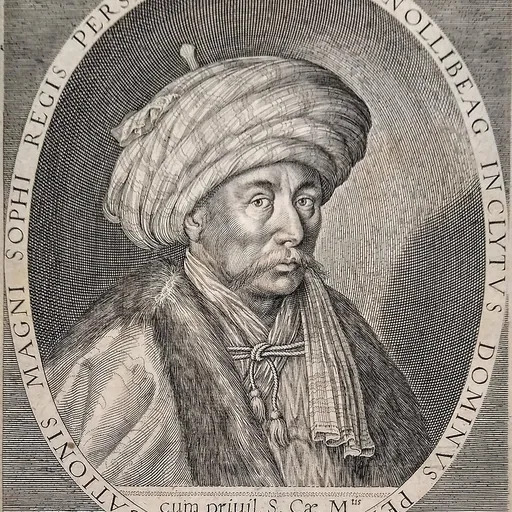
About Hossein Ali Beg Bayat
Hossein Ali Beg Bayat was a diplomat.
Hossein Ali Beg Bayat (, ) was a Safavid diplomat who served as the ambassador to the Holy Roman Empire, the Russian Tsardom, Habsburg Spain and several other royal and noble courts during the reign of king Abbas I (r. 1588–1628), and was part of the first Safavid embassy to Europe.
Career He was a member of Turkoman Bayat clan and was born in Sistan province of Safavid Iran. Already an elderly man by the time he was appointed as an ambassador, he was described as a captain of 200-300 soldiers by Michel Angelo Corai and a close member of royal household. His nephew Ali Qoli beg was a friend of Oruj beg Bayat, both of whom would later join him in the diplomatic mission.
When king Abbas I decided to send Sir Anthony Shirley on an important diplomatic mission in Europe, in order to gain support and to form an alliance against the common cause, the Ottoman enemy, Anthony asked the king to send with him an Iranian of rank. Abbas chose a Qizilbash noble, Hossein Ali Beg, and, according to historian David Blow, he seems to have made him the official leader of the mission. However, this matter was apparently never made clear to Sir Anthony or he simply refused to accept it. This would be the reason for a constant unpleasant atmosphere that would sometimes culminate in bitter disputes between the two over precedence. Sir Robert Shirley, who was Abbas' initial choice instead of his brother Sir Anthony, stayed in Iran as a hostage.
In Russia Hossein Ali Beg and Shirley were accompanied by friars Alfonso Cordero, Nicolas de Melo, four secretaries, including Hossein Ali Beg's nephew Ali Qoli Beg, Oruj beg Bayat (later Don Juan), Bunyad bey, nineteen members of Sir Anthony's original suite.Hossein Ali Beg additionally took a number servants with him. It is indeterminate when the diplomatic entourage departed from Isfahan. Pietro Duodo, Venice’s ambassador to the Holy Roman Empire, indicated the date as 24 May, whilst Oruj bey Bayat proposed 9 July. Duodo's account provides the identical date as the credential letters from Shah Abbas received by Shirley in Gilan. Consequently, 24 May 1599 ought to be regarded as the date of the embassy's departure. Given that the embassy traversed the Isfahan-Dowlatabad-Kashan-Qom-Saveh-Qazvin route to reach Gilan, their departure from Isfahan probably occurred at the beginning of May. The remaining members of Shirley’s contingent—Anthony’s brother Robert, John Ward, John Perrot, and Gabriel Brooks, already mentioned—departed from Dowlatabad and resided at the palace of Shah Abbas.
Hossein Ali bey failed to intercept the caravan departing from Isfahan and only encountered Shirley in Gilan. The embassy stayed in Gilan until the conclusion of June because of adverse weather conditions. Oruj bey Bayat's papers indicate that the embassy encountered a storm on the Caspian Sea after departing from Rudsar and arrived at Astrakhan via Mankyshlak in mid-September. It thereafter encountered Pirgulu beg, who had been dispatched as an ambassador to Russia. After a 16-day stay in Astrakhan, they departed for Nizhny Novgorod on the Volga River on a five-oared boat. The embassy, en route to Moscow through Kazan, experienced a delay of seven weeks. The embassy of Hossein Ali bey was intended to proceed to Poland from this location. Tsar Boris Godunov seemingly prohibited their travel to Poland deliberately. Melo was eventually arrested and exiled to Solovetsky Monastery in Northern Russia.
The embassy, having spent the winter months in Moscow, ultimately reached Arkhangelsk through Yaroslavl, Rybinsk, Totma, Turavets, and Kholmagory route. Following a 20-day sojourn, the embassy, having discovered a Flemish vessel, dispatched thirty-two boxes of gifts directly to Rome at Shirley's recommendation before to their departure. Nonetheless, these gifts did not arrive in Rome. Oruj Bey Bayat suggested that Shirley indeed sold these things to the captain. Shirley on the other hand, claimed that the presents were unworthy of European rulers because to their inferior quality, prompting him to return them to Iran.
In Holy Roman Empire The embassy traveled from Arkhangelsk down the Norwegian coast to Stade, a Hanseatic city located at the Elbe River's mouth. The embassy departed for Emden in August. The mission was met by Count Enno III of East Frisia. Despite Enno's oversight in notifying the emperor on the embassy, Hossein Ali bey dispatched a messenger. The embassy members, who arrived in Oldenburg via the Aurich-Friedeburg-Neuenburg route, encountered John VII, Count of Oldenburg there. They landed in Kassel from Oldenburg on 14 September and met Maurice, Landgrave of Hesse-Kassel according to court historian Wilhelm Dilich. Maurice dispatched a three-horse carriage to greet them at the palace. The diplomats were hosted by the landgrave for ten days; Maurice showcased the chambers of his palace, provided a private tour of the alabaster room, the cabinet of valuable stones adorned with coral walls, the armory, the stables, and exhibited the city’s new cannons. At the formal dining table in the hall, he presented them with fruit, forks, and marzipan shaped as "salt." The embassy members initially failed to comprehend the flavor and laughed. Maurice staged a jousting event in which his son participated prominently. They stayed in Kassel for 8 days and later proceeded eastward through Weimar-Alsfeld, and arrived at Rothenburg an der Fulda on 30 September, traversing Schmalkalden, Gotha, and Erfurt, before continuing to Naumburg the following day. His entrance to Naumburg on was witnessed by Johannes Burger, deacon at St. Wenzel's Church who described the event in his Annalium Naumburgensium. After staying in the famous inn called "Zu den drei Schwanen" (currently, in Jakobsstraße quarter of Naumburg) overnight.
Huseyn Ali bey attempted to confer with Elector Christian II of Saxony in Leipzig; however, the duke disregarded the meeting, prompting the ambassadors to depart for Prague. Hossein Ali beg passed through rest of Saxony and stopped in Louny for lunch. The embassy left in the evening and rested for 3 days at Modletický House in Slaný. The ambassadors departed from Slaný on 10 October and reached the Stella Pavilion (modern Letohrádek Hvězda) in western Prague. Following the alternative southern route to the Golden Route - the traditional route of the Holy Roman Emperors to travel from Prague to Nuremberg - they passed through Waidhaus, Vohenstrauss, Hirschau and Hahnbach and stopped in the city of Sulzbach to spend the night. ) for three days and were taken to the armory and to the grain storage facility there. After leaving the city, they continued along Via Imperii to reach Augsburg where they stayed for 6 days. Hossein Ali bey was later received by Maximilian I, Elector of Bavaria in Munich and was hosted for three days. Continuing the route, Hossein Ali finally reached Mantua and was hosted by Vincenzo I Gonzaga where they were joined by Safavid spy Michel Angelo Corai. Hossein, planning to visit Venice, sent Corai ahead to notify Signoria. The embassy, having awaited official authorization from the Doge for three days in Verona, got unforeseen information: Venice was presently accommodating an Ottoman envoy, rendering the Safavid ambassadors unwelcome. According to, Oruj bey this incited Huseyn Ali bey’s fury, perceiving it as an affront.
In Italy
Tuscany On 16 March 1601, the diplomats landed in Florence, the capital of the Grand Duchy of Tuscany. Ennea Vaini of Imola, the Medici's butler, received them in the village of Scarperia. As Shirley traversed the village of Pratolino, he galloped his horse, aiming to reach Florence before Hossein Ali bey, which aroused Ennea Vaini's suspicion that Shirley might not be the primary ambassador. The embassy spent the night at the Pitti Palace. Vaini selected accommodations for Shirley and Hossein Ali directly across from each other. Hossein Ali bey and his entourage used four rooms adjacent to the guest hall, while Shirley and his followers resided in four rooms adjacent to the ducal chapel. On 19 March, the ambassadors departed with Vaini and reached Pisa, where the grand duke was residing. Grand Duke Ferdinando was to meet the diplomats along the Arno River at the Medici Palace, currently known as the National Museum of the Royal Palace. The initial individual to welcome the ambassadors at the palace was Giovanni de’ Medici, the duke's illegitimate brother. Upon the embassy's arrival at the palace late in the evening, Giovanni escorted them to their accommodations on the side of the palace adjacent to the church of San Nicola. The rivalry between Shirley and Hossein Ali Bey manifested in Tuscany as well. Shirley saw the duke individually and presented him with a letter claiming to be from Shah Abbas. Oruj Bey provides no information regarding this letter, which is entirely composed in Italian and preserved in the Florentine archives. Hossein Ali Bey indicated that Shah Abbas did not compose a specific letter for Ferdinando.
Oruj bey’s account indicate that the embassy resided in Pisa for 10 days, although official Tuscan documents reveal that their visit lasted slightly over a week.
Hossein Ali met Venetian ambassador Giovanni Mocenigo's secretary in Rome on 14 April, explaining his problem with Shirley, denouncing him and warning him about Henry Wotton, Shirley's friend in Venice. According to Spanish ambassador, whole Rome was divided into two factions, some siding with him and others with Shirley. He additionally transmitted the requested documents to the Vatican on the same day. Spanish passport was received on 4 June. Lorenzo Suárez (viceroy of Catalonia), Beltrán de Cueva (viceroy of Aragon) and Pedro Franqueza were given letters of recommendations as well.
Genoa, Savona and Avignon The embassy left Rome and followed the road Via Aurelia to Genoa. Oruj bey Bayat stated that the embassy remained in Genoa for one week and received favorable treatment from the republic’s administration. However, Jorge de Mendoza, the Spanish envoy to Genoa, reported that Hossein Ali bey was met with a lack of warmth by the Genoan signoria, leading to the ambassador's displeasure and early departure. Although Hossein Ali bey informed Mendoza of his intention to travel to Antibes or Fréjus by sea, followed by a land journey to Avignon, it appears that he later reconsidered this plan.
Hossein Ali bey's entourage followed Via Julia Augusta from Savona, touring French Riviera and turned north from Arles and went to Avignon through Via Alta road. There, Hossein Ali bey then met with the papal legate in Avignon and changed horses and mules. Leaving Avignon, embassy followed Via Domitia and arrived in Perpignan.
In Iberia
Spain Hossein Ali bey’s entry into Barcelona on 15 July 1601 was documented comprehensively in the city chronicle. According to the chronicle, Hossein Ali bey rode a horse sent by the viceroy, wearing a crimson velvet coat lined with matras and carrying a scepter about a palm and a half long. The ambassador remained in Barcelona for ten days before departing for Zaragoza. The embassy traversed the foothills of Montserrat and visited the monastery of Santa Maria before entering Aragon. Hossein Ali bey and Oruj bey were received by the viceroy of Aragon, who provided them with six carts. They entered the viceroy's palace and remained there for two days, surrounded by the amazed gazes of hundreds of inhabitants. Oruj Bey specifically expresses his astonishment at the Nuestra Señora del Pilar Basilica in the city. The embassy coming from Aragon to the village of Olivares de Duero was required to halt in Tudela de Duero, about 15 kilometers from Valladolid. Hossein Ali bey dispatched Oruj bey Bayat and canon Francesco Vasco - who was guiding them since Rome - to the palace. The representatives were received by the king's steward, Gomez Davila. Oruj Bey was greatly impressed by this meeting. Upon returning to Tudela, Oruj bey communicated the steward's message to Huseyn Ali bey: the palace mandated their presence for a minimum of eight days.
The palace delayed their proceedings due to the tardy arrival of the Duke of Sessa's report from Rome on 8 June. The royal government commenced deliberations regarding the arrival of the Safavid ambassadors on 17 July, while the ambassadors were in Barcelona. The cabinet thoroughly reviewed the documents received from Rome, and recommended to King Philip III the initiation of communication with the Safavid state via Portuguese India. As noted by the Spanish court historian Luiz Cabrera de Córdoba, the embassy conducted its ceremonial entry into the city on 13 August 1601. Hossein Ali bey was welcomed by Don Luis Enriquez, the steward of the King. Don Luis later escorted him to the palace to meet the king. The Vatican’s nuncio to Spain, Domenico Ginnasi, documented in his report that the king removed his cap as a gesture of respect upon receiving Shah Abbas’ letter. Oruj bey observed that this letter was composed on golden paper measuring over a meter in length and three fingers in width. Interestingly, Hossein Ali bey praised Cardinal Cinzio Aldobrandini and claimed that he had “sworn an oath of brotherhood” with him. The ambassador commended the 21-year-old Cardinal Giovan Battista Detti and highlighted his disapproval of Pietro Aldobrandini due to the latter's preference for Shirley. After the meeting, Don Luis returned with Hossein Ali to meet the Nuncio and the Venetian ambassador at the celebration for the wedding of the Sancho de la Cerda and Doña María de Villena. Upon inquiring about his opinion of the party, Hossein Ali stated that it was enjoyable; however, he expressed discontent regarding Margaret of Austria's dancing, considering her condition as she was expecting the first heir to the throne. During one day of that week, Hossein Ali bey also watched a Spanish-style bullfighting event. Before leaving, Hossein Ali bey requested 13 original architectural plans published in 1599 by the architect Juan de Herrera and wanted to take them to Iran since he liked the Escorial Palace. Hossein Ali bey later went to the cities of El Pardo, Madrid, Aranjuez and Toledo, according to the writings of both Sepulveda and Oruj bey. Luiz Cabrera de Córdoba mentions that when Huseyn Ali bey was in Madrid, he visited 72-year-old Maria of Austria, the widow of Emperor Maximilian II. Girolamo da Sommaia (1573-1635), a Florentine researcher who resided in Spain during that period and pursued his studies at the University of Salamanca, documented that Hossein Ali bey performed a song during this ceremony. He refers to Hossein Ali bey’s song as "Song that the Ambassador of Persia made at the birth of the Princess" . Francesco de Benedictis, who conducted an analysis of both songs, posits that the lyricist was, in fact, Oruj bey Bayat, an individual proficient in the Castilian language. Francesco ascribes this to the superior education that Oruj bey received in Iran. Luiz Gil Fernandez, however, claimed that it was overly simplistic to assume that Oruj bey could compose a sonnet or a rhyming poem in the Castilian language within a brief timeframe. Although the question of Oruj bey’s authorship is in doubt, Nicolas-Claude Fabri de Peiresc, a musical researcher of the time, testified to Hossein Ali bey’s music knowledge, claiming to have seen him playing a kind of guitar. The Spanish court historian Fr. Jeronimo de Sepulveda also noted that Hossein Ali bey was a musician. According to him, Hossein Ali bey asked for a lute at the end of the meal in El Escorial and played some tunes in tones very different from those used in Spain. Then he sang praises to the king, the monastery, and the hospitality shown to him.
Don’t just read it —
keep it.
Full-length biographies made to live with: read them, listen on the way to work, watch them tonight.
- E-book
- Audio
- Video
Instant download · yours to keep · every purchase keeps this site free
Important facts
Related people
Same field, nearest in time

Frequently asked questions
Who was Hossein Ali Beg Bayat?
former ambassador of Safavid empire
When was Hossein Ali Beg Bayat born?
Hossein Ali Beg Bayat was born in Sistan.
When did Hossein Ali Beg Bayat die?
Hossein Ali Beg Bayat died in 1601 in Isfahan.
What was Hossein Ali Beg Bayat's occupation?
Hossein Ali Beg Bayat was a diplomat.
What nationality was Hossein Ali Beg Bayat?
Hossein Ali Beg Bayat's recorded nationality: Safavid Iran.
Sources & further reading
· Wikipedia: Hossein Ali Beg Bayat
· DBpedia: Hossein Ali Beg Bayat
Cite this page
APA: Biography.guide. (2026). Hossein Ali Beg Bayat. https://biography.guide/hossein-ali-beg-bayat/
MLA: "Hossein Ali Beg Bayat." Biography.guide, https://biography.guide/hossein-ali-beg-bayat/.
Chicago: "Hossein Ali Beg Bayat." Biography.guide. https://biography.guide/hossein-ali-beg-bayat/.
Data last updated: 2026-09-21 · Spot an error? Report a correction.
Portrait: Wikimedia Commons · author & licence
Page generated 2026-09-27 05:01 UTC