
Horst Hrubesch
German association football player and manager
About Horst Hrubesch
Born 1951. Horst Hrubesch is a German association football player and association football coach.
Horst Hrubesch (; born 17 April 1951) is a German professional football manager and former player who last managed the Germany women's national team. As a player, Hrubesch won three West German championships with his club side, Hamburger SV, as well as the European Cup title in 1983. He was a key member of the West Germany team that won the 1980 European Championship and made it to the final of the 1982 World Cup, losing to Italy. His nickname was Das Kopfball-Ungeheuer (the Header Beast) for his heading skills as a centre forward.
Club career
Hrubesch played in small clubs until the age of 24 when he was signed by Rot-Weiss Essen. There, he played well enough that in 1978 Hamburger SV (HSV) bought him. At Hamburg he blossomed into one of the most productive forwards of the Bundesliga and was soon called up for the West German national team. Hrubesch formed an attacking partnership with fellow HSV player Manfred Kaltz, a right wingback whose crosses Hrubesch often headed in, or headed to teammates to provide them with scoring chances. Hrubesch won the West German championship three times with Hamburg, in 1979, 1982 and 1983; and his team finished second in the league standings twice, in 1980 and 1981. In all, he scored 96 goals in 159 matches for the club.
Hrubesch won the European Cup in 1983, captaining the team to a 1–0 win against favourites Juventus in the final in Athens. Three years earlier he had been on the team that lost the 1980 European Cup Final against Nottingham Forest, however he was injured shortly before the game and could only feature as a half time substitute. Hamburg reached one other major European final while Hrubesch was on the team, losing the 1982 UEFA Cup final against IFK Göteborg.
Hrubesch left Hamburg after the 1983 season to play for Belgian club Standard Liège. After two years he returned to the Bundesliga to play for Borussia Dortmund, appearing in about half the club's games during his one season there. Over the course of his entire career he scored 136 goals in 224 games in the Bundesliga.
International career
West Germany's match-winning hero in the UEFA Euro 1980 final in Rome against Belgium, Hrubesch scored two goals, the second a trademark bullet header, in the 89th minute. It was a day of redemption for the big Hamburger SV centre forward who a few weeks earlier had hobbled around the field with an ankle injury as his club lost the European Cup final to Nottingham Forest. A latecomer to the international scene, Hrubesch had only been called into the West Germany squad after Klaus Fischer broke his leg, and the game against Belgium was only his fifth international appearance. He would play for West Germany 21 times, scoring six goals, his last match being the losing 1982 FIFA World Cup final against Italy.
Hrubesch is also famous for having scored the only goal in the Disgrace of Gijón victory against Austria, and the winning penalty which defeated France in the 1982 FIFA World Cup semi-final, after an epic game which was tied 3–3 after extra-time. Minutes earlier, in the second extra-time period with France leading 3–2, it was Hrubesch who headed a cross from the left wing to Fischer, enabling his spectacular overhead kick equalizer. Irish television commentator Jimmy Magee during the shoot-out coined the nickname that made Hrubesch best known in the English-speaking world: "The man they call 'The Monster'."
Coaching career Club football Hrubesch started his coaching career with Rot-Weiss Essen He was there between 1 July 1986 and 14 September 1987. His first match was a 2–0 loss against Rot-Weiß Oberhausen on 25 July 1986. He had won two of nine league matches and a first round exit from the cup before leaving the club. His final match was a 3–1 loss to Rot-Weiß Oberhausen on 13 September 1987. This includes a 1–1 draw and a 6–1 loss against to Eintracht Frankfurt. Hrubesch then took over Swarovski Tirol from 1 January 1992 to 30 June 1992. His first match was a 2–0 win against Austria Salzburg. Hrubesch took over at Hansa Rostock between 4 January 1993 and 26 June 1993. His first match was a 3–0 loss to Waldhof Mannheim on 6 February 1993. Hrubesch took over as head coach of Dynamo Dresden on 22 November 1994 and was there until 1 March 1995. His first match was a 1–1 draw against Karlsruher SC on 26 November 1994. Dynamo Dresden also lost a 2–1 to Bayern Munich, 1–1 draw against Bayer Leverkusen, 1–0 loss to Werder Bremen, and a 2–0 loss to VfL Bochum. His first match was a 4–0 win against Vorwärts Steyr on 2 August 1995. Hrubesch was head coach of Samsunspor for the 1997–98 season. Samsunspor finished second in Group 6 of the UEFA Intertoto Cup, three points behind Hamburger SV. Their record was three wins and a loss.
On 3 May 2021, Hrubesch was appointed as manager of Hamburger SV for the last three matches of the 2020–21 2. Bundesliga season.
International
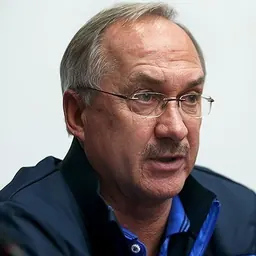
Hrubesch was head coach of Germany's B team from 22 March 1999. He was appointed assistant coach of Germany's A team on 8 May 2000. The coaching staff was reconstructed on 26 March 2002 with Uli Stielike becoming the new head coach of Germany's B team. In 2008, Hrubesch won the European Championship with the Germany U–19 team. On 9 January 2009, Hrubesch was named interim coach of the Germany U–21 team. Rainer Adrion was unavailable to become the permanent head coach until the summer. On 11 November 2009, it was announced that he will begin to work as U-19 coach of the DFB. He returned to the Germany U–21 team after Rainer Adrion was sacked on 21 June 2013.
At the 2016 Summer Olympics, he was the coach when Germany won the silver medal.
On 13 March 2018, he was appointed as the head coach for the Germany women's national team. He took over the same role again in 2023, as an interim coach for Martina Voss-Tecklenburg, who was out with an illness and eventually sacked.
Career statistics
Club
International Scores and results list West Germany's goal tally first, score column indicates score after each Hrubesch goal.
Managerial statistics
Team From To Record Rot-Weiss Essen 1 July 1986 Germany women national team (interim) 7 October 2023 9 August 2024 Total—
Honours
As a player Hamburger SV Bundesliga: 1978–79, 1981–82, 1982–83 European Cup: 1982–83, runner-up: 1979–80
West Germany UEFA European Championship: 1980 FIFA World Cup runner-up: 1982
Individual Sport Ideal European XI: 1980 UEFA European Championship Team of the Tournament: 1980 Onze de Bronze: 1980 Onze Mondial: 1980, 1983 Guerin Sportivo All-Star Team: 1980 Bundesliga Torschützenkönig: 1981–82
As a coach Germany U19 UEFA European Under-19 Championship: 2008
Germany U21 UEFA European Under-21 Championship: 2009
Germany U23 Summer Olympics silver medal: 2016
Germany Women UEFA Women's Nations League third place: 2023–24 Summer Olympics bronze medal: 2024
Orders
Don’t just read it —
keep it.
Full-length biographies made to live with: read them, listen on the way to work, watch them tonight.
- E-book
- Audio
- Video
Instant download · yours to keep · every purchase keeps this site free
Important facts
People in Horst Hrubesch's life
Named in this biography and alive at the same time






Related people
Same field, nearest in time





Contemporaries
People whose lives overlapped Horst Hrubesch's

Frequently asked questions
Who is Horst Hrubesch?
German association football player and manager
When was Horst Hrubesch born?
Horst Hrubesch was born on 17 April 1951 in Hamm.
What is Horst Hrubesch's occupation?
Horst Hrubesch is an association football player and association football coach.
What nationality is Horst Hrubesch?
Horst Hrubesch is German.
Sources & further reading
Cite this page
APA: Biography.guide. (2026). Horst Hrubesch. https://biography.guide/horst-hrubesch/
MLA: "Horst Hrubesch." Biography.guide, https://biography.guide/horst-hrubesch/.
Chicago: "Horst Hrubesch." Biography.guide. https://biography.guide/horst-hrubesch/.
Data last updated: 2026-09-20 · Spot an error? Report a correction.
Page generated 2026-09-27 05:24 UTC