
About Horace W. Babcock
Lived 1912 – 2003 (aged 90). Horace W. Babcock was an American astronomer, known for Adaptive optics and Babcock Model.
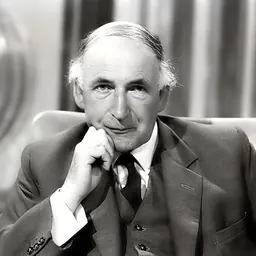
Horace Welcome Babcock (September 13, 1912 – August 29, 2003) was an American astronomer. He was the son of Harold D. Babcock.
Career Babcock invented and built several astronomical instruments and was the first to propose adaptive optics in 1953. He specialized in spectroscopy and the study of magnetic fields of stars. He proposed the Babcock Model, a theory for the magnetism of sunspots.
During World War II, he was engaged in radiation work at MIT and Caltech. After the war, he began a productive collaboration with his father. His undergraduate studies were at Caltech, and his doctorate was from the University of California, Berkeley.
Babcock's 1938 doctoral thesis contained one of the earliest discoveries of dark matter. He reported measurements of the rotation curve for the Andromeda galaxy (M31) and wrote, "The velocities therefore indicate a greater mass than that derived from the luminosity. This discrepancy can hardly be explained unless we postulate either a change in the nature of the stellar population in the outer parts of the nebula or a departure from the laws of circular motion," and "the mass-to-light ratio increases markedly at large radii. It is evident that the outer parts of the nebula contain either a great amount of non-luminous matter or that the motions depart significantly from circularity." Babcock considered the possibility that there was more dust in the outer parts of the galaxy than previously thought, thereby increasing the mass-to-light ratio, but did not conclude this was the explanation. Nonetheless, it was not until the work of Morton (Mort) Roberts in the late 1960s, Rubin & Ford, and Freeman in regard to NGC 300, that attention to spiral galaxy rotation curves was again in the spotlight as an indication of a mass or gravity problem in spiral galaxies.
Babcock was director of the Palomar Observatory for Caltech from 1964 to 1978.
Honors Awards Henry Draper Medal of the National Academy of Sciences (1957) Eddington Medal (1958) Fellow of the American Academy of Arts and Sciences (1959) Bruce Medal (1969) Gold Medal of the Royal Astronomical Society (1970) George Ellery Hale Prize of the American Astronomical Society Solar Physics Division (1992) Named after him Asteroid 3167 Babcock (jointly with his father) Babcock crater on the Moon is named only for his father Honors
Elected to the United States National Academy of Sciences (1954) Elected to the American Academy of Arts and Sciences (1959) Elected to the American Philosophical Society (1966)
Don’t just read it —
keep it.
Full-length biographies made to live with: read them, listen on the way to work, watch them tonight.
- E-book
- Audio
- Video
Instant download · yours to keep · every purchase keeps this site free
Important facts
People in Horace W. Babcock's life
Named in this biography and alive at the same time

Related people
Same field, nearest in time



Contemporaries
People whose lives overlapped Horace W. Babcock's






Frequently asked questions
Who was Horace W. Babcock?
American astronomer (1912–2003)
When was Horace W. Babcock born?
Horace W. Babcock was born on 13 September 1912 in Pasadena.
When did Horace W. Babcock die?
Horace W. Babcock died on 29 August 2003 in Santa Barbara.
What was Horace W. Babcock's occupation?
Horace W. Babcock was an astronomer.
What was Horace W. Babcock known for?
Horace W. Babcock was known for Adaptive optics and Babcock Model.
What nationality was Horace W. Babcock?
Horace W. Babcock was American.
Sources & further reading
· Wikipedia: Horace W. Babcock
Cite this page
APA: Biography.guide. (2026). Horace W. Babcock. https://biography.guide/horace-w-babcock/
MLA: "Horace W. Babcock." Biography.guide, https://biography.guide/horace-w-babcock/.
Chicago: "Horace W. Babcock." Biography.guide. https://biography.guide/horace-w-babcock/.
Data last updated: 2026-09-20 · Spot an error? Report a correction.
Page generated 2026-09-27 05:19 UTC